Cookware
Fish Roasting Pan (Besuguera)
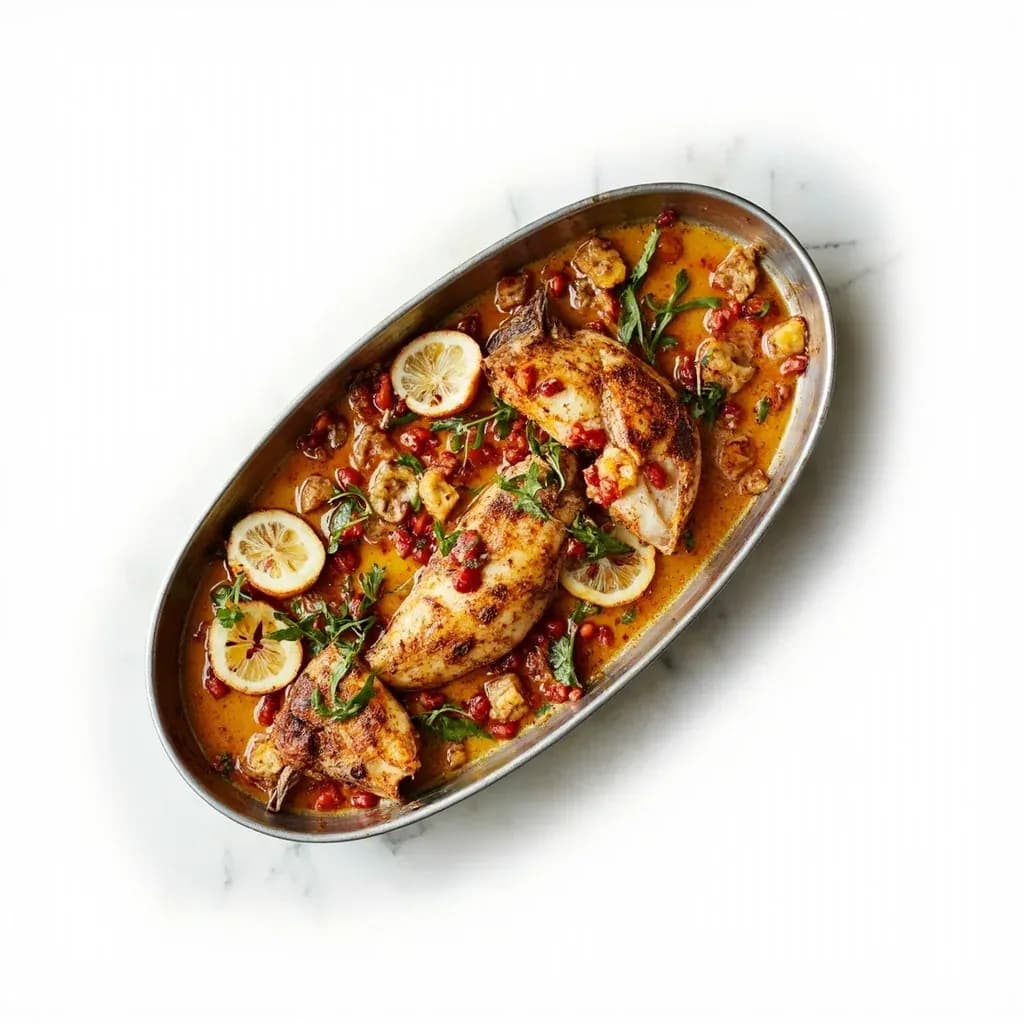
A long, narrow pan shaped to roast or bake a whole fish such as sea bream.
A besuguera is an elongated, shallow roasting pan sized to hold a whole fish, traditionally the besugo (sea bream) in Spanish cooking. Its narrow oval shape fits the fish snugly so it cooks evenly with aromatics and oil. The long form makes it easy to baste, lift and present the fish whole at the table.
The besuguera is a long, narrow, lidded roasting pan shaped to cradle a single whole fish so snugly that the fish essentially cooks in its own juices. Originating in the coastal kitchens of Spain — particularly the Basque Country and Galicia — it was purpose-built for besugo, the red sea bream (Pagellus bogaraveo) that gives the pan its name, and that remains the centerpiece of the Spanish Nochebuena (Christmas Eve) dinner. The defining feature is the very small clearance between the fish and the pan walls: rather than roasting in dry, circulating heat, the fish poaches gently in a shallow bed of wine, stock, or oil while the lid traps steam, producing flesh that is silky and moist rather than crisp-skinned.
Traditional versions are made of porous red or buff earthenware (barro), which gives an even, gentle heat and a faint earthy aroma; copper and tinned-copper models offer faster, more responsive cooking and are favored in higher-end Basque kitchens. The most distinctive antique variant has a recessed lid designed to hold hot embers, so the fish browns from above and below at the same time. Modern enameled-steel versions keep the characteristic long, narrow shape but trade the thermal gentleness of clay for convenience and dishwasher-safe durability.
The pan is a tool, but it is also a method: choosing to cook in a besuguera means committing to a particular style of fish cookery — restrained seasoning, moderate oven heat, minimal intervention — that has been refined along the Iberian Atlantic coast for centuries. Reach for it whenever you want a whole fish cooked through evenly in a fragrant, wine-based broth, served in the pan with its own juices spooned over.
Alternatives
Types & varieties
The traditional version; porous red or buff clay, gives gentle, even heat and a faint earthy aroma. Must be seasoned before first use and never heated dry.
Tinned or lined copper body, often with brass handles; preferred in upper-tier Basque kitchens for faster, more responsive heat conduction.
Modern, low-maintenance version; lighter, non-reactive, and dishwasher-safe, though it heats less gently than clay or copper.
Traditional double-lid design with a recessed upper lid that holds embers so the fish browns from above as well as below.
Includes a low internal rack that elevates the fish so rendered juices and added stock pool beneath — useful for sauces and for keeping delicate skin intact.
Smaller 20–25 cm size made for one small fish or a single portion, common in traditional asadores.
The cooking method behind the shape
A besuguera is not just a smaller roasting pan; the tight fit is the whole point. With little air space around the fish, the small amount of liquid you pour in (wine, stock, olive oil, or a mixture) cannot evaporate freely, so it cycles around the fish as steam, condenses on the lid, and falls back. The result is a hybrid of roasting and gentle poaching: the skin picks up some color from the bottom heat, but the flesh stays exceptionally moist and the cooking liquid reduces into a light, fish-flavoured sauce.
This is why a few habits matter more than the recipe: preheat the oven moderately, not hot; add the liquid to the pan before the fish, not over it; score the skin so fat can render; and resist lifting the lid to baste. The pan is doing the basting for you.
- Score the fish in 3–4 diagonal cuts along each side to let fat render and let the liquid penetrate.
- Pour roughly 1 cm (½ in) of white wine, fish stock, or a wine-and-olive-oil mix into the pan before adding the fish.
- Roast at 180–200 °C (350–400 °F) rather than at high heat; the closed environment cooks the fish through before the exterior dries out.
- For a 1–1.5 kg fish, plan on 30–40 minutes depending on the oven; the flesh should just flake at the thickest part of the spine.
When you don't have a besuguera
Because the shape is the technique, the substitute has to mimic the tight, lidded environment. A generic oval gratin is too wide and shallow — the liquid evaporates before the fish cooks and the flesh dries out. Better stand-ins:
- A small enameled oval gratin dish with a fitted lid or tightly tented foil, sized so the fish nearly touches the sides.
- The insert of a copper fish poacher set over a bain-marie, with the lid on (essentially a horizontal version of the same idea).
- A long tinned-copper fish sauté pan (poêlon à poisson) with a domed cover — the closest Western European equivalent.
- A large clay or ceramic tagine with the fish laid across the rim and the conical lid replaced — unconventional, but the geometry works for one fish.
Common uses
Tips & pitfalls
- Always add liquid (wine, stock, olive oil) to the pan before heating earthenware or clay models; never preheat dry or you risk cracking.
- Season a new clay besuguera by brushing the interior with olive oil and baking empty at a low temperature, then cooling gradually in the oven, before first use.
- Size the pan to the fish: the cavity should be just slightly longer and wider. Excess empty space lets steam escape and dries the flesh.
- Don't baste aggressively — the closed shape is designed to self-baste; opening the lid repeatedly drops the temperature and stops browning.
- Avoid strong dish soap on unglazed traditional clay; soak in hot water with baking soda and scrub with a stiff brush instead.
- Let earthenware cool in the turned-off oven to prevent thermal shock and cracking.
- For the charcoal-lid version, use fully glowing embers rather than flaming coals, and rotate the lid partway through so heat is even.
Good to know
- Origin
- Spain, strongly associated with Basque and Galician coastal cooking traditions
- Named for
- Besugo, the red sea bream (Pagellus bogaraveo) it was designed to cook
- Shape
- Long, narrow oval or boat-shaped cavity, only a few centimetres wider than the fish itself
- Typical length
- Roughly 30–45 cm (12–18 in) long; smaller individual versions run 20–25 cm
- Traditional material
- Red or buff earthenware (barro / loza); also copper, tinned copper, and modern enameled steel
- Lid
- Fitted domed or flat cover; some traditional models have a recessed lid that holds embers for top-down heat
- Capacity
- Sized for one whole fish, typically 1–2 kg (2.2–4.4 lb)
- Cultural occasion
- The classic vessel for the Spanish Christmas Eve (Nochebuena) dinner of besugo a la vasca or besugo a la gallega
Also called
Besuguera · fish roaster · whole-fish pan
Related

Steamer
Gentle moist heat that keeps vegetables, fish, and dumplings tender

Frying Pan
Shallow sloped pan for frying, sautéing, and quick sears

Saucepan
Tall, straight-sided pot for sauces, grains, and small batches

Sauté Pan
Wide straight-sided pan with room to brown and braise

Dutch Oven
Heavy lidded pot that turns tough cuts tender over hours

Stock Pot
Tall, roomy pot for stocks, pasta, and big-batch cooking

Wok
High-sided bowl pan built for blistering-hot stir-fries

Griddle
Flat, broad surface for pancakes, smash burgers, and breakfast