Knives & Cutting
Fish Shears
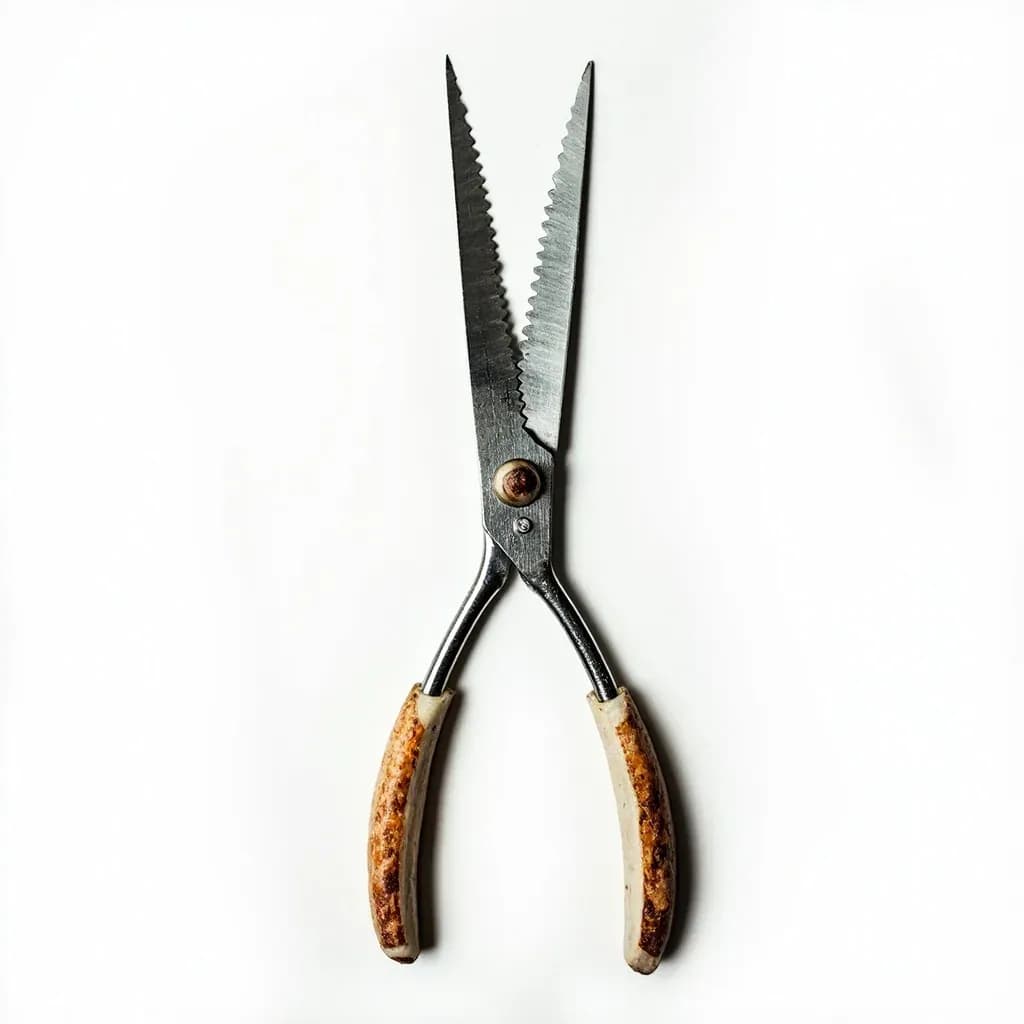
Heavy kitchen scissors for trimming fins, cutting through fish bones and skin.
Fish shears are stout kitchen scissors built to snip off fins, cut through small fish bones and trim away skin during cleaning. Their strong, often slightly serrated blades handle slippery fish more safely than a knife for these tasks. Some include a notch or scaler on the handle for added prep functions.
Fish shears are the bridge between a paring knife and a cleaver — heavy-duty kitchen scissors purpose-built for the awkward, snappy cuts that fish demand: shearing through fins, cracking small rib bones, and opening bellies without tearing the delicate skin. Their defining feature is the bone notch, a semicircular cutout in one blade that localizes force exactly where it matters, letting you snap a pin bone or a thin rib with a clean squeeze instead of a twisting, skin-tearing wrench. Unlike ordinary kitchen shears, fish shears are almost always take-apart, which matters more here than anywhere else in the cutlery drawer: fish blood and fat embed in the pivot and breed a lingering odor that surface washing alone will never cure.
A good pair earns its place on whole-fish work — trout, mackerel, smelt, small salmon, branzino — and on portioning larger fillets where you want to cut cleanly through tough skin without the drag and tearing a knife leaves behind. They are not a replacement for a flexible fillet knife, which still does the precise flesh-side work of lifting meat off the spine. Think of shears as the rough-cutting partner: the tool you reach for before and after the knife, when the job is breaking joints, snipping fins, opening bellies, and trimming ragged edges rather than sliding along bones.
Alternatives
Types & varieties
Hard, finely ground blades (e.g., Kai); prized for clean cuts on salmon and mackerel bones; exceptionally sharp out of the box.
Forged stainless with screw-apart construction (Wüsthof, Fiskars Pro, Messermeister); durable, easy to deep-clean, often with multi-tool features like a bottle opener.
Self-opening spring action reduces hand fatigue during repetitive trimming of fins and small bones.
Hybrid tools (OXO, Mundial) that handle fish, poultry, herbs, and packaging; take-apart for cleaning.
Smaller, thinner shears aimed at anglers and small-boat cooks; lighter leverage on thicker bones.
Heavy pivot and aggressive notch, sometimes sold as 'game shears,' used in butcheries; overlap with fish work for large trout, salmon, or small game.
The bone notch: why it matters
The notch isn't decoration — it's the geometry that makes the tool work. By recessing the cutting edge, it concentrates the closing force of your hand onto a single thin line of contact rather than spreading it across two wide blades. That focused pressure is what lets a 9 cm blade snap through a 4 mm rib bone without you having to twist or torque the shears, which is exactly the kind of force that would tear the flesh around the cut.
- Use the notch, not the tip, for any bone work; the tip is for skin and trimming.
- Position the notch over the bone, then close decisively in one motion — partial squeezes bend the blade.
- Inspect the notch after heavy use; chips or flattening mean the shears need professional re-grinding, not DIY sharpening.
Pairing fish shears with a fillet knife
The two tools are not redundant — they divide labor along a clear line. Shears do the structural, snap-through work at the front and back of the fish; the fillet knife does the long, sliding cuts along the spine. A cook who tries to do everything with one or the other ends up fighting the tool. The shears open the belly, remove the head, snip fins, and crack ribs; the knife then has clean, exposed edges to run along, with no awkward twisting around the head joint.
- Shears first: head off, belly open, fins and tail gone, vent cleared.
- Rinse the cavity, then switch to a flexible fillet knife for spine work.
- Return to shears for portioning — cutting through skin into uniform steaks or fillet pieces without dragging the knife back and forth.
- Reserve a dedicated fish pair if you process more than a fish or two a month; cross-flavor from poultry or herbs will taint delicate white fish.
Cleaning and odor control
More than any other kitchen tool, fish shears live or die by their cleaning routine. The pivot is the failure point: it traps scales, fat, and blood that turn into a permanent smell and eventually rust the screw. Take-apart models exist specifically so you can wipe every contact surface, and that advantage is only real if you actually use it.
- Disassemble immediately after use; wash each blade and the pivot screw separately under hot water.
- Wipe metal with lemon juice or diluted white vinegar before washing to neutralize odor.
- Hand-dry thoroughly, then leave open until fully dry before storing.
- A drop of food-safe mineral oil on the pivot, once a season, keeps the action smooth and helps prevent rust blooms.
Common uses
Tips & pitfalls
- Disassemble the shears after every use — trapped scales and bloodlines in the pivot cause corrosion and a smell that will never wash out of a closed tool.
- Rinse or wipe blades with lemon juice or diluted white vinegar before washing to neutralize fish odor; soap alone won't shift the smell.
- Hand-dry the pivot and blades immediately; salt and moisture will pit even stainless steel within a season.
- Use the bone notch — not the blade tip — for any bone work; the tip is for skin and trimming only.
- Don't try to shear through the backbone of a large fish; that's a cleaver, a bone saw, or a deba job, and forcing it will chip the notch.
- Resharpen only on a fine diamond rod or send to a professional; aggressive pull-through sharpeners wreck the serrations and notch geometry.
- Lightly oil the pivot screw with food-safe mineral oil once a season if the action stiffens or develops rust blooms.
- Store open or loosely closed so air circulates; trapped moisture in a sealed handle is the leading cause of rust spots on otherwise well-cared-for shears.
Good to know
- Tool type
- Heavy-duty kitchen shears engineered for processing whole fish
- Blade length
- 7–10 cm (about 3–4 in)
- Blade material
- Forged high-carbon or stainless steel, often micro-serrated for grip
- Construction
- Usually take-apart (disassemblable) for thorough cleaning; some spring-loaded
- Key features
- Bone notch in one blade, serrated edge for slippery skin, non-slip handle, often a jar/bottle opener and screwdriver tip built in
- Cutting capacity
- Fins, rib bones, skin, and small skeletal bones — not large backbones or thick shells
- Care
- Hand-wash and dry immediately; wipe with lemon or diluted white vinegar to neutralize odor; oil pivot occasionally
- Dishwasher safe
- No — most manufacturers recommend hand-washing only; detergent and heat dull edges and pit steel
- Price range
- Roughly $15–$120 for consumer models; professional forged versions cost more
Also called
fish scissors · seafood shears
Related

Knife
The fundamental cutting tool every kitchen is built around

Chef's Knife
The do-everything blade for chopping, slicing, and mincing

Paring Knife
Small, nimble blade for peeling and detailed in-hand work

Serrated Knife
Saw-toothed blade that slices crusty bread without crushing

Cleaver
Heavy broad blade for chopping through bone and bulk prep

Cutting Board
The stable surface every cut starts on

Mandoline
Adjustable blade for paper-thin, perfectly even slices

Kitchen Shears
Heavy-duty scissors for poultry, herbs, and packaging