Baking & Pastry
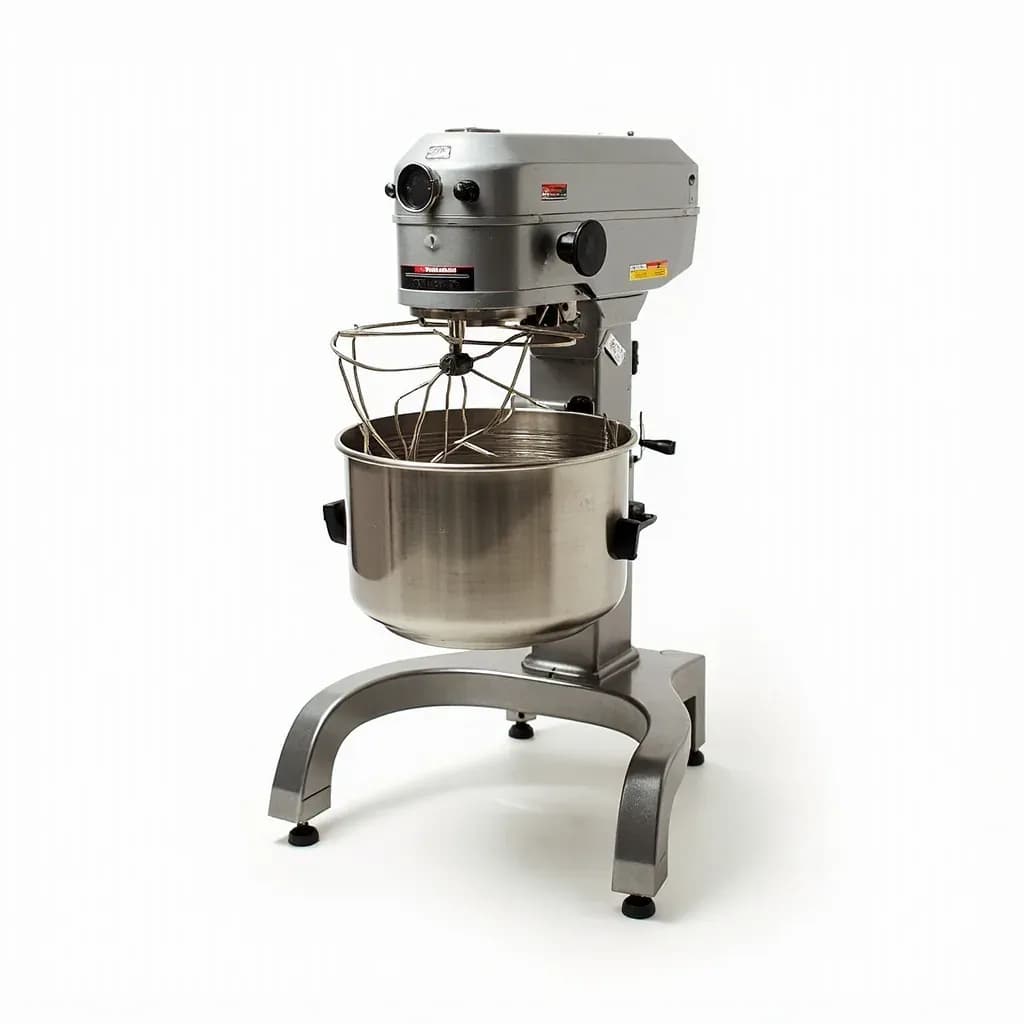
60-Quart Floor Mixer
A large freestanding planetary mixer for kneading and mixing big batches of dough and batter.
A floor mixer is a heavy freestanding planetary stand mixer, often 60 quarts, built to knead bread dough and mix batter, frosting and meringue in volume for bakeries and busy kitchens. Interchangeable hook, paddle and whisk attachments handle different tasks. Its powerful gear-driven motor works stiff dough that would stall a countertop machine.
The 60-quart floor mixer is the workhorse of the mid-volume bakery, the hotel pastry kitchen, and the serious garde-manger or test kitchen. It sits at the practical heart of the commercial planetary line — a step up from the 30-quart à la carte unit and a step down from the 80-quart wholesale machine — and it is the size at which gear-driven, properly torqued mixing becomes the norm rather than the exception.
The defining trait of any 60-quart is the planetary mixing action: the agitator spins on its own axis while a geared head sweeps it around the inside of a stationary bowl. That geometry scrapes the bowl efficiently and lets one machine handle everything from a stiff bagel dough to a foaming 12-quart meringue. Bowl volume, however, is misleading. Wet batters can fill all 60 quarts, but flour-based doughs are loaded to roughly half that, by the long-standing commercial "half-full rule," because dough climbs the hook, stalls the agitator, and overheats the motor when it is packed to the rim.
The real difference between a good 60-quart and a marginal one lives in the drivetrain. A properly geared Hobart-class machine will run whole-wheat or bagel dough at low speed for eight to twelve minutes without complaint, while a budget belt-driven unit bogs, slips the belt, and overheats under the same load. That is why the 60-quart is the size at which most cooks first treat a mixer as a piece of installed equipment — anchored to a floor that can carry roughly five hundred pounds of live load, wired to a dedicated circuit, and respected rather than just plugged in.
Alternatives
Types & varieties
Current flagship 60-qt Hobart; gear-driven, variable electronic speed, lift-bowl, stainless attachments.
Iconic mid-century belt-driven models still found in many older bakeries; three fixed speeds, cast-iron construction, swing-bowl head on most.
Popular Hobart competitor; gear-driven, three-speed, bowl-truck compatible, common in mid-volume commercial kitchens.
Value-tier commercial unit, gear-driven, three-speed — a workable choice for smaller bakeries on a budget.
Most are 208/240 V three-phase; single-phase variants are available but typically deliver less torque and durability under heavy dough loads.
Lift-bowl (bowl rises into the agitator) is the modern ergonomic standard; swing-bowl (head tilts back) is the older H-600 design and is still serviceable but less comfortable for tall batters.
Buying and installing a 60-quart
Before a 60-quart is even uncrated, three site questions have to be answered: power, floor, and clearance. Most units require a 208/240 V three-phase drop on a dedicated circuit — a 120 V household line will not run one, and a single-phase 208/240 V hookup will run it but with noticeably reduced torque on stiff doughs. The floor must support roughly 500 lb of live load (mixer, bowl, attachment, and product combined), and the unit needs at least 6 in of clearance on every side for venting and bowl removal. A 60-quart typically measures about 24–28 in wide by 30–36 in deep, so plan the surrounding worktable space accordingly. When evaluating a used 60-qt, the two failure points to inspect are the bowl-lift mechanism and the worm-gear oil level (on older Hobart H-600 and P-600 models); both are expensive to rebuild and signal a tired machine.
- Confirm voltage and phase with an electrician before the unit ships — three-phase 208/240 V is the norm.
- Verify the floor can support roughly 500 lb of live load (mixer, bowl, attachment, and product combined) at the unit's footprint.
- Plan ≥6 in clearance on all sides for ventilation and bowl removal.
- Inspect the bowl-lift mechanism and gear oil on any used unit before purchase.
- Add a bowl truck (dolly) to the budget — it is not optional for a 60-qt.
Common uses
Tips & pitfalls
- Respect the half-capacity rule for flour-based doughs: a full 60-qt bowl of bread dough climbs the hook, stalls the agitator, and can burn out the motor — hold bread-flour batches to roughly 25–30 lb.
- Always lock the bowl and close the safety guard before starting; the interlock exists to keep hands, hair, and jewelry clear of the moving agitator, and the mixer will not run with the guard open.
- Add flour gradually and let each addition incorporate before adding more, especially on stiff doughs — dumping a full bag at once can wedge the bowl and overload the lift mechanism.
- Pulse for the first 30 seconds when combining flour and water to wet everything in and eliminate flour-dust clouds, then move to continuous mixing at recipe speed.
- Use the bowl truck to move the bowl — 60 quarts of batter or dough weighs 50–100 lb and is awkward and dangerous to lift by hand.
- Never reach into a running bowl, even at low speed; turn the mixer off, wait for the agitator to stop, and scrape down with a flexible spatula only after it is fully stopped.
- Match the agitator to the task: dough arm for bread and pasta, flat beater for cake, cookie dough, and potatoes, wire whip for aerating eggs, cream, and meringue.
- When scaling a recipe up from a smaller mixer, reduce hydration by 1–2% — the longer mixing time and wider bowl geometry of a 60-qt develop more gluten and lose less moisture to the bowl walls than a home bench mixer.
Good to know
- Bowl capacity
- 60 quarts (≈57 L) for wet batters; effective dough capacity is roughly half that, or about 25–30 lb of bread flour, by the standard commercial "half-full rule."
- Mixing action
- Planetary — the agitator spins on its own axis while the head sweeps around a stationary bowl.
- Standard speeds
- Three fixed speeds (low, intermediate, high) on most legacy models; many modern 60-qt units (e.g., Hobart HL600) add variable electronic speed control.
- Typical motor
- 2–3 HP, gear-driven on modern units; belt-driven on legacy machines like the Hobart H-600 and P-600.
- Electrical
- 208–240 V three-phase is standard on commercial units; single-phase 208/240 V versions exist but deliver less torque. A dedicated circuit is required — these mixers will not run on a 120 V household line.
- Standard attachments
- Aluminum or stainless flat beater (paddle), spiral or J-style dough arm, stainless wire whip, and a bowl truck (dolly) for moving the bowl.
- Attachment hub
- Front-mounted #12 hub accepts a meat grinder, vegetable/fruit slicer-shredder, or pasta roller — capacity far above a countertop mixer's #5 or #8 hub.
- Bowl guard
- Required safety screen interlock on modern units; the mixer will not start with the guard open.
- Net weight
- Approximately 400–475 lb (≈180–215 kg) without bowl; total live load with bowl, attachment, and product can approach 500 lb.
- Origin
- Commercial planetary floor mixers in this size class trace to early-20th-century American manufacturers; Hobart's 60-quart models (H-600, P-600, and the modern HL600) became the de-facto benchmark from the mid-20th century onward.
Also called
Commercial Floor Mixer · Spiral Mixer · Planetary Mixer
Related

Muffin Pan
Multi-cup pan for muffins, cupcakes, and egg bites

Bundt Pan
Fluted ring mold for showstopping cakes with a center hole

Springform Pan
Latch-release pan that frees delicate cakes without flipping

Pie Dish
Sloped round dish for crisp-bottomed pies and quiches

Tart Pan
Fluted pan with a pop-out base for clean-edged tarts

Rolling Pin
Rolls dough into even sheets for pastry and bread

Pastry Brush
Brushes on egg wash, glaze, butter, and marinades

Bench Scraper
Flat blade that divides dough and clears your work surface