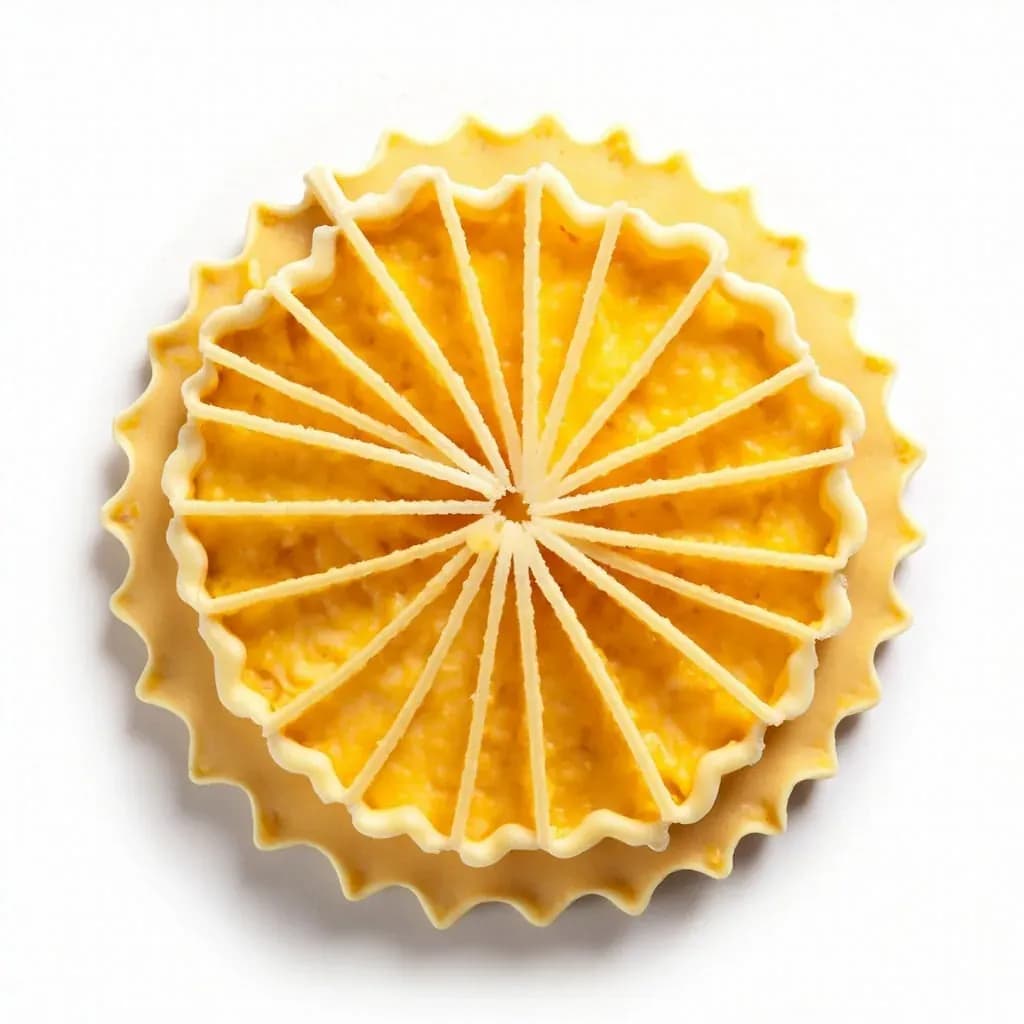
Baking & Pastry
Fluted Pastry Wheel
Rolling wheel with a zigzag edge that cuts decorative crimped borders in dough.
A fluted pastry wheel is a handled tool with a rotating wavy-edged disc used to cut and crimp rolled dough. Bakers run it along pasta sheets, ravioli, pie strips, and cookie dough to leave a sealed, decorative scalloped edge. The crimping action both finishes the dough attractively and helps seal filled pasta and pastries.
A fluted pastry wheel is a small, handled rolling cutter whose stainless-steel disc carries a wavy, scalloped, or zigzag edge. The wheel's job is twofold: it slices dough cleanly and, in the same pass, leaves a decorative crimped border that signals hand-finished pastry work. Because the cut and the ornament happen simultaneously, the tool replaced fork-pricked edges across much of European and American home baking and remains the standard way to finish hand pies, ravioli, lattice tops, and shortbread borders.
The key to using one well is to treat it like a tiny wheel and not a stamp. The scalloped edge only reads as crisp if the wheel rolls in a single, continuous motion across well-chilled, lightly floured dough. Pressing straight down — the instinct of anyone used to a knife or a cookie cutter — flattens the dough, blunts the waves, and drags sticky residue back into the next cut. Get the motion right and the wheel produces a sharp, even edge that holds its shape through baking, freezing, and filling.
Wheel diameter typically runs 3.5–5 cm (about 1½–2 in), small enough to be steered one-handed but large enough to make long lattice strips in two or three strokes. Handles range from simple straight wooden pegs to offset metal shafts that lift the knuckles clear of the dough — a small detail that makes a real difference once you start weaving.
Alternatives
Types & varieties
The standard, most affordable form with the handle aligned behind the wheel. Compact, simple, and adequate for everyday pie and cookie work.
The wheel sits ahead of the handle, lifting the hand clear of the dough. Gives unobstructed sightlines and finer control — the choice for precise lattice and decorative cuts.
Two fluted wheels fixed at a set distance apart, cutting matched pairs of strips in a single pass. Ideal for braids and consistent lattice tops.
Parallel wheels on an adjustable bar that lets you change strip width; often pairs one fluted and one straight wheel so you can cut and finish in one motion.
Interchangeable or reversible heads on a single handle, switching between a clean cut and a decorative crimp without changing tools.
Fine waves give a subtle, refined edge suited to shortbread and delicate tarts; deep scallops produce a bold, rustic crimp that reads on thicker hand-pie doughs.
Choosing the right wheel for the job
The wheel you reach for should match the dough and the scale of the work. For everyday pie edges and cookie borders, a straight-handle wheel with a moderate flute is the most versatile. For lattice tops, an offset handle pays for itself the first time you try to cut a long, straight strip without bumping knuckles into the dough, and an adjustable or double wheel makes matched pairs almost effortless. For delicate, refined work such as shortbread or petit four borders, choose a fine flute; the impression stays legible after baking rather than swelling into a vague scallop. For rustic hand pies and thicker doughs, a deep flute gives a confident crimp that holds up to filling weight and oven spring.
- Straight handle: general purpose, most affordable, fine for cookie and pie-edge work.
- Offset handle: best for lattice and long, straight cuts where visibility matters.
- Double or adjustable wheel: cuts matched strips at a fixed width — the lattice-maker's tool.
- Fine flute: refined edges for shortbread, sugar cookies, and delicate tart lids.
- Deep flute: bold crimps for hand pies, galettes, and rustic doughs.
Getting a clean cut every time
Three conditions make the difference between a sharp, even scallop and a ragged drag. The dough must be thoroughly chilled and rested so the flour has time to hydrate and the butter or fat is firm; warm dough smears under the wheel and rounds off the edge of the cut. The work surface must be lightly and evenly floured — rice flour or fine semolina works especially well because it absorbs less into the dough. And the wheel itself must be clean and lightly dusted between passes, because built-up dough residue distorts the next impression and drags sticky bits into the cut behind it.
- Chill dough until firm (usually 30+ minutes in the fridge) before cutting.
- Dust the surface and the wheel with rice flour or fine semolina to reduce sticking.
- Wipe the wheel with a dry cloth every few cuts to clear residue.
- Roll in one continuous motion; never press straight down.
- Re-chill and re-flour if the wheel starts to drag mid-job.
Common uses
Tips & pitfalls
- Chill the dough thoroughly before cutting — cold, rested dough cuts cleanly and holds the flute impression through baking.
- Roll the wheel in one smooth, continuous motion; pressing straight down flattens the dough and blunts the scallops.
- Lightly dust the wheel with flour, rice flour, or fine semolina between cuts to prevent sticking and dragging.
- Use a ruler, metal straight edge, or a gridded pastry mat as a guide to keep lattice strips uniform in width — the single biggest upgrade for consistent results.
- Wipe the wheel with a dry cloth every few cuts; built-up dough residue distorts the next impression and pulls sticky dough back into the cut behind it.
- For ravioli or hand pies, lay the top dough over the filling and press the fluted wheel along the edge in a single pass — it cuts and crimps at once, sealing the seam.
- Pair a fluted wheel with a plain straight wheel when building lattice; the fluted edges read as the visible front of the weave.
- If the wheel drags, the dough is too warm or under-floured — re-chill and dust again before continuing rather than pressing harder.
- Store the wheel flat or hanging; never toss it loose in a drawer where the fine edge can be nicked against other tools.
Good to know
- Also known as
- Pastry jagger, fluted pastry cutter, zigzag pastry wheel; tagliapasta in Italian pastry tradition
- Primary materials
- Stainless-steel fluted wheel with wood, plastic, or metal handle
- Wheel diameter
- Typically 3.5–5 cm (1½–2 in)
- Flute style
- Scalloped or wavy edge, ranging from fine ripples to deep, bold scallops
- Operation
- Rolling motion across dough — pushed or pulled, never pressed straight down
- Working conditions
- Best on chilled, well-floured dough on a flat surface or pastry mat
- Care
- Hand wash and dry promptly; dishwashers shorten the life of wooden-handled models
- Origin
- European pastry tradition; fluted forms became widespread alongside decorative pie and tart work in the 19th–20th centuries
Also called
pastry-wheel · pastry-cutter-wheel · Crimping Wheel · Pasta Wheel
Related

Muffin Pan
Multi-cup pan for muffins, cupcakes, and egg bites

Bundt Pan
Fluted ring mold for showstopping cakes with a center hole

Springform Pan
Latch-release pan that frees delicate cakes without flipping

Pie Dish
Sloped round dish for crisp-bottomed pies and quiches

Tart Pan
Fluted pan with a pop-out base for clean-edged tarts

Rolling Pin
Rolls dough into even sheets for pastry and bread

Pastry Brush
Brushes on egg wash, glaze, butter, and marinades

Bench Scraper
Flat blade that divides dough and clears your work surface