Baking & Pastry
French Rolling Pin
A slim, handleless tapered wooden pin that gives a baker direct feel for rolling and shaping dough.
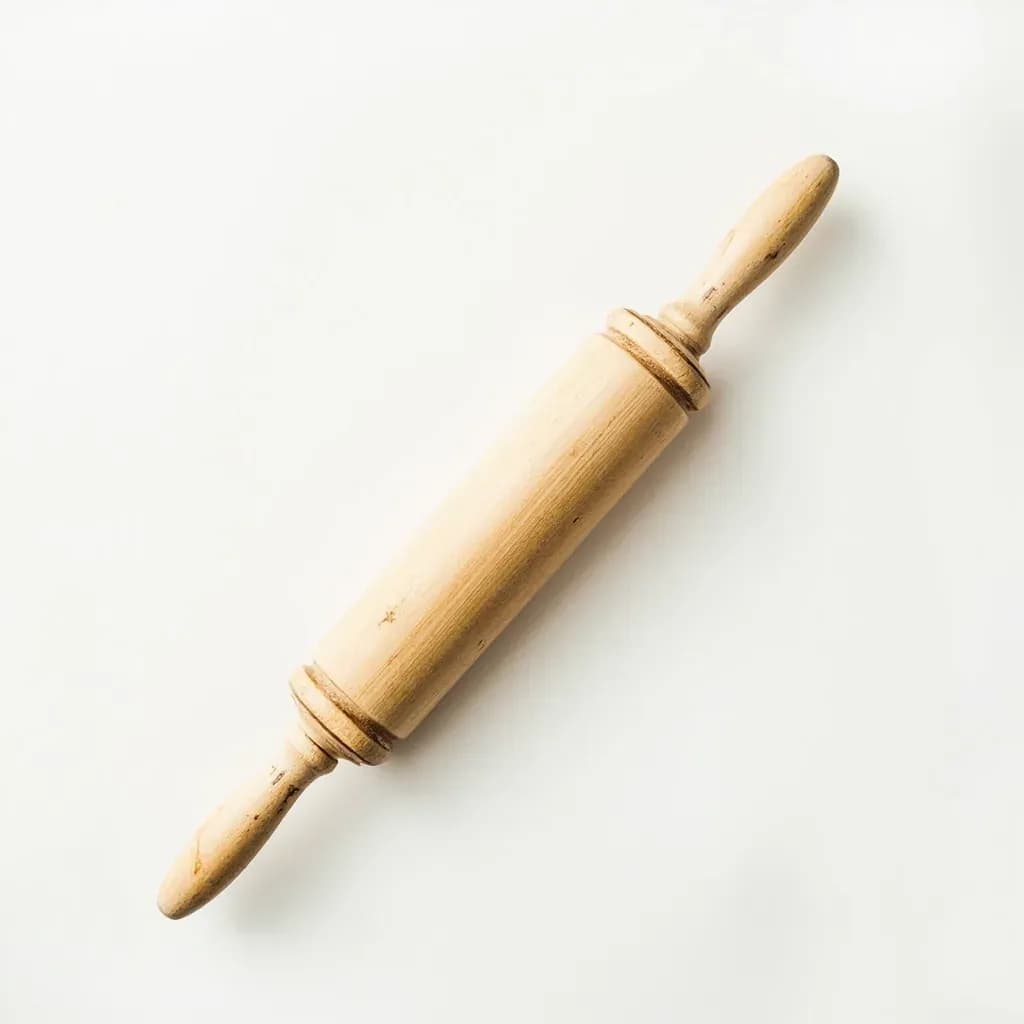
A French rolling pin is a single piece of wood, usually tapered toward the ends and without handles, used to roll out pastry and dough. The lack of handles lets the baker feel dough thickness directly and pivot the tapered ends to shape rounds. It excels at delicate pastry where control matters more than the brute weight of a barrel pin.
The French rolling pin — rouleau à pâtisserie in its native kitchen — is a single piece of solid hardwood, sanded smooth and slightly tapered from a fatter middle to slim, rounded tips. There are no handles: the baker's palms rest directly on the barrel, and the whole pin moves as one with the hands. Most are turned from beech, though maple, walnut, and cherry are common, and a standard professional length runs 18 to 20 inches. The form has barely changed in centuries because it answers a question French pastry asks constantly: how thick is this dough right now, and what is it doing under my hands?
The handleless design is the point. Pressure, temperature, and the moment a dough starts to stick or a butter layer begins to smear are all transmitted through the palms, so the cook can adjust in real time. The thick center delivers the flattening force, while the narrow tips let the pin reach into corners, roll tight strips for lattice, or shape a small tart ring on a crowded bench. The pin's own weight — typically 700 g to a kilo — does much of the work, which is why French-trained bakers are taught to use long, light strokes rather than to lean on the dough.
American-style pins with rotating handles are easier for a beginner to pick up, but the handles insulate the hand from the dough and tend to apply pressure unevenly. Anyone who spends a few weeks with a French pin usually finds the handled version feels clumsy and vague, the way a pair of oven mitts feels clumsy once you are used to working bare-handed.
Alternatives
Types & varieties
The standard 18–20 in beech pin with a gentle taper; the workhorse of French pastry shops.
A shorter, thicker, almost barrel-shaped pin (about 8–10 in / 20–25 cm) used for small tarts, individual portions, and detail work on a crowded bench.
Extra-long (24–26 in) versions for very large sheets of puff pastry, croissant dough, and brik.
A heavier stone pin that stays naturally cool; favored for laminated doughs and sugar work.
Modern non-wood variant, often hollow and fillable with chilled water; prized for keeping butter-rich doughs cold.
Why the taper matters
The shape is not decorative. The fat middle flattens dough quickly because the hand naturally rests at the center of the pin, where its weight and pressure are both focused, and a single pass lays down a wide band of dough. The slim tips, by contrast, apply pressure to a narrow line — useful for rolling strips for lattice, easing into the corners of a tart ring, and pivoting in tight quarters. Because the pin has no handles, the hands can also slide along its length, shifting where the pressure falls without lifting the pin off the dough. That instant shift is what gives a French-trained baker the ability to roll a round of pâte brisée into a near-perfect circle without measuring.
- Use the middle for the bulk of the flattening on a large round.
- Switch to the tips for the last few passes, for narrow strips, and to even out the rim of a tart shell.
- Slide the hands up and down the barrel rather than lifting and repositioning the pin.
Care and maintenance
A wooden French pin will outlast the cook who buys it if it is treated like a wooden spoon rather than a kitchen gadget. Moisture and heat are the enemies; soap and dishwasher detergent strip the wood of its natural oils and cause checking.
- Wipe clean with a barely damp cloth and dry upright; never soak or submerge.
- Never put a wooden pin in the dishwasher.
- Once or twice a year, rub the surface with food-grade mineral oil (or a light beeswax-and-oil blend), let it sit for an hour, then buff off the excess.
- If the surface roughens or picks up dark stains, sand lightly with 220-grit paper, re-oil, and the pin is essentially new.
- Store dry and out of direct sunlight; many pastry chefs keep a pin in the refrigerator for laminated doughs.
Common uses
Tips & pitfalls
- Push outward with the heel of the hand from the center, then pull back from the ends; pressing straight down jams the dough into the bench and creates sticking.
- Rotate the dough a quarter turn every two or three passes to keep it round and stop one side from adhering.
- For butter-rich doughs (puff, croissant, pâte brisée), chill the pin for 15–20 minutes first; a cold pin keeps the fat firm and prevents the dough from softening and shrinking back.
- Dust the bench and pin sparingly with flour — too much dries the dough and toughens the final crust; use rice flour for delicate sweet doughs where gluten development is most at risk.
- Work from the center outward, never edge to edge; rolling over the rim first seals it to the bench and cracks the edge.
- If the dough springs back, stop rolling, slip it onto a sheet, and rest it in the refrigerator for 10–15 minutes; trying to force elasticity just toughens the gluten.
- Let the pin's weight do the work; use long, even strokes with light pressure rather than heavy downward thrusts that compress the dough unevenly.
- Sand and re-oil a wooden pin periodically with 220-grit paper and food-grade mineral oil to keep the surface glassy and prevent dough from catching on rough spots.
Good to know
- Origin
- France; a traditional tool of French patisserie in continuous use for centuries.
- Material
- Solid hardwood, most commonly beech; also maple, walnut, cherry, boxwood, and olive wood.
- Shape
- A single solid, handleless cylinder that tapers smoothly from a thicker middle to thinner rounded ends.
- Typical dimensions
- 18–20 in (45–50 cm) long, 1.5–2 in (4–5 cm) at the center, tapering to about 3/4 in (2 cm) at the tips.
- Weight
- Roughly 0.7–1 kg (1.5–2.2 lb); heavier than most handled American pins, so the weight does the flattening.
- Surface finish
- Sanded smooth and left unfinished or lightly oiled; no lacquer, so it can be re-conditioned as it ages.
- Cleaning
- Wipe with a barely damp cloth only; never soak or run through a dishwasher.
- Approximate cost
- $20–$60 for a quality beech pin; specialty-wood or marble versions can exceed $100.
Also called
Tapered Rolling Pin · Dowel Rolling Pin
Related

Muffin Pan
Multi-cup pan for muffins, cupcakes, and egg bites

Bundt Pan
Fluted ring mold for showstopping cakes with a center hole

Springform Pan
Latch-release pan that frees delicate cakes without flipping

Pie Dish
Sloped round dish for crisp-bottomed pies and quiches

Tart Pan
Fluted pan with a pop-out base for clean-edged tarts

Rolling Pin
Rolls dough into even sheets for pastry and bread

Pastry Brush
Brushes on egg wash, glaze, butter, and marinades

Bench Scraper
Flat blade that divides dough and clears your work surface