Cookware
Frying Basket
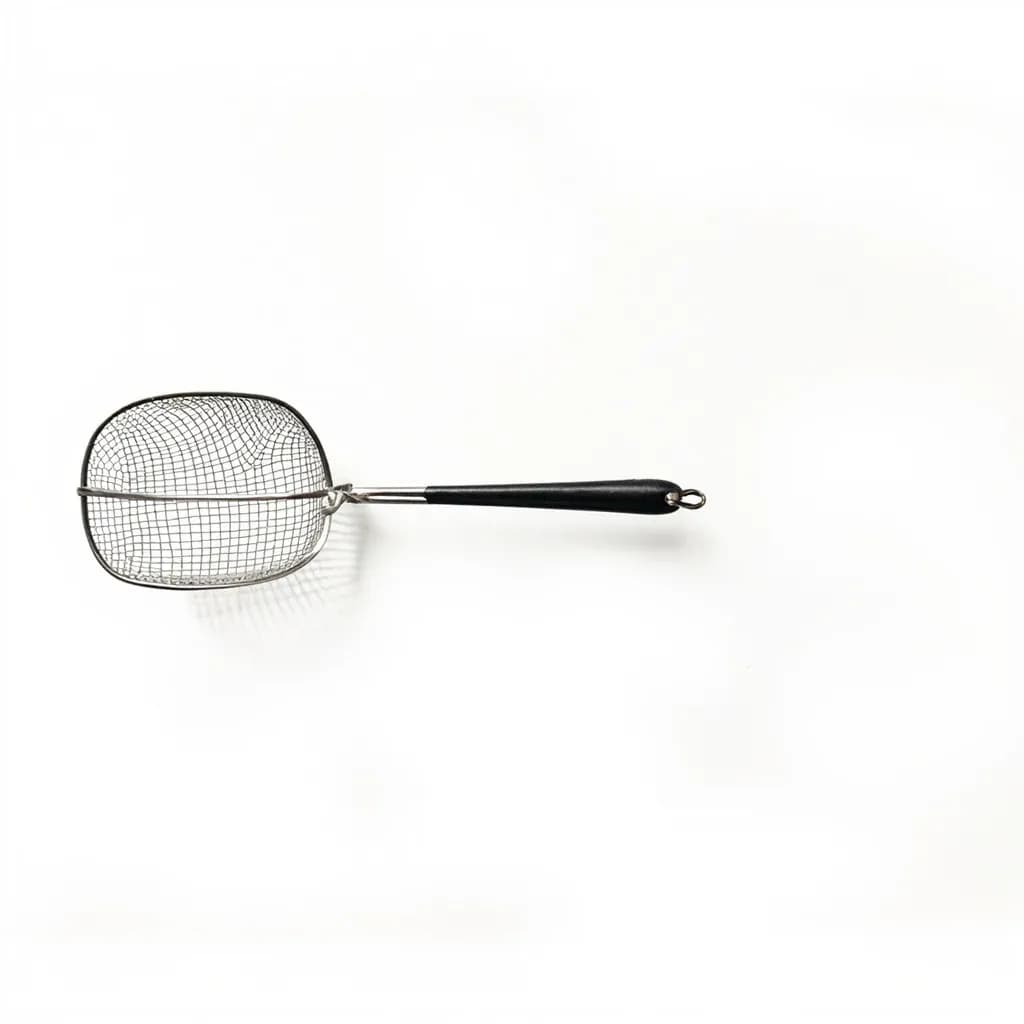
A wire mesh basket that holds food submerged in hot oil and lifts it out to drain in one motion.
A frying basket is a wire-mesh basket with a long handle that lowers food into hot oil and raises it to drain when crisp. It keeps fries, chicken, and fritters together for even cooking and easy removal without fishing pieces out. It is the standard insert for deep fryers and is also used over a deep pot of oil.
A frying basket is the simplest piece of equipment that turns an ordinary stockpot or Dutch oven into a serviceable deep fryer. At its core it is a bowl of wire mesh on a long handle, and that mesh is what defines the tool: it lets hot oil flow freely in and out, so food can be submerged, cooked, and lifted out to drain in a single motion without tongs, slotted spoons, or precarious fishing. The draining step happens over the pot, where the oil belongs, so the basket also keeps countertops cleaner and reduces the amount of oil the food carries to the paper towels.
Beyond the obvious deep-frying role, the basket solves a handful of small kitchen problems: it stops fragile breading from breaking apart under tweezers or tongs, it gives a consistent way to lower food into oil without splashing, and it lets the cook shake, turn, or rearrange a batch while everything stays contained. The same lifting-and-draining logic carries over to blanching vegetables, retrieving poached eggs, or fishing dumplings out of simmering broth.
The behavior of the basket in the pot matters as much as the food inside it. A properly loaded basket allows oil to recover temperature between batches, drains cleanly when hoisted, and rests securely on the pot rim while the cook does something else with both hands. Choose one whose diameter leaves at least an inch of clearance on every side of the pot, whose mesh is fine enough to hold the smallest piece you intend to fry, and whose handle keeps the knuckles well back from the oil surface, and the tool will outlast every non-stick pan in the kitchen.
Alternatives
Types & varieties
Standard form, fits stockpots and Dutch ovens; the most common shape in home and small pro kitchens.
Designed for rectangular countertop deep fryers; matches the tank walls so capacity is not wasted in the corners.
Flat, shallow wire-mesh skimmer on a long bamboo or metal handle; shares the same draining logic but is open rather than enclosed, ideal for lifting single pieces or skimming foam.
Tight weave for very small items — capers, small herbs, popcorn shrimp — that would slip through a standard mesh.
Nylon- or silicone-coated mesh that is gentler on delicate batters, but limited to roughly 400 °F / 200 °C and best hand-washed.
Porcelain-enamel finish over steel; resists corrosion and cleans easily, though chips expose bare metal underneath.
Punched holes instead of woven mesh; more rigid and smoother inside, but with slightly slower oil circulation.
Oversized 11–13 in version with a reinforced handle and lifting hook, sized to hold a whole bird safely during outdoor frying.
Japanese-style rectangular mesh basket, sometimes with an integrated draining platform for tempura and other light-batter fried foods.
Two short side handles instead of one long one; drops into a dedicated deep-fryer well and is lifted straight up rather than at an angle.
Choosing the right basket for your pot
The most common mistake is buying a basket that nearly fills the pot. Oil level rises the moment food goes in, so the basket needs at least 1 in of clearance on every side and 2–3 in of headroom above the oil line to keep boiling-over at bay. For a standard 8-quart stockpot, an 8 in round basket is the practical sweet spot; 10–12 in baskets belong in 12-quart pots or larger. Diameter matters more than mesh count for everyday frying — the wrong mesh size can usually be worked around, but the wrong diameter is unsafe.
Mesh geometry and how it affects the fry
Mesh is the variable that quietly controls the result. A coarse mesh drains faster, which is why it suits chicken and doughnuts where you want minimal oil carryover, and it resists clogging with starch-heavy batters. A fine mesh holds small or fragile items but slows drainage and traps more oil against the food. The trade-off is real: switching from a coarse to a fine basket for the same recipe will make the food feel slightly heavier and greasier even when the fry itself is identical.
Common uses
Tips & pitfalls
- Do not overcrowd: leave at least a third of the basket empty so the oil can recover temperature and food crisps rather than steams.
- Pat food thoroughly dry before frying — surface moisture is the main cause of violent oil splatter when the basket hits the oil.
- Lower the basket slowly and at a slight angle so the air trapped inside escapes gradually instead of bubbling up through the food.
- Rest the handle hook on the pot rim to keep the basket from sliding in and to free both hands for shaking or turning the food.
- Lift the basket as soon as frying ends and let it drip over the oil for 15–30 seconds; paper towels are a final step, not a substitute for in-pot draining.
- Use a fine-mesh basket for anything smaller than the openings of a standard mesh — capers, small shrimp, fine herbs — or it will slip through.
- Skip coated baskets above 375 °F / 190 °C; the nylon or silicone can soften, discolor, or off-gas at higher temperatures.
- Clean the mesh thoroughly after every use; residual oil and food scraps are a fire hazard and taint the flavor of the next fry.
- Do not use a fry basket in a pan of shallow oil; it is designed for deep submersion, and a basket sitting on the pan bottom will scorch the food and the oil.
- Replace chrome-plated baskets that have worn through to bare steel — exposed metal can corrode and taint food, especially with salty or acidic batters.
Good to know
- Material
- Stainless steel (typically 18/8 or 18/10); also chrome-plated, nickel-plated, enamel-coated steel, and silicone- or nylon-coated versions.
- Construction
- Woven or welded wire-mesh bowl with a long handle, often fitted with a hook at the end to rest on the pot rim.
- Common diameters
- 4–5 in (eggs and small portions), 6 in (snacks), 8–9 in (general home use), 10–12 in (large batches), 11–13 in (turkey fryers).
- Handle length
- Typically 9–14 in, sized to keep the hand well clear of the oil surface.
- Fits
- Round stockpots and Dutch ovens (round baskets) or rectangular countertop deep fryers (rectangular baskets).
- Mesh size
- Fine mesh for small foods such as capers, popcorn shrimp, or herbs; coarse mesh for chicken pieces, fillets, and doughnuts where faster drainage matters.
- Heat tolerance
- Plain stainless tolerates 500 °F / 260 °C and above; coated versions are typically limited to roughly 375–400 °F / 190–200 °C.
- Dishwasher safe
- Stainless and chrome-plated baskets are usually dishwasher-safe; coated baskets are best hand-washed to preserve the finish.
- Origin
- Direct descendant of the French friteuse basket; stainless-steel home versions became common from the mid-20th century as domestic deep frying spread.
Also called
Fry Basket · Deep Fry Basket · Chip Basket
Related

Steamer
Gentle moist heat that keeps vegetables, fish, and dumplings tender

Frying Pan
Shallow sloped pan for frying, sautéing, and quick sears

Saucepan
Tall, straight-sided pot for sauces, grains, and small batches

Sauté Pan
Wide straight-sided pan with room to brown and braise

Dutch Oven
Heavy lidded pot that turns tough cuts tender over hours

Stock Pot
Tall, roomy pot for stocks, pasta, and big-batch cooking

Wok
High-sided bowl pan built for blistering-hot stir-fries

Griddle
Flat, broad surface for pancakes, smash burgers, and breakfast