Knives & Cutting
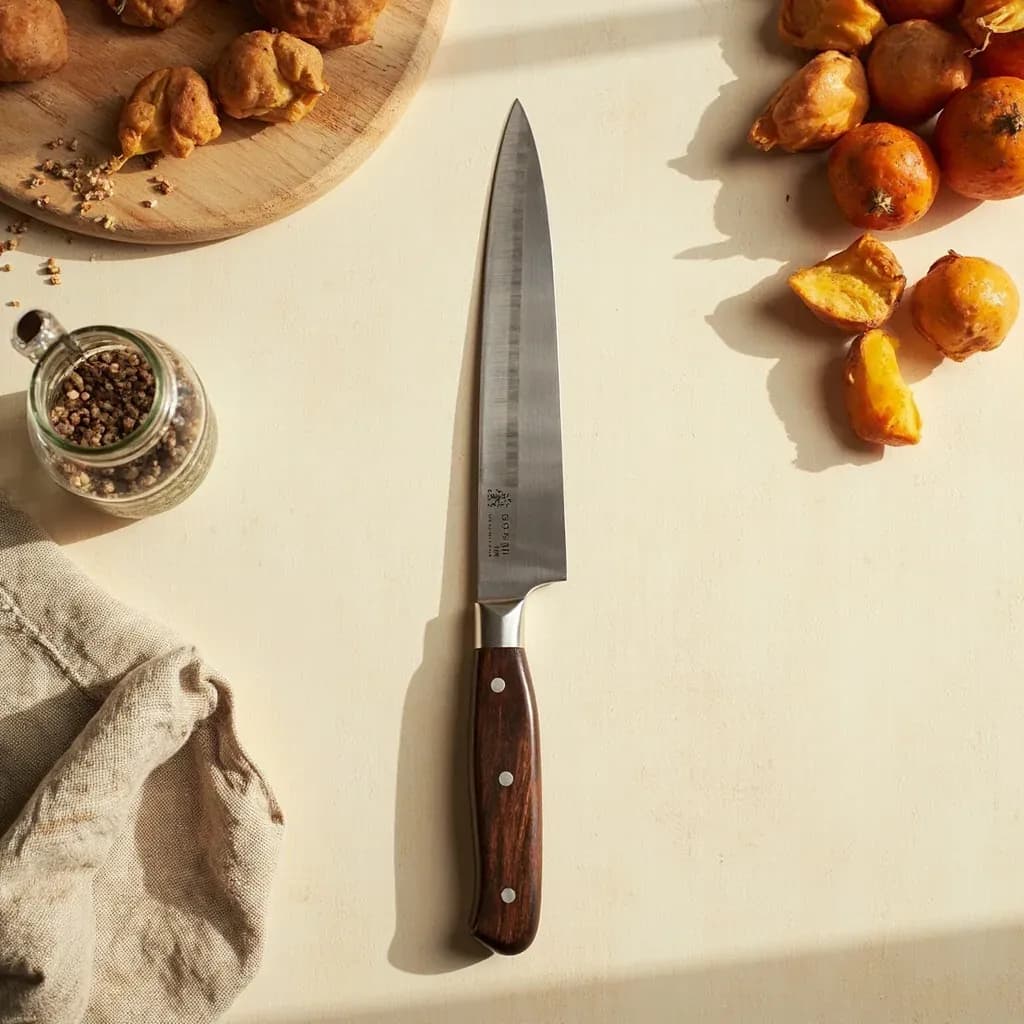
German Chef's Knife
Heavier, thicker German chef's knife with a curved belly for rock-chopping herbs and dense vegetables; tougher edge than a thin Japanese gyuto but less precise for fine slicing.
The German chef's knife, or Kochmesser, is the European workhorse forged for the rhythm of Western cooking: long slicing strokes through roast, firm rock-chopping through onions, and the kind of everyday abuse — knuckle-bone contact, hard vegetable skins, an occasional tap against a board — that would punish a thinner blade. The form was standardized in Solingen, the protected "City of Blades," where makers like Wüsthof and Zwilling (along with Güde, Herder, and others) have built cutlery for over two centuries. The defining silhouette is a tall blade with a pronounced curve from heel to tip, a full or partial bolster where the steel meets the handle, and a weight that does much of the cutting for you.
What separates a Kochmesser from a Japanese gyuto is the steel and the geometry. The standard German high-carbon stainless — X50CrMoV15, hardened to roughly 56–58 HRC — is significantly softer than Japanese hard steels (often 60–64 HRC), which makes the edge tougher and far easier to resharpen on a whetstone or honing steel, but also duller out of the box and prone to rolling rather than chipping. The bevel is ground at a more obtuse 17–20° per side, giving the edge a wedge-like shape that resists fracture but sacrifices some of the paper-thin slicing a Japanese blade achieves.
For a cook, the practical consequence is a tool that rewards a rocking motion over a single clean slice: push down and forward, let the curve do the work, and the knife will glide through cabbage wedges, dense root vegetables, and small poultry joints with a momentum a lighter knife cannot match. It is not a scalpel — long, continuous slices of fish sashimi-grade or translucent rounds of cucumber are not its strength — but for the daily 80 percent of prep in a home or professional kitchen, a well-maintained German chef's knife remains one of the most forgiving and durable tools you can own.
Alternatives
Types & varieties
The archetypal Wüsthof Classic / Zwilling Four Star profile: full bolster, pronounced curve, 8-inch forged blade
Hollow-ground scallops along the blade face that create air pockets to reduce sticking of starchy foods like potatoes and eggplant
Wüsthof Classic Ikon and Zwilling Pro lines drop the full bolster, thin the spine, and trim weight for a hybrid feel between German and Japanese
Cut from rolled sheet rather than forged; lighter, thinner, no true bolster, closer in feel to a French chef's knife at a lower price
Tall blade giving extra knuckle clearance when chopping flat against a board
Smaller version for cooks with smaller hands or tight prep stations; less momentum on heavy cuts
The Rocking Motion
The curved belly of a Kochmesser is not a stylistic choice — it is a mechanical one. The arc keeps a long section of the edge in contact with the board as you rock from tip to heel, so herbs and onions stay on the surface and get cut multiple times in a single stroke. A straight-edged knife asks you to lift and chop; a German chef's knife asks you to rock.
- Keep the tip in light contact with the board throughout the stroke — do not chop straight up and down as you would with a cleaver.
- Set up the cut: curl the guiding-hand fingertips into a claw, knuckles forward; square the food on the board; pinch-grip the blade just past the bolster.
- Begin the rock: tip on the board, heel raised; push down and forward in one fluid motion so the blade slices forward as the heel comes down.
- Return the blade: lift the heel slightly while keeping the tip on the board, and draw the blade back toward your knuckles to begin the next stroke.
- Advance the cut: move the guide hand a fingertip-width backward between strokes; the claw protects it and the rocking blade does the slicing in thin, even passes.
- Finish by slicing cleanly through the root end — the motion is one continuous rhythm of down, back, advance, not a series of separate chops.
Honing and Sharpening
The softer German steel is a gift when it comes to maintenance. It rolls rather than chips, responds quickly to a honing steel, and is forgiving on a whetstone. A neglected gyuto can be ruined by amateur sharpening; a neglected Kochmesser can be brought back from almost any state.
- Hone before or after every cooking session — 5–6 light passes per side, alternating, with light pressure.
- Sharpen on a 1000/4000-grit whetstone every 2–3 months for home cooks; weekly for daily professional use.
- Maintain the factory edge angle of 17–20° per side; steeper edges feel durable but cut poorly, shallower edges chip.
- A ceramic rod or fine diamond steel is a reasonable substitute for daily honing if you do not have a traditional steel.
- Test sharpness by slicing a ripe tomato or paper, not by touch — the edge is sharper than your fingers can reliably judge.
Common uses
Tips & pitfalls
- Hand-wash and dry immediately; dishwashers destroy edge retention, attack wooden handles, and loosen rivets over time.
- Use wooden, rubber, or polyethylene boards — never glass, marble, or stone, which will dull the edge in minutes.
- Avoid prying or twisting the blade sideways — the thicker geometry can snap at the tip if leveraged against a joint or bone.
- Do not use on frozen food or bones harder than poultry; the softer HRC will chip or roll the edge.
- A heavier knife is not a sharper knife — pinch-grip on the blade just past the bolster for control, slide back to the handle only for power cuts.
- Replace or re-handle if rivets loosen; a wobbly knife is dangerous and cannot be tuned out by sharpening.
- Store on a magnetic strip, in a block, or in an edge guard; loose drawer storage dulls the edge and damages the tip.
- Crush garlic by laying the flat side down and pressing with the heel of your palm — the weight of the blade is built for this.
Good to know
- Origin
- Solingen, Germany — protected geographical indication for cutlery, with continuous production since the Middle Ages
- Common Steel
- X50CrMoV15 high-carbon stainless (martensitic, ~0.5% C, 15% Cr, plus molybdenum and vanadium)
- Rockwell Hardness
- Typically 56–58 HRC — softer than Japanese hard steels, harder than most French stamped blades
- Edge Angle
- ~17–20° per side (total ~35–40°), more obtuse than Japanese blades to resist chipping
- Typical Blade Length
- 8 inches (20 cm) is standard; 6, 10, and 12 inch versions are also made
- Construction
- Forged from a single bar with full or partial tang, usually a forged bolster, often triple-riveted
- Handle Materials
- POM (polyoxymethylene) plastic, African blackwood, olive wood, or pakkawood
- Standard
- DIN 10955 / DIN EN ISO 8442-2 governs materials, hygiene, and sharpness for kitchen knives sold in Germany
Also called
german knife · european chef knife · wusthof-style chef knife · 8-inch chef knife
