Cookware
Glass Teapot
A heat-resistant glass pot for steeping tea while showing the leaves and color unfurl.
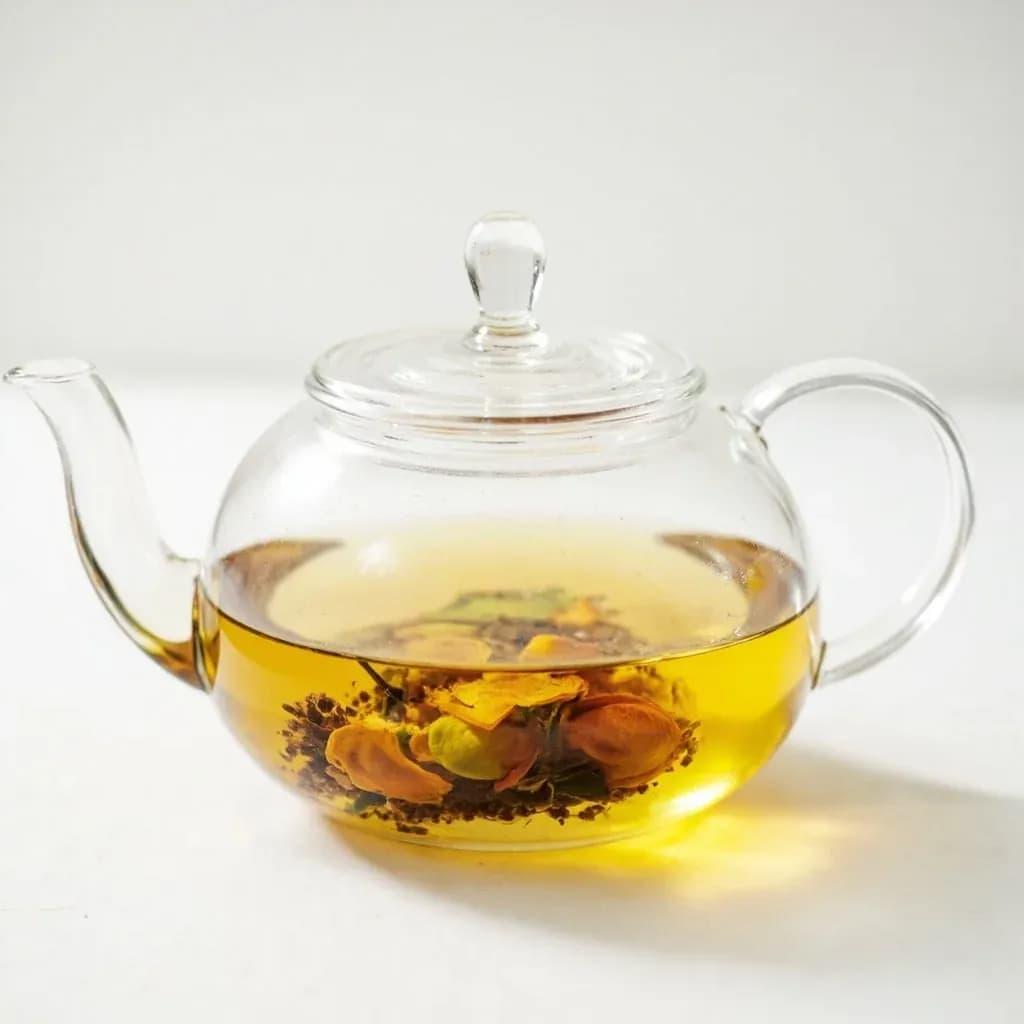
A glass teapot is a borosilicate-glass vessel, usually with a built-in mesh infuser, used to steep loose-leaf tea while letting the color and the leaves opening stay visible. It is popular for blooming flowering teas and for brewing where watching the steep helps judge strength. The neutral glass adds no flavor and is easy to see clean, and many are stovetop- or warmer-safe.
A glass teapot is a transparent brewing vessel, usually borosilicate glass, designed to steep and serve tea while letting the drinker watch leaves unfurl, liquor color deepen, and — in the case of flowering teas — hand-tied bundles bloom into shape. The format pairs naturally with Chinese gongfu service, where small glass brewing pitchers and fairness cups let the brewer read each infusion shot by shot, and with delicate greens, whites, and oolongs that oversteep quickly and benefit from visual cues rather than a timer alone.
Borosilicate glass is the practical standard: it tolerates both stovetop heat and the temperature jump from room temperature to boiling without cracking. Cheaper soda-lime glass pots are common but should only receive pre-warmed or just-boiled water, and they are more prone to thermal shock. The trade-offs are familiar — fragility, visible staining from tannins and hard water, and the need to pre-warm before pouring boiling water in — but for any tea where color and leaf movement are part of the experience, a glass pot remains the most honest vessel in the kitchen.
Most glass teapots share a simple anatomy: a glass body, a glass or stainless lid, and a removable mesh infuser (stainless steel or, for a fully transparent look, glass). Larger cylindrical or rounded bodies are designed specifically for flowering teas, which need room to unfurl and rotate, while smaller gongfu-style glass pitchers — the Chinese gong dao bei, or fairness cup — decant brewed tea so strength is evened across cups.
Alternatives
Types & varieties
Thick-walled and rated for direct burner use; often paired with a stainless steel infuser
Lighter glass body, not for direct flame; used for steeping with pre-heated water
Larger rounded or cylindrical body (often 600 ml–1.2 L) with a wide base so blooming teas can fully unfurl and rotate
Small glass server used to decant brewed tea so strength is evened across cups; often paired with a glass brewing vessel
Two layers of glass for insulation; keeps tea hotter longer and stays cool to the touch
Glass body held in a stainless steel frame for protection and easier pouring
Built-in base holds a lit tea light beneath the pot to keep tea warm during service
All-glass removable strainer; preserves the fully transparent look, popular with flowering teas
Borosilicate vs. soda-lime glass
The single most important distinction when buying or using a glass teapot is the glass itself. Borosilicate — the same family used in laboratory glassware and quality bakeware — is formulated to handle thermal shock, so it survives the jump from a cool countertop to boiling water and can, in thicker-walled models, sit on a low flame. Soda-lime glass is the standard window-and-bottle formula: cheaper, perfectly clear, but vulnerable to sudden temperature changes. Treat a soda-lime pot the way you would a thick drinking glass — pre-warm it, never subject it to direct flame, and never set a hot pot on a cold wet surface.
Matching the pot to the tea
Glass teapots are not one-size-fits-all. A wide, roomy flowering-tea pot is wrong for a tight 30-second gongfu steep, and a 350 ml fairness pitcher is too small for a pot of afternoon-service English Breakfast. The vessel should match the leaf, the brewing style, and the role the pot plays in service — brewer, server, or both.
Common uses
Tips & pitfalls
- Preheat the empty pot with a splash of warm water before adding boiling water; this prevents thermal shock, especially on soda-lime glass — never pour boiling water into a cold pot straight from the cabinet.
- On stovetop models, keep to low or medium heat and never let the pot boil dry; a dry glass pot on a flame can shatter.
- Avoid placing a hot pot on a cold or wet surface (granite countertop, metal trivet with moisture); the temperature differential can crack it.
- Use wooden, bamboo, or silicone spoons and stirrers; metal utensils can scratch or chip glass rims.
- Descale regularly with a soak of equal parts white vinegar and warm water, then rinse thoroughly — tannin and mineral films stain glass and mute color.
- Hand wash rather than machine wash when possible; dishwasher detergents and high heat can etch and cloud the glass over time.
- Choose a mesh infuser with fine enough holes for the leaf size — fannings and small broken-leaf teas slip through coarse strainers and end up in the cup.
- Don't overfill: leave at least 2 cm below the rim so the infuser doesn't trap leaves against the spout and block pouring, and remove the infuser once the tea reaches desired strength to avoid over-extraction, especially with green and white teas.
- Store with the lid off or slightly ajar to prevent musty odors and mildew in the lid knob crevices.
Good to know
- Primary material
- Borosilicate glass (heat-resistant); cheaper versions use soda-lime glass
- Typical capacity
- 350 ml to 1.5 L; common sizes 500 ml, 700 ml, and 1 L
- Heat tolerance
- Borosilicate handles roughly -40°C to 300°C; still vulnerable to sudden temperature swings
- Stovetop use
- Only borosilicate models rated for direct heat; gas or electric, low to medium flame
- Microwave use
- Most glass bodies are microwave-safe; remove metal infuser and lid fittings first
- Common components
- Glass body, glass or stainless lid knob, removable mesh infuser, sometimes bamboo handle or stainless frame
- Origin era
- Modern Western-style glass teapots emerged in the late 20th century as borosilicate glass became affordable; Chinese tea culture long used small glass vessels (fairness cups, brewing pitchers) for visual appreciation
- Notable use case
- Showcasing flowering teas (hand-tied bundles that unfurl in hot water)
- Cleaning
- Hand wash recommended; descale with white vinegar or citric acid to remove tannin and limescale buildup
- Price range
- Basic models roughly $10–25; premium borosilicate or hand-blown pieces $30–80+
Also called
Ceramic Teapot · Glass Tea Pot · Borosilicate Teapot
Related

Steamer
Gentle moist heat that keeps vegetables, fish, and dumplings tender

Frying Pan
Shallow sloped pan for frying, sautéing, and quick sears

Saucepan
Tall, straight-sided pot for sauces, grains, and small batches

Sauté Pan
Wide straight-sided pan with room to brown and braise

Dutch Oven
Heavy lidded pot that turns tough cuts tender over hours

Stock Pot
Tall, roomy pot for stocks, pasta, and big-batch cooking

Wok
High-sided bowl pan built for blistering-hot stir-fries

Griddle
Flat, broad surface for pancakes, smash burgers, and breakfast