Cookware
Grill Basket
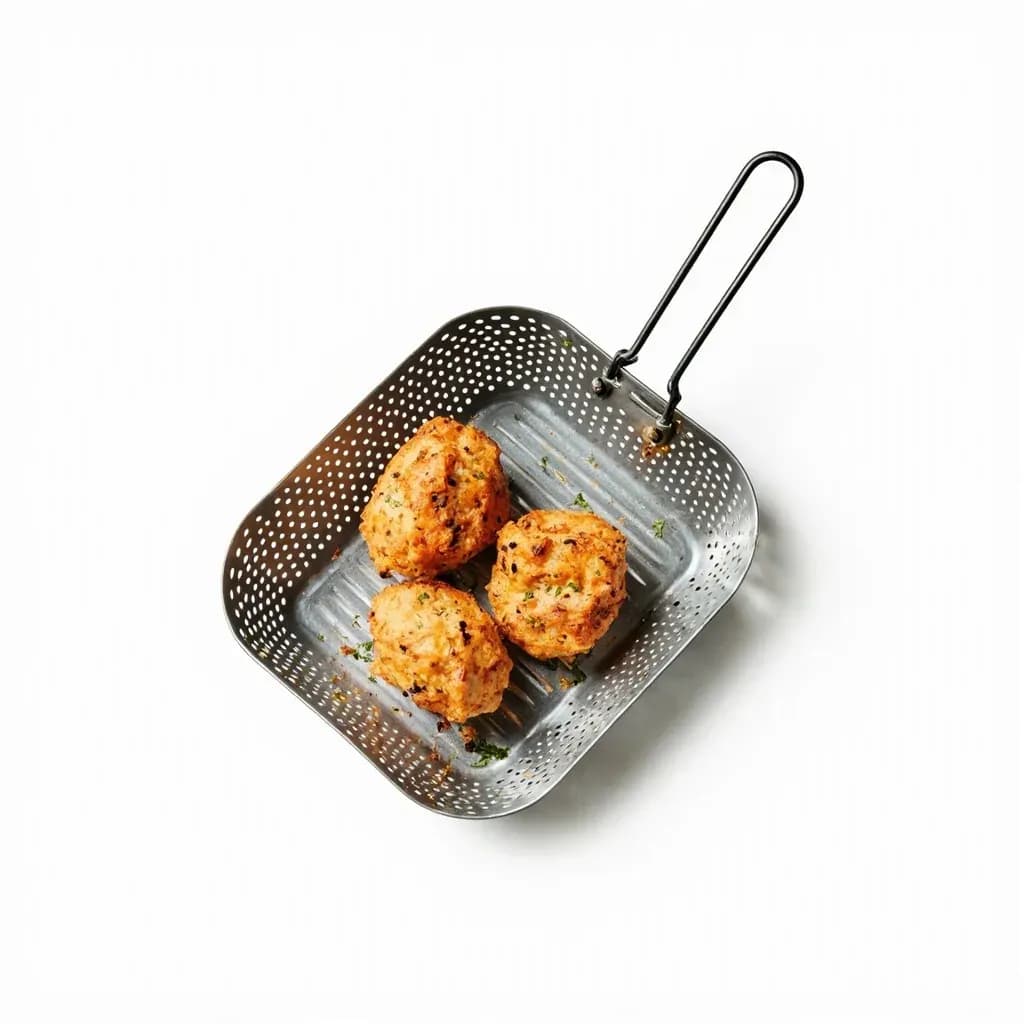
A perforated metal cage that holds small or delicate foods together so they don't fall through grill grates.
A grill basket is a hinged or open perforated metal container used to grill foods that would otherwise slip through the grates, such as vegetables, shrimp, or flaky fish. It lets smoke and flame reach the food while letting you flip everything at once with a single motion. Many baskets have a long handle and a locking lid to secure the contents for tossing over the coals.
A grill basket is a perforated metal cage — most commonly stainless steel — that tames the open fire for foods too small, too flaky, or too delicate to survive directly on the grates. Two hinged grids clamp together around the food, and a long handle keeps the cook's hand away from the heat, so you can flip an entire portion in one confident motion instead of chasing individual shrimp across the bars with tongs. The perforations let smoke and radiant heat reach the food, so the grilled flavor is essentially the same as cooking directly on the grate.
What separates a useful basket from a frustrating one is how it manages contact. A preheated, lightly oiled surface sears rather than sticks; an overcrowded basket steams and the food never marks. The open mesh also shields small items from flare-ups while still allowing the airflow that defines live-fire cooking, which is why a basket can produce both crisp edges and genuine smoke flavor in a single batch. In practical terms, a basket earns its place whenever food is smaller than about 1 inch / 2.5 cm, or whenever it would otherwise disintegrate between the bars.
The category covers more than the familiar rectangular clam-shell. Wok-shaped baskets let a cook toss and stir over flame, fish-shaped baskets pin a whole fish flat for even skin, and fine-mesh round baskets hold the smallest fragments — chopped nuts, sliced garlic, herbs — that would slip through anything else. The right choice depends on what is being cooked and how.
Alternatives
Types & varieties
The most common style; two hinged perforated grids with a clasp, ideal for vegetables, shrimp, and diced meats. Often sold in small, medium, and large sizes.
Curved, bowl-shaped basket with a single long handle; lets you toss and stir-fry ingredients directly over the flame.
Long, narrow, oval basket sized for whole trout, branzino, or other small whole fish; holds the fish flat so the skin crisps evenly.
Circular hinged basket, useful for shrimp, sliced vegetables, and fajita-style mixes; rotates easily for even cooking.
Coated grids (PTFE or ceramic) that release delicate fish and cheese more readily; tolerates lower heat than bare metal.
Fine wire-mesh version (often round) for the smallest items such as sliced garlic, herbs, or chopped nuts that would fall through a standard perforated grid.
Handle detaches so the basket can go in the oven or be stored flat; the detachable handle also fits multiple baskets for batch cooking.
Choosing the Right Basket
Match the basket to the food rather than buying one size for everything. A rectangular hinged basket is the most versatile all-rounder for vegetables, shrimp, and diced meat; a wok-style basket is the only practical choice for stir-frying over live fire; a fish-shaped basket is worth owning if whole fish appear on the menu more than twice a season. For most households a medium rectangular stainless basket covers 80 percent of the jobs, with a round or mesh basket added later for the small stuff.
- Pick stainless steel for durability and high-heat searing; reach for non-stick only when the menu is mostly delicate fish or soft cheese.
- Choose a removable-handle design if you want to slide the basket into the oven to finish or to store multiple baskets in one drawer.
- Buy the largest rectangular basket your grill can still close with the lid down — overcooking small batches in a big basket is easier than juggling two small ones.
- Fine mesh is worth the splurge for toasted nuts, garlic chips, and smoking herbs, which are otherwise lost between the grates.
Cleaning and Care
The biggest enemy of a grill basket is burnt-on carbon, and the biggest mistake is scrubbing it while it is still scorching — the metal warps from thermal shock, the non-stick coating scratches, and the cook burns a hand. A short soak in hot, soapy water does most of the work; a non-scratch pad or wire brush handles what is left.
- Soak a still-warm basket (not red-hot) in hot soapy water for 10–15 minutes before scrubbing.
- Avoid the dishwasher for non-stick baskets, wooden-handled models, and anything with a coated grip.
- Dry stainless baskets briefly over low grill heat after washing to prevent water spots and surface rust.
- Store baskets flat or hung; folding them with a wet interior invites corrosion at the hinge.
Common uses
Tips & pitfalls
- Preheat the basket on the grill for 2–3 minutes before adding food; a hot surface prevents sticking far more than extra oil does.
- Season food just before it goes in; salt drawn out by long pre-salting creates steam and prevents proper grill marks.
- Do not overcrowd — leave a little space between pieces so smoke and heat circulate; cook in batches if needed.
- Use one confident flip with a long-handled spatula, or turn the whole basket if it is a hinged double-sided design; flipping individual small pieces usually sends them over the edge.
- For non-stick baskets, keep the grill around medium (about 350–400 °F) so the coating is not damaged; bare stainless can take higher, direct heat.
- Soak a still-warm (not scorching) basket in hot soapy water for 10–15 minutes; burnt-on bits release easily and a wire brush or non-scratch pad finishes the job.
- Skip the dishwasher for non-stick models and for baskets with wooden handles; the heat and detergent shorten the coating's life.
- Common mistake: placing wet, un-oiled fish or vegetables in a cold basket — they weld to the metal. Pat food dry, preheat, and oil the food (not necessarily the basket).
- Common mistake: leaving the basket empty over very high heat for more than a few minutes; thin stainless can discolor and non-stick coatings will degrade.
- A fish-shaped basket works best with fish close to its length; oversized fish bow and cook unevenly, while undersized fish flop inside the cage.
Good to know
- Category
- Cookware / grilling accessory
- Primary material
- Stainless steel; also sold in hard-anodized aluminum and non-stick coated steel
- Construction
- Perforated or mesh basket with a long handle, usually two hinged grids that clamp together with a clasp
- Typical sizes
- Rectangular baskets 12–16 in. long and 8–10 in. wide; round baskets 12–14 in. diameter; fish-shaped baskets 15–18 in. long
- Heat tolerance
- Stainless and anodized aluminum are safe to roughly 500–600 °F / 260–315 °C; non-stick coatings are typically rated to about 400–450 °F
- Dishwasher safe
- Most stainless models are; non-stick versions and baskets with wooden handles are usually hand-wash only
- Also called
- Grill tray, grill cage, grilling basket, fish basket (for the long, narrow style)
- Approximate price range
- Entry-level wire baskets from about $10; premium stainless or non-stick models $20–$50
Also called
BBQ Basket · Vegetable Grill Basket · Fish Grill Basket
Related

Steamer
Gentle moist heat that keeps vegetables, fish, and dumplings tender

Frying Pan
Shallow sloped pan for frying, sautéing, and quick sears

Saucepan
Tall, straight-sided pot for sauces, grains, and small batches

Sauté Pan
Wide straight-sided pan with room to brown and braise

Dutch Oven
Heavy lidded pot that turns tough cuts tender over hours

Stock Pot
Tall, roomy pot for stocks, pasta, and big-batch cooking

Wok
High-sided bowl pan built for blistering-hot stir-fries

Griddle
Flat, broad surface for pancakes, smash burgers, and breakfast