Knives & Cutting
Ham Carving Knife (Cuchillo Jamonero)
A long, thin, flexible blade for carving paper-thin slices from a bone-in cured ham.
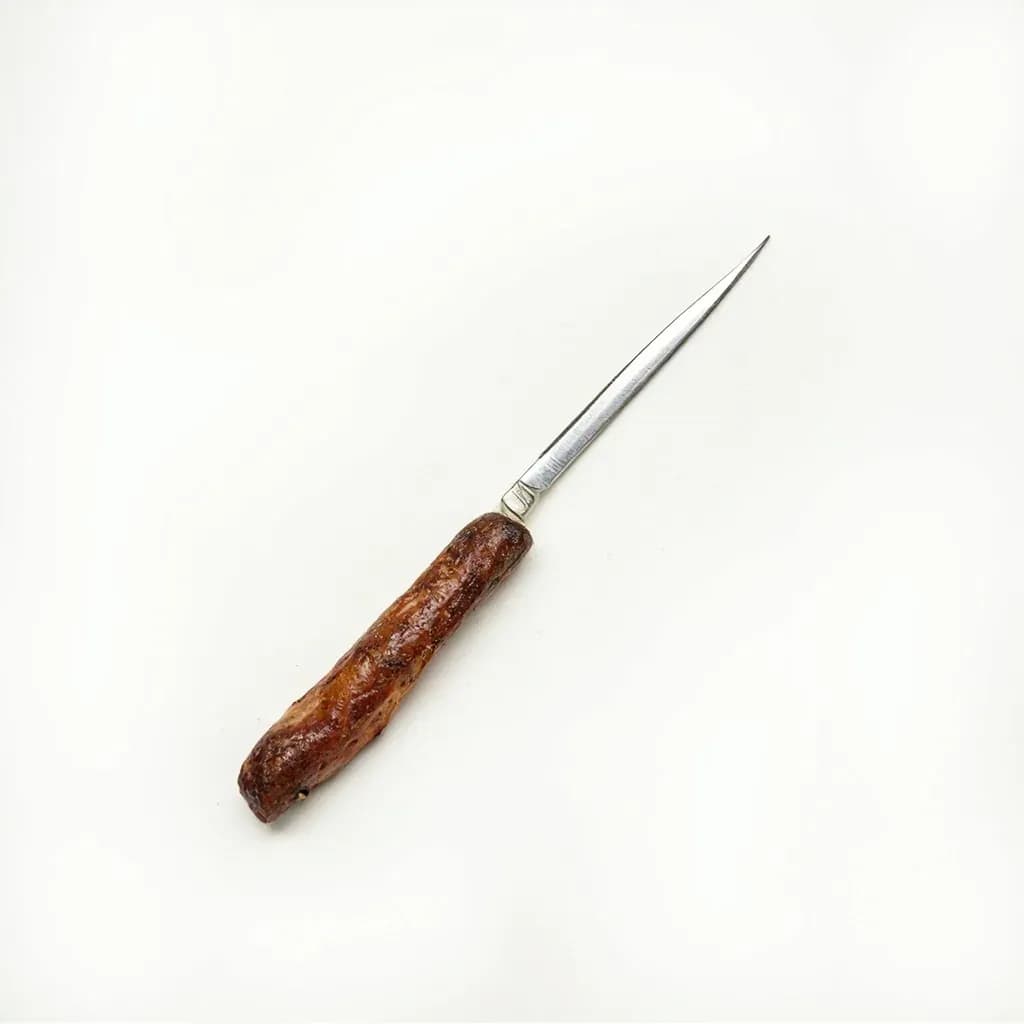
A ham carving knife, or cuchillo jamonero, has an extra-long, narrow, flexible blade designed to shave thin, even slices from Spanish jamón and other bone-in cured hams. Its flexibility lets the carver glide along the leg and around the bone with control. It is typically used with a ham holder (jamonero) and a short rigid boning knife to free meat near the bone.
The jamonero is a knife shaped entirely by the geometry of a bone-in cured ham leg. Its long, narrow, highly flexible blade — typically 20 to 30 centimeters, with 24 and 26 centimeter models the most common — was designed to glide along the flat face of a jamón and wrap the contours of the femur and tibia, producing slices thin enough to read through. Where a chef's knife mashes and tears, the jamonero's thin spine and acute edge angle yield clean cuts that preserve the marbling of fat and lean that defines good Ibérico or Serrano.
Beyond the slicer itself, a complete ham kit includes the shorter, stiffer deshuesador for scoring rind and working around the bone, and the puntilla, a narrow pointed knife for fine trimming. Together they form a small, purpose-built system: the jamonero for the long, even pull-cut, the deshuesador for the heavy work, the puntilla for the detail. Using the wrong knife in the wrong role is the single most common cause of torn, ragged slices and damaged legs.
For home cooks, a 24 to 26 centimeter double-bevel stainless model with a full-tang wood handle is the most forgiving and the easiest to maintain. Professionals tend to reach for 28 to 30 centimeter single-bevel blades in carbon or high-carbon stainless, sharpened to a finer edge and capable of the paper-thin slices prized in Spanish carving tradition.
Alternatives
Types & varieties
The classic long, thin, flexible blade used for slicing paper-thin cuts off the flat face of the ham.
Shorter, stiffer knife (often slightly curved) used to score the rind, trim fat, and separate meat from the bone.
Short, narrow, pointed knife for cleaning around the tibia, knuckles, and hoof, and for decorative trimming once the leg is worked down.
Asymmetric grind, hand-sharpened, favored by jamón professionals for a cleaner pull-cut.
Symmetric edge; easier to maintain at home and ambidextrous.
A minority variant that cuts through tough outer fat but tears the tender lean meat, so most experts avoid it.
High-end gift and professional versions in layered or VG-10/MoV steels, often with decorative handles.
Choosing a jamonero
The right size and grind depend on the size of the leg you usually carve and on whether you sharpen your own knives. A 24–26 cm double-bevel stainless blade is the most forgiving home choice; a longer 28–30 cm single-bevel in carbon or high-carbon stainless rewards a practiced hand with thinner, cleaner slices.
- 24 cm suits whole Ibérico de bellota and most Serrano legs; 26 cm gives more reach for larger pieces; 30 cm is for very large professional legs.
- Single-bevel cuts more cleanly but only sharpens on one side and is usually ground for right-handers.
- Double-bevel is ambidextrous and easier to maintain on a standard whetstone.
- High-carbon steel takes a keener edge but must be dried and lightly oiled to prevent rust; stainless is more forgiving.
- Full-tang construction with a riveted wood handle (olive, chestnut, cocobolo, or pakkawood) gives the best balance and control.
- Established Albacete makers — Arcos, Martínez y Gascón, 3 Claveles, Miguel Nieto, Pallarès — define the modern standard.
The ham-knife system
A jamón is carved with three knives, each with a distinct job. Substituting a chef's knife or utility knife for any of them is the most common cause of ragged slices and wasted meat.
- Jamonero: long, thin, flexible slicer for the flat face of the leg (maza and contra).
- Deshuesador: short, stiff, often slightly curved for scoring rind, removing yellow fat, and lifting meat off the bone.
- Puntilla: short, narrow, pointed for fine work around the tibia, knuckles, and hoof.
- All three should share the same handle style and balance so the hand does not have to readjust.
Common uses
Tips & pitfalls
- Keep the blade razor-sharp: a dull jamonero drags and tears the meat instead of slicing it cleanly. Hone with a long rod or stone before each session.
- Always work on a jamonero (ham stand) with the hoof pointing up or sideways; carving a free-standing leg is unsafe and produces uneven slices.
- Let the ham sit at room temperature for 30–60 minutes before carving. Cold fat smears instead of cutting cleanly and dulls the edge faster.
- Use a single long pull-cut from heel to tip in the direction of the grain; never saw back and forth.
- Start at the rump end (maza) where the muscle is largest, and work toward the hoof (contra) as the leg is consumed.
- Trim only the rind and yellow exterior fat before slicing; leave a thin layer of fat on each slice for flavor and to keep the lean from drying out.
- Hold the slice with the back of the knife or your fingertips as it comes off the blade to lay it flat and show the marbling.
- Wipe the blade with a damp cloth between cuts so sticky residue does not drag or tear the next slice.
- When you reach the bone, switch to the deshuesador or puntilla rather than forcing the long flexible blade against it.
- Common mistake: using a chef's knife or utility knife. It is too thick and rigid, mashing the meat instead of gliding through it.
- Sharpen on a long whetstone (1000/3000 grit) following the original bevel angle; a honing rod is fine for quick touch-ups but will not replace a proper stone.
- Store dry, never loose in a drawer. Roll the blade in a cloth or use a saya (wooden guard) so the edge does not touch other tools.
Good to know
- Origin
- Spain; the craft is centered in Albacete (Castilla-La Mancha), historically a Spanish cutlery capital.
- Also called
- Cuchillo jamonero (Spanish); sometimes 'Spanish ham knife' or 'jamón slicer' in English.
- Typical blade length
- 20–30 cm (8–12 in); 24 cm and 26 cm are the most common home sizes, 28–30 cm for very large legs.
- Blade width and flex
- Narrow, roughly 2–2.5 cm at the heel, tapering to a fine point; thin and flexible along its length so it can follow the bone.
- Edge geometry
- Traditional examples are single-bevel (usually right-handed); modern Western-style versions are double-bevel and ambidextrous.
- Common blade materials
- Stainless steel (most common), high-carbon steel (sharper, more traditional), and Damascus or stainless-clad steel for premium models.
- Companion tools
- Used with a ham stand (also called a jamonero in Spanish — the word refers to both the knife and the stand) and often a shorter deshuesador (deboning knife) for work around the bone.
- Suitable for
- Bone-in dry-cured hams: Jamón Ibérico (de bellota, cebo de campo, cebo), Jamón Serrano, Italian prosciutto crudo, and Speck.
Also called
Cuchillo Jamonero · Jamón Knife · Ham Slicing Knife
Related

Knife
The fundamental cutting tool every kitchen is built around

Chef's Knife
The do-everything blade for chopping, slicing, and mincing

Paring Knife
Small, nimble blade for peeling and detailed in-hand work

Serrated Knife
Saw-toothed blade that slices crusty bread without crushing

Cleaver
Heavy broad blade for chopping through bone and bulk prep

Cutting Board
The stable surface every cut starts on

Mandoline
Adjustable blade for paper-thin, perfectly even slices

Kitchen Shears
Heavy-duty scissors for poultry, herbs, and packaging