Cookware
Heavy-Bottomed Stockpot
A tall, thick-based pot for simmering stocks, broths, and large-batch soups without scorching.
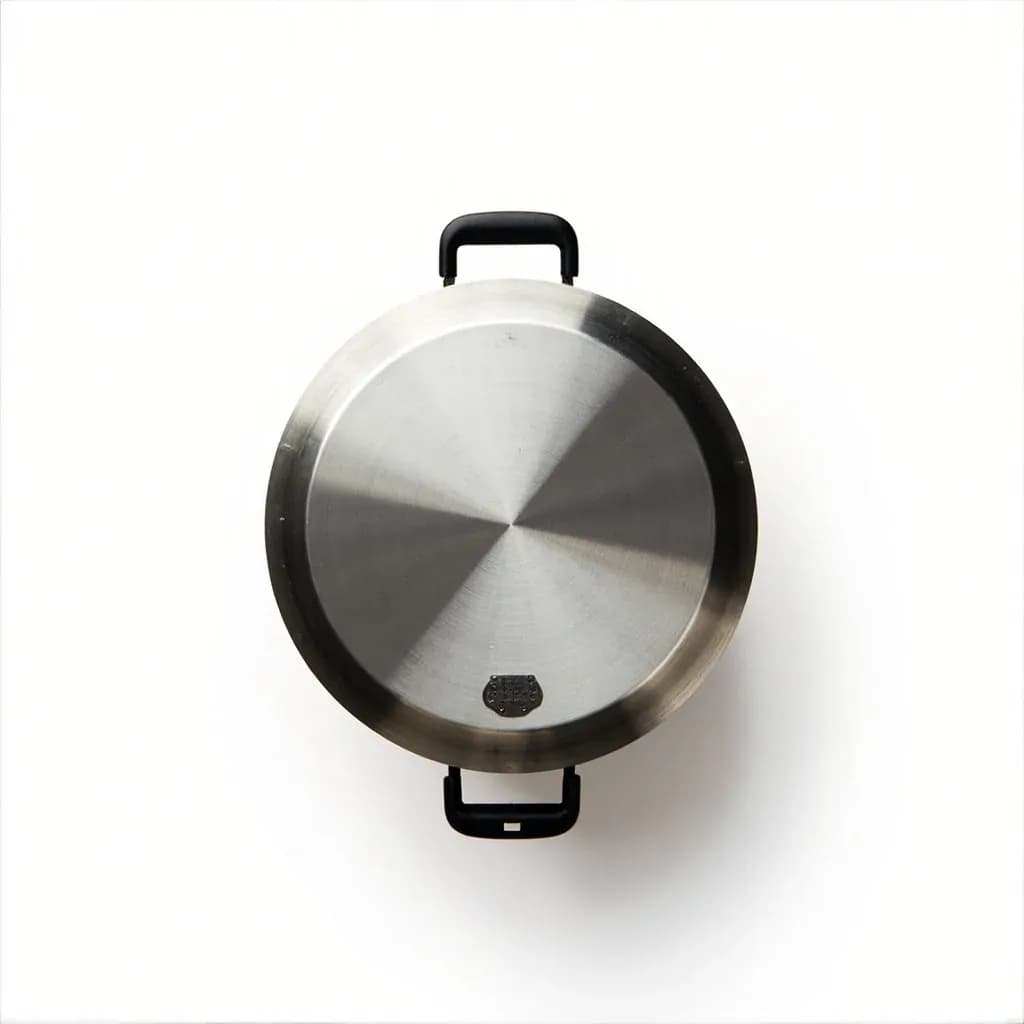
A heavy-bottomed stockpot is a deep, straight-sided pot with a thick base that spreads heat evenly and resists scorching during long, slow cooks. It is used to simmer bones, vegetables, and aromatics for stocks and broths, as well as to cook large batches of soup, pasta water, or tonkotsu-style ramen base. The tall, narrow shape minimizes surface evaporation so liquids reduce slowly over many hours.
A heavy-bottomed stockpot is a tall, relatively narrow pot built for the long, gentle simmers that define stock- and broth-making. Its defining feature is a thick, heat-spreading base — typically 4–7 mm of encapsulated aluminum or copper clad between stainless layers, or the uniformly thick walls of enameled cast iron — that flattens out the hot spot a burner would otherwise concentrate directly under the center of the pan. The tall proportions (9–14 in high on an 8–14 in diameter at home scale) deliberately limit evaporation, so a stock can cook for hours while losing only a fraction of its volume rather than boiling down to a glaze.
Why the weight matters: on a thin-bottomed pot, a single burner flame creates a hot zone beneath the center of the base, and that zone eventually carbonizes the proteins, sugars, and aromatics in contact with it, turning a delicate chicken stock acrid and cloudy. A heavy base conducts heat laterally before it reaches the food, evening out the cooking surface across the full footprint of the pot. The same property makes the vessel reliable for slow reductions, dense bean braises, and any cook where a brief lapse in attention would otherwise leave scorch marks on the bottom.
The form descends from the French marmite, a covered earthenware or tinned-copper vessel used for slow simmering, and the modern stainless-clad version became standard in professional kitchens as bonded cookware technology matured in the late 20th century. Clad stainless is the versatile default — lighter, dishwasher-safe, and induction-ready. Enameled cast iron is the upgrade for the most demanding long cooks and acidic braises, at the cost of significant weight when full.
Alternatives
Types & varieties
Stainless interior and exterior with a full aluminum core; even heating, durable, dishwasher-safe, induction-compatible. The home and pro workhorse.
Adds an extra stainless-aluminum layer for more uniform heat across the tall sides; valuable for long simmers and reductions where vertical hot spots appear.
Heavy throughout, not just at the base; excellent heat retention, ideal for very long cooks and acidic liquids. Heavier to lift; hand-wash only.
Thick, durable, non-reactive surface; heats evenly and quickly. Induction-compatible only when a magnetic steel base is bonded on.
Best heat responsiveness of any material; mostly a professional tool, expensive, and requires periodic retinning.
Budget option; prone to scorching during long simmers unless paired with a flame-tamer or used carefully on a modest burner.
Lightweight with good conductivity; common in restaurants for high-volume stock production. Not induction-compatible.
Extra-tall (12+ qt) with a removable rack; sized to keep Mason jars off the bottom during water-bath canning.
Perforated basket that lifts out for lobsters, crabs, crawfish, or corn-on-the-cob boils.
Choosing the Right Material
The material decision is mostly a trade-off between weight, responsiveness, and how the pot handles long, slow heat. Clad stainless gives the best balance for most cooks: it heats evenly, cleans up easily, works on every cooktop including induction, and is light enough to lift when full. Enameled cast iron is the choice for braises that run all day or for acidic liquids like tomato or wine-based stocks, because the enamel is non-reactive and the mass holds temperature even when cold ingredients are added. Bare aluminum is the budget workhorse of restaurant stock production — light, conductive, cheap to replace — but it reacts with acidic ingredients and is not induction-compatible without a bonded steel plate. Copper is the connoisseur's choice, with the most precise heat response, but the cost and retinning maintenance put it out of reach for most home cooks.
- Pick clad stainless as the default for versatility and easy maintenance.
- Pick enameled cast iron when weight is not an issue and long, acidic braises are common.
- Pick heavy-gauge aluminum only if you cook enormous volumes and want light lift weight.
Matching Pot to Burner
A heavy base only does its job if the burner underneath is sized to it. A 12-quart stockpot on a 6-inch burner develops a hot zone directly under the center with cool edges; the same pot on a 10-inch burner or two stacked burners heats much more uniformly. On gas, watch for flames licking up the sides — that is wasted energy scorching handles and heating the kitchen. On powerful gas ranges, even a heavy-clad pot can benefit from a flame-tamer (heat diffuser) ring to soften the input and mimic a gentler, older-style burner.
- Match pot diameter to burner size; a bigger burner or wider pot is usually better than the reverse.
- Use a flame-tamer under thin-based stockpots on powerful gas burners.
- On induction, use the largest ring that fits under the base to engage the full footprint.
Care and Longevity
Stainless-clad stockpots are nearly indestructible: dishwasher-safe, resistant to warping, and able to take metal utensils on the interior. Enameled cast iron requires more caution — thermal shock can crack the enamel, so always let the pot cool before washing, never submerge a hot pot in cold water, and avoid steel wool or abrasive pads that dull the finish. Both benefit from thorough drying before storage to prevent rust on exposed cast iron edges or water spots on polished stainless. Scorch marks that do appear respond well to a soak with baking soda and hot water; for stainless, a paste of baking soda and a non-scratch scrubber lifts discoloration without damaging the polish.
- Let enameled cast iron cool fully before washing to prevent enamel cracking.
- Dry thoroughly before storing to prevent rust and water spots.
- Soak scorched pots with baking soda and hot water; avoid steel wool on polished stainless or enamel.
Common uses
Tips & pitfalls
- Fill no more than two-thirds to three-quarters full when making stock — foam needs room to rise so you can skim cleanly.
- Start stocks in cold water so proteins and impurities extract slowly for a clearer result.
- Hold a bare simmer, not a rolling boil — violent bubbling emulsifies fat and clouds the stock.
- Pre-warm the pot over low heat before adding liquids, especially with clad stainless, to avoid sticking and uneven thermal stress.
- Match pot diameter to burner size; flames licking up the sides waste energy and scorch handles.
- Salt late: stocks reduce and concentrate, so undersalt early and adjust at the end.
- Reserve the largest pot (16–20 qt) for stocks and canning; a mid-size 8–12 qt handles most weeknight soups and pasta.
- Use a flame-tamer ring on a thin-based stockpot over a powerful gas burner to mimic a heavy base.
Good to know
- Typical capacities
- Home: 8–20 qt (12 qt most common); commercial: 24–80+ qt
- Common construction
- Tri-ply or 5-ply stainless-clad (stainless with aluminum or copper core); also enameled cast iron and heavy-gauge hard-anodized aluminum
- Base thickness
- Encapsulated bases 4–7 mm; cast iron walls and base 4–6 mm
- Standard dimensions
- Height 9–14 in (taller than wide) to limit evaporation; diameter 8–14 in for home sizes
- Stovetop compatibility
- Stainless-clad and cast iron: gas, electric, and induction; non-clad aluminum: gas and electric only
- Oven safety
- Fully clad stainless and cast iron are generally safe to 450–500 °F; always check manufacturer for lid and handle limits
- Average weight (12 qt clad)
- Approximately 6–9 lb empty
- Origin of form
- European kitchen tradition; the French marmite is the direct historical ancestor
Also called
Heavy-Bottom Pot (Patila) · Large Stock Pot · Tall Tonkotsu Stock Pot · Heavy-Bottomed Pot
Related

Steamer
Gentle moist heat that keeps vegetables, fish, and dumplings tender

Frying Pan
Shallow sloped pan for frying, sautéing, and quick sears

Saucepan
Tall, straight-sided pot for sauces, grains, and small batches

Sauté Pan
Wide straight-sided pan with room to brown and braise

Dutch Oven
Heavy lidded pot that turns tough cuts tender over hours

Stock Pot
Tall, roomy pot for stocks, pasta, and big-batch cooking

Wok
High-sided bowl pan built for blistering-hot stir-fries

Griddle
Flat, broad surface for pancakes, smash burgers, and breakfast