Cookware
Hot Pot Vessel
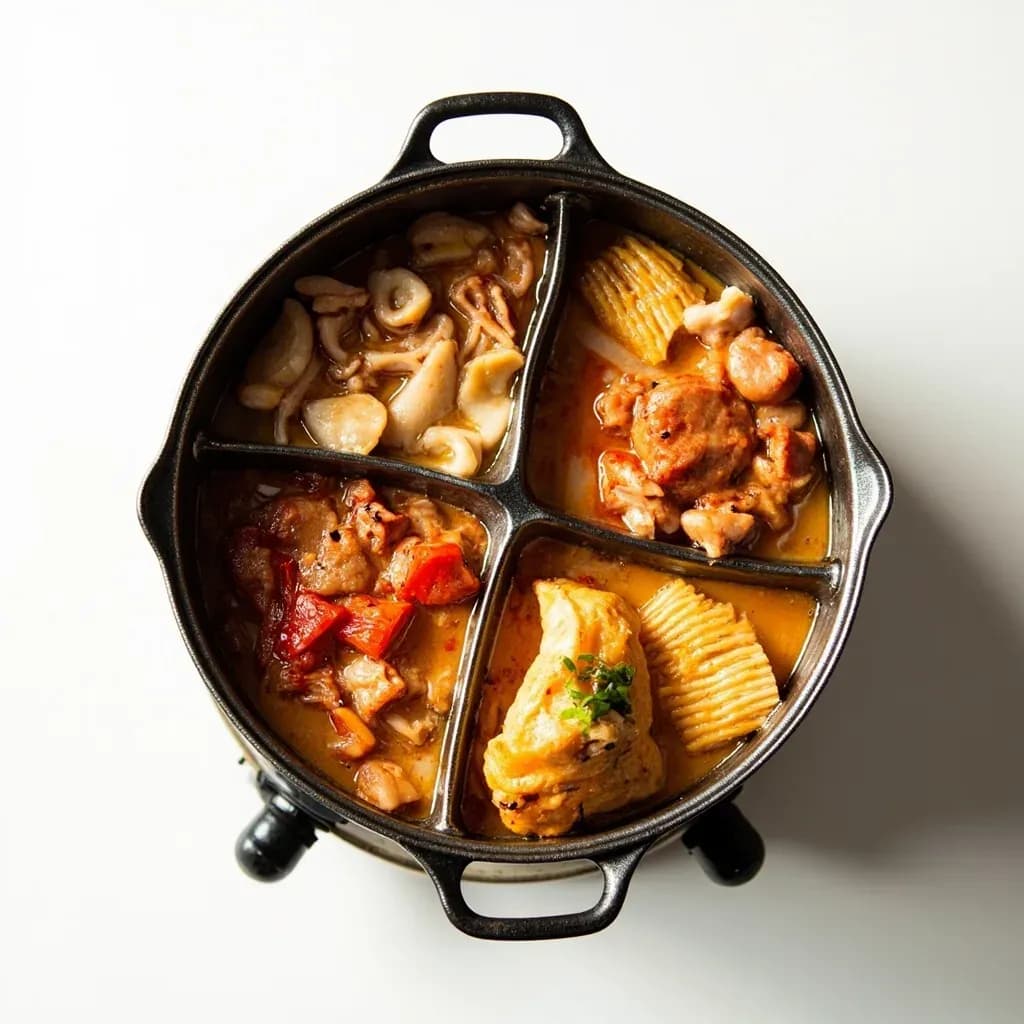
Tabletop pot of simmering broth for cooking ingredients communally at the table.
A hot pot vessel is a wide pot of simmering, seasoned broth kept hot on a tabletop burner so diners cook thin meats, seafood, and vegetables in it as they eat. Divided models hold two broths at once, such as a mild and a spicy side. Set over its own heat source, it keeps the liquid at a steady simmer throughout the meal.
The hot pot vessel is the heart of one of the world's oldest communal cooking formats: a tabletop pot kept at a gentle simmer while diners cook thin-sliced ingredients directly in the broth. Unlike a stockpot on the back burner, a hot pot vessel is sized for the table, designed to be reached from multiple seats, and built to hold a steady low simmer rather than a rolling boil. Its job is twofold — to cook food quickly through contact with hot liquid, and to serve as the social and visual anchor of the meal.
What separates one hot pot vessel from another comes down to three things: material (which dictates heat retention, reactivity, and care), whether it is divided (so two broths can run side by side), and which heat source it accepts — gas, induction, charcoal, or a built-in electric element. A copper chimney pot heated by charcoal behaves very differently from a glazed clay donabe on a gas ring, even though both will simmer your dinner at the table.
For cooks setting up a hot pot at home, the practical question is usually not "what's traditional" but what fits the burner, the group, and the tolerance for cleanup. A 4-liter divided stainless pot on a portable induction plate is the most forgiving all-rounder; a charcoal copper pot is a centerpiece, not a weeknight tool.
Alternatives
Types & varieties
Divided pot with two chambers allowing two broths at once — typically one mild, one spicy/mala. Originated in Hong Kong and Sichuan, and now the most popular format for mixed groups.
Tall cylindrical copper or brass vessel with a central flue/chimney for charcoal heating. Traditional, decorative, and a direct descendant of early nomadic cookers.
Usually a divided, often nine-grid pot designed for an intensely spicy, numbing oil-based broth. Most commonly stainless or iron.
Shallower stainless or clay pot, often with a clear, light broth that emphasizes seafood and seasonal greens.
Glazed earthenware nabe that retains heat gently; the traditional vessel for sukiyaki, yudofu, and shabu-shabu. Requires gradual heating to avoid cracking.
Shallow, flat cast-iron pan, often black or enameled, used for the sweet soy-broth simmer-and-dip style of cooking.
Wide, shallow stoneware or cast-iron vessel for stew-style hot pots cooked at the table; jeongol often arrives partially assembled and finishes simmering at the burner.
Clay or cast-iron pot, often lidded and chimney-shaped, set over a charcoal ring; Jim Jum is the Thai-Chinese cook-and-dip tradition, frequently paired with a Tom Yum-style broth.
All-in-one pot with a built-in heating element; convenient for dorms or single diners, but with limited heat output and a tendency to scorch.
Small personal glazed clay pot used for one-person hot pots in Cantonese, Yunnan, and Korean home cooking.
Choosing the right vessel
Match the pot to your burner and your group before you worry about tradition.
- For groups of 4+ with mixed spice tolerance, choose a divided yuan-yang pot, ideally 32–36 cm across and 4–5 L capacity.
- For solo or couple use, a 1.5–2 L donabe or shāguō gives the best heat retention and presentation.
- For an authentic Mongolian centerpiece, a charcoal-fired copper pot with a chimney works beautifully but needs a charcoal base, longer preheating, and good ventilation.
- For apartment or office use, an induction-compatible stainless pot on a portable induction plate is the safest and cleanest option.
- For travel, dorms, or shabu-shabu at a small table, an electric hot pot is self-contained but runs hot continuously and may scorch delicate broths.
Setup at the table
A few minutes of setup prevents most hot pot mishaps — boil-overs, scorched broth, and unstable burners.
- Place the burner on a trivet or heat-resistant mat; never directly on a wooden or laminate table.
- Center the pot so all diners can reach it and so the heat source is stable and level.
- Position sauces, raw plates, and a 'landing' plate (for cooked items) within reach of every seat.
- Keep a ladle and a small pot of simmering broth nearby for topping up between rounds.
- Cover raw proteins waiting to go in — they should not sit at room temperature for long.
Regional differences worth knowing
The vessel and the broth are tuned to each other; what you cook in the pot is shaped by both.
- Sichuan / Chongqing: heavy mala oil broth, divided pot common, lots of tripe, beef, duck blood, and luncheon meat.
- Mongolian: clear or herb broth, emphasis on lamb, traditionally charcoal in a tall copper pot.
- Cantonese: light clear broth, fresh seafood and leafy greens, often individual casseroles at family meals.
- Yunnan: wild mushroom and chicken broth, mixed wild greens; sometimes paired with a tabletop grill.
- Japanese shabu-shabu: very light kombu broth, paper-thin wagyu or pork, ponzu and goma-dare dipping sauces.
- Japanese sukiyaki: shallow cast-iron pan, sweet soy-warishita broth, ingredients cooked then dipped in raw beaten egg.
Care and longevity
Hot pot vessels are generally long-lived, but each material has one habit that will shorten its life if ignored.
- Cast iron and carbon steel: dry immediately after washing, rub a thin coat of oil, store in a dry place.
- Copper: polish occasionally to maintain shine; tin-lined interiors should not be scrubbed with abrasives.
- Donabe: never heat empty, never quench hot with cold water; air-dry with the lid off to prevent mold in the glaze.
- Stainless steel: the most forgiving — dishwasher safe, but avoid prolonged contact with salt or acidic broths to prevent pitting.
- Charcoal copper pots: empty ash fully after each use and store the chimney and base separately to prevent scratches.
Common uses
Tips & pitfalls
- Bring the broth to a proper simmer at the stove before transferring to the table — starting cold at the table wastes fuel and dilutes flavor.
- Keep the heat at a gentle simmer, not a rolling boil: vigorous boiling foams the broth, toughens proteins, and splatters oil in mala pots.
- Slice proteins and vegetables no thicker than 2–3 mm so they cook in 10–30 seconds; thicker cuts cool the broth and overcook unevenly.
- Use two sets of chopsticks or spoons — one for raw ingredients and one for eating — to avoid cross-contamination.
- Top up the pot with hot water or pre-made broth, not cold, to maintain the simmer and the seasoning balance.
- Skim foam and oil globules with a fine-mesh skimmer between rounds; this keeps the broth clean and the flavor clear.
- For divided pots, stir each side occasionally to keep spices suspended and prevent the mild broth from over-reducing.
- Pre-arrange ingredients in cooking order: vegetables and aromatics first, then seafood, then meats, then noodles last to soak up the broth.
- Don't overfill — cap the broth at about two-thirds full so ingredients have room without boil-over.
- Use wooden or bamboo cooking utensils on clay or non-stick vessels to avoid scratching.
Good to know
- Category
- Cookware / tabletop cooking vessel
- Primary function
- Simmering broth in which diners cook raw ingredients at the table
- Typical materials
- Cast iron, stainless steel, copper, brass, aluminum, glazed clay/earthenware (donabe, shāguō)
- Common sizes
- 1.5 L (personal) up to 6–7 L (8+ diners); 26–40 cm diameter for round pots
- Heat sources
- Butane portable stove, induction plate, electric hot pot, canned heat (Sterno), charcoal (traditional copper pots with chimney)
- Fill level
- Filled roughly two-thirds full to leave room for ingredients without overflow
- Ideal simmer
- Gentle, not a rolling boil — typically 85–95 °C (185–205 °F)
- Cost range
- Basic divided stainless ~$30–60; donabe ~$60–150; traditional copper charcoal hot pot ~$100–300+
Also called
hot-pot-vessel · hot-pot · divided-hot-pot · hot-pot-burner · Hotpot · Shabu Pot
Related

Steamer
Gentle moist heat that keeps vegetables, fish, and dumplings tender

Frying Pan
Shallow sloped pan for frying, sautéing, and quick sears

Saucepan
Tall, straight-sided pot for sauces, grains, and small batches

Sauté Pan
Wide straight-sided pan with room to brown and braise

Dutch Oven
Heavy lidded pot that turns tough cuts tender over hours

Stock Pot
Tall, roomy pot for stocks, pasta, and big-batch cooking

Wok
High-sided bowl pan built for blistering-hot stir-fries

Griddle
Flat, broad surface for pancakes, smash burgers, and breakfast