Cookware
Idli Steamer
A pot and stacked perforated trays that steam fermented batter into soft round idli cakes.
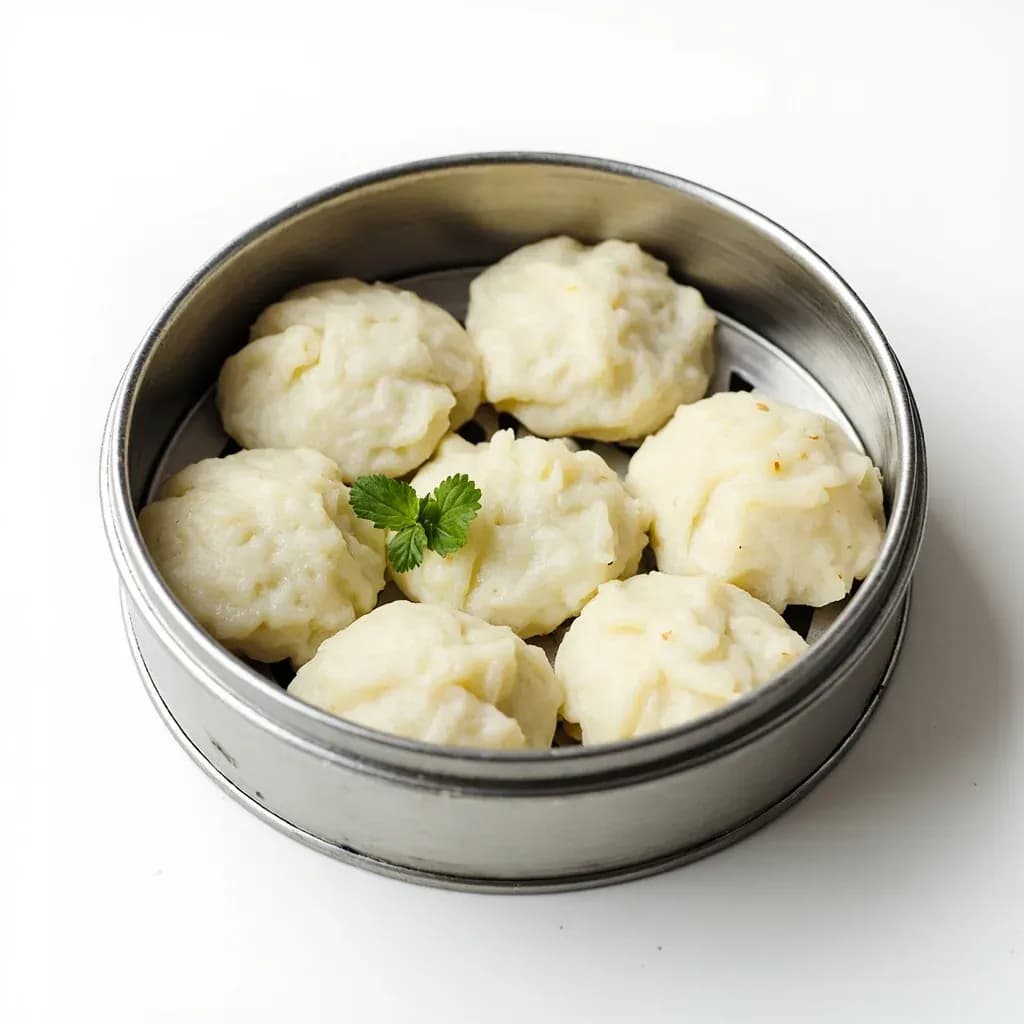
An idli steamer is a lidded pot holding stacked trays of shallow round molds in which fermented rice-and-lentil batter is steamed into fluffy idli. Water boils below and steam rises through the perforated stand to cook several batches at once. Stovetop and electric versions exist, and the same trays often work inside a pressure cooker without the weight.
An idli steamer is a specialized tiered steaming vessel designed to turn fermented rice-lentil batter into the soft, spongy round cakes that anchor a South Indian breakfast. At its heart, it pairs a deep base pot with three or four shallow, perforated plates, each plate pressed with a grid of concave circular wells that give idlis their signature flat-bottomed, domed shape. The wells matter: batter poured loose onto a flat plate spreads and runs; in the well, it sets in a tidy disc that lifts out cleanly. Steam from boiling water in the base rises through the plate perforations, cooking the idlis from below while the domed lid traps moisture from above, so the cakes rise evenly without drying out.
The tool has co-evolved with idli itself, attested in Tamil literature as far back as the 10th–12th centuries, and its design reflects centuries of refinement. A standard household model holds 16 to 24 idlis per batch across four plates, while commercial and wedding steamers scale up to 50 or more by widening the plate diameter and adding tiers. Because the batter is leavened naturally by fermentation, the steamer's job is gentle, even heat: a sustained rolling boil, a tightly fitting lid, and a vessel that doesn't run dry partway up the stack. Get those three things right and a beginner can pull out perfect idlis on the first try.
Modern stainless-steel versions are the default for good reason: they're durable, non-reactive, induction-friendly, and indifferent to long contact with slightly acidic fermented batter. Traditional brass and copper models, often tinned inside, are prized heirlooms in Tamil and Kerala kitchens, while aluminum and non-stick options remain common. The dedicated steamer isn't the only way to cook idlis — a pressure cooker with a perforated idli stand works on the same principle, and a deep pot with a trivet and a foil-covered plate can stand in for a one-off batch — but for anyone making idlis more than a few times a year, the stackable, well-shaped plates make the work faster, the results more uniform, and the cleanup easier.
Alternatives
Types & varieties
The modern default; durable, non-reactive, induction-compatible, and inexpensive. Usually 3–4 plates.
Lightweight and a good heat conductor, but reacts with acidic batters over time and can discolor.
Heirloom Tamil and Kerala pieces, often tinned on the inside; prized for even heat and traditional flavor but require more care.
Coated plates that release idlis easily; the coating degrades with metal scrubbers and high dry heat.
A perforated stainless insert (single or 2–3 tier) that sits inside a domestic pressure cooker; the most common household substitute for a dedicated steamer.
Countertop plug-in appliance with a timer; useful for dorms, offices, and kitchens without a gas stove.
Smaller-diameter plates with more, shallower molds (often 9–12 per plate) for bite-size idlis used in chaats and sambar-idli.
Large-diameter (14–18 inch) multi-tier units built for volume service; typically aluminum or heavy-gauge steel.
Choosing a steamer that will last
The market is full of featherweight steamers that warp after a year on a gas flame. A few details separate a tool that becomes a daily fixture from one that ends up in a back cupboard.
- Look for a heavy-gauge base — 3 mm or thicker on stainless steel — to resist warping over a gas burner.
- Check that the plates sit level on the base rim and stack without rocking; a wobbly stack lets steam escape at the seams.
- For induction, confirm a flat ferromagnetic base; traditional kadai-style steamers often have a rounded bottom that needs an induction adapter disc.
- Inspect the perforations: they should be small enough to prevent batter drips but numerous enough to let steam rise freely through every well.
- Confirm the handles are solidly riveted and shaped so you can lift a fully loaded stack confidently with a kitchen towel at peak steam.
Common uses
Tips & pitfalls
- Grease every plate thoroughly with sesame oil or ghee before pouring batter — even non-stick plates benefit, and it prevents tearing when lifting idlis out.
- Fill each mold only about three-quarters full; the batter expands as it steams, and overfilled wells overflow, fusing idlis to the plate rims.
- Bring the water in the base to a full rolling boil before stacking the loaded plates — starting cold lengthens the cook and can leave idlis dense at the center.
- Keep the lid slightly ajar for the first 30–60 seconds to let steam establish evenly, then close it for the remainder; the brief vent helps prevent sunken tops and a cold, dense first layer.
- Resist the urge to peek: every lid lift drops the temperature inside and can collapse the rising batter, leaving idlis with a dimpled, sticky surface.
- Wipe condensation off the inside of the lid between batches; droplets dripping back onto rising idlis leave craters on top.
- Test doneness by inserting a toothpick into the thickest idli (it should come out clean) or by pressing the surface — it should spring back without sticking.
- Let the plates rest 1–2 minutes after removing from the pot; idlis firm up as they cool and release much more cleanly.
- Loosen each idli with a flat spoon or butter knife dipped in water — the water, not the force, is what releases the cake cleanly.
- Common mistake: stacking more tiers than the burner can sustain a rolling boil under. If the pot simmers dry, the bottom plates scorch and the top tier stays undercooked — either use a wider base or split the batch into two rounds.
- Common mistake: folding in salt, baking soda, or fruit salt (eno) and then letting the batter sit. Once leavened, the batter must be steamed within minutes or the rise is lost.
- Storage: dry all parts thoroughly before stacking to prevent musty odor or rust at the joints; nest plates with a thin cloth between them to prevent scratches.
Good to know
- Origin
- South India; evolved alongside idli, with the dish attested in Tamil literature from at least the 10th–12th centuries.
- Primary material
- Stainless steel (modern standard); traditionally brass, copper, or aluminum in Indian households.
- Typical configuration
- A deep cylindrical base pot with 3–4 stacked perforated idli plates and a domed lid; 5- and 6-tier versions exist for large batches.
- Plate dimensions
- Standard household plates are about 10–11 inches (25–28 cm) across; mini idli plates run 7–8 inches with more, shallower molds.
- Capacity
- Molds per plate (usually 4–7) multiplied by number of plates; a 4-tier standard steamer holds 16–24 idlis per batch.
- Steaming time
- 10–15 minutes on a rolling boil for standard idlis; 7–9 minutes for mini idlis.
- Water level
- About 1–1.5 inches (2.5–4 cm) in the base, kept below the lowest plate to prevent boil-over and soggy idlis.
- Compatible cooktops
- Gas, electric coil, and induction (flat-bottom models only); dedicated electric idli cookers are a parallel category.
- Cleaning
- Hand-wash with warm soapy water; stainless steel is generally dishwasher-safe. Avoid steel wool on aluminum to prevent oxidation and discoloration.
Also called
Idli Cooker · Idli Maker · Idli Stand
Related

Steamer
Gentle moist heat that keeps vegetables, fish, and dumplings tender

Frying Pan
Shallow sloped pan for frying, sautéing, and quick sears

Saucepan
Tall, straight-sided pot for sauces, grains, and small batches

Sauté Pan
Wide straight-sided pan with room to brown and braise

Dutch Oven
Heavy lidded pot that turns tough cuts tender over hours

Stock Pot
Tall, roomy pot for stocks, pasta, and big-batch cooking

Wok
High-sided bowl pan built for blistering-hot stir-fries

Griddle
Flat, broad surface for pancakes, smash burgers, and breakfast