Cookware
Cast-Iron Jambalaya Pot
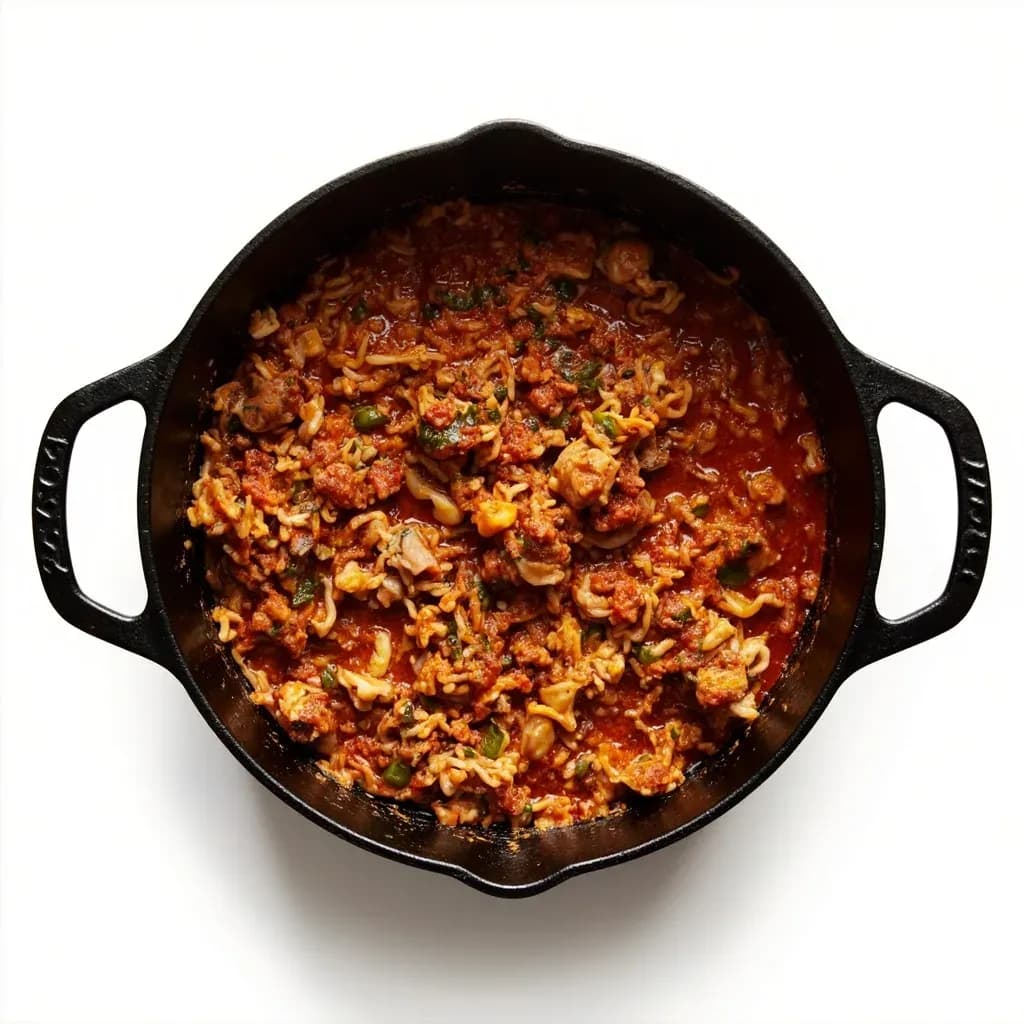
A large heavy cast-iron pot for cooking big batches of jambalaya and Cajun rice dishes.
A jambalaya pot is a wide, deep cast-iron or cast-aluminum pot, often used with a tall propane burner, to cook large quantities of jambalaya, gumbo, and stews for crowds. The heavy bottom spreads heat evenly so the rice and meat cook without scorching while a long paddle stirs the mass. It is a staple of Louisiana outdoor cooking and community gatherings.
A cast-iron jambalaya pot is a wide, flat-bottomed, heavy-walled pot built for the one-pot rice dishes of Louisiana — jambalaya, étouffée, gumbo, red beans, and the rest of the Cajun and Creole canon. Its defining virtue is mass: a 14- to 20-quart model weighs 15 to 30 pounds, and that thermal inertia is exactly what rice absorption cooking requires. Stock comes to a boil, rice goes in, and the heat holds steady through the long, slow simmer without the hot spots that scorch a thin layer of rice on the bottom of a lighter pot. The flat base is sized to sit securely over the single ring of an outdoor propane burner — the 50,000- to 100,000-BTU 'patio cooker' or 'turkey fryer' stand that is the de facto Louisiana outdoor kitchen.
The form factor is what separates it from a Dutch oven. A Dutch oven is taller for its diameter, often enameled, and built around oven braising. A jambalaya pot is wider and shallower relative to its diameter, with a flat (not rounded) bottom, two loop or bail handles, and frequently a domed lid cut with a notch that accepts a long stirring paddle. That wider footprint gives more surface area for browning the trinity (onion, bell pepper, celery) and the meat before the rice goes in — a step that matters more in jambalaya than most cooks realize. Bayou Classic, founded in the Cajun country of south Louisiana, popularized the modern shape and remains the standard maker.
In practice, the same pot pulls duty as a stockpot, a fryer, and a seafood-boil kettle. Crawfish boils, shrimp boils, and whole-turkey deep-frying all use it with a perforated basket and a thermometer. Most owners use it outdoors on a high-BTU propane stand, but 10- and 12-quart models work comfortably on a home range for weeknight batches.
Alternatives
Types & varieties
The most common form: a wide round body with a flat bottom and two side handles. Home sizes run 10–20 qt; commercial and boil sizes go to 40 qt.
Bayou Classic's signature shape. The oval base straddles a single-burner stand more securely and gives a wider surface for browning the trinity and proteins.
Built with a pour spout on the rim for ladling off stock or draining liquid without a separate strainer.
The lid is cut with a slot that admits a long paddle, so you can stir during the slow rice-absorption phase without lifting the lid and losing heat and steam.
Sold as a set with a perforated basket and stand. Functions identically as a jambalaya pot but doubles as a crawfish-, shrimp-, or crab-boil kettle and a turkey fryer.
Smaller makers produce one-off hand-poured pots in the 6–10 qt range for home stoves. Rarer, pricier, and prized by cooks who want a smaller, stove-friendly vessel.
Indoor stove vs. outdoor burner
Most cooks first meet a jambalaya pot at a crawfish boil or a backyard tailgate, but the smaller sizes work well on a home range. The trade-offs are real:
- 10–14 qt is the practical ceiling for indoor stovetop use. Larger pots heat slowly, weigh too much to lift safely, and may not seat on a standard grate.
- On a propane patio burner (50,000–100,000 BTU), the same pot reaches deep-fry temperatures in minutes. Always keep the lid closed when not stirring to suppress flare-ups from rendered fat or oil.
- Never leave an outdoor burner unattended. A boil-over of 350°F oil onto an open flame is a serious fire hazard — fill no more than two-thirds full for rice dishes, and well below that for frying.
- A long flat wooden paddle (a dedicated 'jambalaya stirrer' or a boat paddle) is the right tool; it scrapes the rice layer off the bottom and prevents scorching, something a spoon cannot do.
Seasoning and long-term care
The pot arrives with a thin factory seasoning that benefits from reinforcement, and once you build a good patina it is nearly indestructible. A few habits make the difference:
- Before first use, wipe a thin coat of oil inside and out, place it upside-down at 250°F / 120°C for an hour, and repeat two or three times.
- After every wash, set it on a lit burner for a minute to drive off all moisture, then wipe a thin film of oil inside while still warm. This single habit prevents 90 percent of rust problems.
- If rust does appear, scrub with coarse salt and a little oil and re-season. Do not discard the pot — cast iron survives almost anything.
- Avoid long acidic cooks (heavy tomato, wine-heavy sauces) in a freshly seasoned pot; acid strips the patina. Build up the seasoning over many uses first, or keep acidic finishing steps short — under 20 to 30 minutes of simmer.
Common uses
Tips & pitfalls
- Never subject a cold pot to a hot burner (or vice versa). Cast iron cracks under thermal shock — preheat gradually over medium heat for several minutes before adding food or raising the flame.
- Do not fill past two-thirds when making jambalaya. Rice roughly doubles in volume, and a boil-over on an outdoor propane burner is a real fire hazard.
- Use a long flat paddle rather than a spoon. A spoon cannot scrape the rice layer off the bottom; a paddle can, and that single habit prevents the scorched bottom that ruins most beginner batches.
- Skip the dishwasher and never soak. Standing water pools in the pores of the iron and produces flash rust within hours.
- For stubborn carbon and outdoor soot, use a chain-mail scrubber or coarse salt with a little oil. Reserve dish soap for when the seasoning is already compromised — routine use strips the patina over time.
- Choose a 14- to 16-quart oval-bottom model with a notched lid as a first pot if you plan to use it outdoors. The oval shape straddles a single-burner stand more securely than a round pot of the same capacity, and the notched lid is a real advantage during the long absorption phase.
- If you only have a round-bottomed cast-iron piece (a wok or karahi), it is a different tool. The jambalaya pot is specifically flat-bottomed and sized for a propane ring.
Good to know
- Category
- Cast-iron cookware
- Origin
- Louisiana (Cajun and Creole cooking tradition)
- Material
- Cast iron, typically pre-seasoned with a thin vegetable-oil coat
- Typical sizes
- 10, 12, 14, 16, 20, 24, 30, and 40 quarts
- Weight (14–20 qt)
- Roughly 15–30 lb (7–14 kg)
- Heat sources
- Gas stovetop, outdoor propane burner (50,000–100,000 BTU), oven, campfire
- Leading maker
- Bayou Classic (also Lodge, Camp Chef, Cabela's, Bayou Cookware)
- Approximate price
- $60–$200 depending on size and brand
- Care
- Hand wash, dry on heat, oil lightly; never soak or dishwasher
Also called
cast-iron jambalaya pot · Cajun cooking pot · outdoor stew pot
Related

Steamer
Gentle moist heat that keeps vegetables, fish, and dumplings tender

Frying Pan
Shallow sloped pan for frying, sautéing, and quick sears

Saucepan
Tall, straight-sided pot for sauces, grains, and small batches

Sauté Pan
Wide straight-sided pan with room to brown and braise

Dutch Oven
Heavy lidded pot that turns tough cuts tender over hours

Stock Pot
Tall, roomy pot for stocks, pasta, and big-batch cooking

Wok
High-sided bowl pan built for blistering-hot stir-fries

Griddle
Flat, broad surface for pancakes, smash burgers, and breakfast