Cookware
Kadai / Karahi (Indian Wok)
Deep, round-bottomed Indian pan for deep-frying, sauteing, and karahi curries.
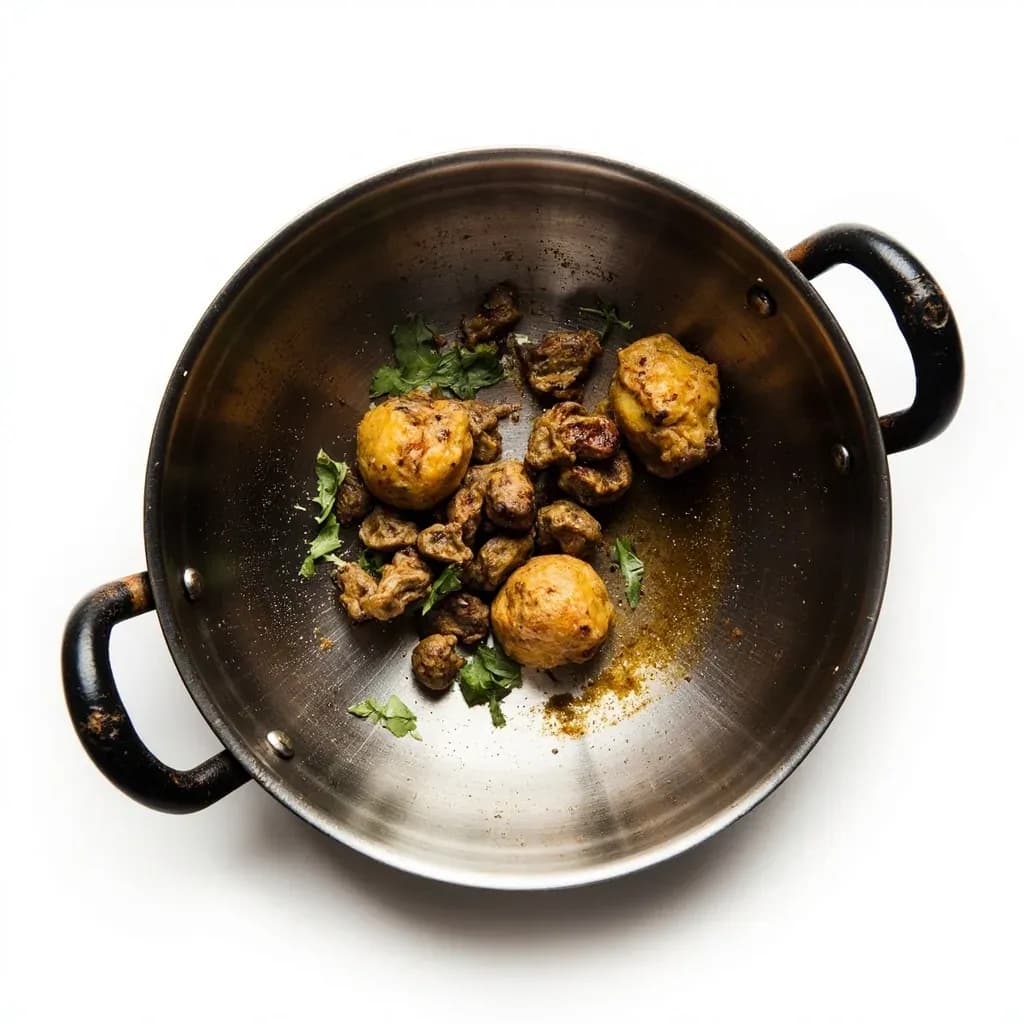
A kadai (also karahi) is a deep, round-bottomed pan with two handles, used across South Asia for deep-frying, tempering spices, sauteing, and cooking the namesake karahi-style curries. Its concave shape concentrates heat at the base and uses oil efficiently, much like a wok. Traditionally cast iron or carbon steel, it is also made in stainless steel and nonstick.
The kadai (also spelled karahi, kadahi, kadhai, or kadai) is the deep, round-bottomed pan that anchors everyday cooking across India, Pakistan, Bangladesh, and Nepal. Shaped like a wide bowl with steeply sloped sides and two riveted loop handles, it resembles a Chinese wok but with a fuller, more bowl-like curve. Cast iron is the traditional material and still the one most home cooks reach for; its heat retention and the dark, well-seasoned surface it develops are central to the pan's character.
What defines the kadai is how it behaves over fire. The deep base concentrates heat under a small pile of food, the sloping sides let a cook toss and turn ingredients with a flick of the wrist, and the high walls contain splashing oil during the hard, fast sears behind dishes like chicken karahi, mutton karahi, kadai paneer, and kadai chicken — all of which take their name from the pan. The same vessel doubles as a deep-fryer for pakoras, bondas, and pooris, and as a tempering bowl for whole spices bloomed in ghee. Restaurants often bring the kadai to the table still bubbling, which is why traditional iron versions stay dangerously hot long after the burner is off.
A round-bottomed kadai is unstable on a flat Western cooktop, so most modern home versions are pressed with a flat base that sits securely on electric, ceramic, or induction hobs. Carbon steel has become a popular lighter alternative; stainless steel and hard-anodized aluminum are easier to live with but lack the searing response of seasoned iron. Choosing among them is largely a question of stove type, how much weight you can manage one-handed, and how much seasoning care you are willing to take on.
Alternatives
Types & varieties
Traditional choice; excellent heat retention and searing, requires seasoning and rust care
Lighter than cast iron, heats faster, also needs seasoning — the closest analog to a Chinese wok
Low maintenance, no seasoning required; poorer heat retention and a stickier surface than iron
Easy food release for eggs and delicate dishes; cannot handle the very high heats a seasoned iron kadai tolerates
Excellent heat conductivity; usually tin- or stainless-lined, decorative and expensive
Modern adaptation that sits directly on Western electric, ceramic, or induction hobs without a wok ring
Authentic traditional form; needs a wok ring or a fitted Indian-stove cutout to sit stably
Hand-forged from thin sheet iron; lightweight with a textured surface, common in Andhra Pradesh and parts of South India
Wok-shaped with two flat riveted handles; widely associated with British-Pakistani restaurant cooking, where the vessel is often called simply a balti pan
Kadai, wok, balti, handi: telling them apart
The four pans look superficially similar and are routinely confused in cookbooks and kitchen catalogs, but they cook different things in different ways. Knowing which is which helps you read a recipe correctly and choose the right vessel at the store.
- Wok: shallower and slimmer, with a long wooden or steel handle plus a small helper handle. Built for fast stir-frying of small batches over a roaring flame. A kadai is deeper, heavier, and meant to hold more liquid for curries.
- Balti: thinner metal, two flat riveted handles rather than loops, and a more sharply curved bowl. Closely associated with UK Pakistani restaurant service, where the vessel is often simply called a balti pan; it cooks faster and lighter than a heavy cast iron kadai.
- Handi: a deep pot that narrows toward the top, with a flat or rounded base and a fitted lid, used for slow dum cooking of biryanis and kormas. The handi traps steam; the lidless kadai does not.
Common uses
Tips & pitfalls
- Season a new cast iron or carbon steel kadai before first use: scrub, dry thoroughly on the heat, rub in a thin film of oil, and heat until it just smokes; repeat two or three times for a dark, food-releasing surface.
- Use a wok ring on electric or coil stoves with a round-bottom kadai — without it the pan rocks and transfers heat unevenly, and it is genuinely dangerous on a tilted burner.
- Preheat the kadai fully before adding oil; oil into a cold pan encourages sticking, especially on iron.
- Reach the curved base with a flat-edged wooden or metal spatula; a round ladle leaves a ring of food welded to the bottom.
- Avoid overcrowding when deep-frying — the oil temperature drops, the food turns greasy, and recovery between batches slows to a crawl.
- Never plunge a hot cast iron kadai into cold water; thermal shock can crack the body or strip the seasoning in a single moment of impatience.
- Skip dish soap on a seasoned iron kadai; hot water, a brush, and a scraper are enough. Re-oil lightly after drying on the stove.
- Re-season any kadai that has gone sticky, dull, or rusty: scrub with coarse salt and a little oil, rinse, dry on the heat, and rub in a fresh coat of oil.
- For high-heat stir-frying, gas and induction give the best results; flat-bottom versions transfer heat more evenly than round ones.
- When serving karahi dishes at the table, rest the kadai on a trivet or wooden board — cast iron stays hot for a long time.
Good to know
- Origin
- Indian subcontinent; used across India, Pakistan, Bangladesh, and Nepal
- Traditional material
- Cast iron, with wrought or hand-hammered sheet iron as historical alternatives
- Typical diameter
- 20–40 cm (8–16 in) for home use; 50+ cm in restaurant kitchens
- Typical depth
- 8–15 cm (3–6 in)
- Handles
- Two riveted loop handles on opposite sides; long-handled single-handle versions also exist
- Shape
- Deep circular bowl with steeply sloped sides; traditionally round-bottomed
- Heat tolerance
- Cast iron and carbon steel handle very high heat and are suited to deep-frying and hard searing
- Dishes named after it
- Chicken karahi, mutton karahi, kadai paneer, and kadai chicken
Also called
kadai · karahi · karahi-wok · karai
Related

Steamer
Gentle moist heat that keeps vegetables, fish, and dumplings tender

Frying Pan
Shallow sloped pan for frying, sautéing, and quick sears

Saucepan
Tall, straight-sided pot for sauces, grains, and small batches

Sauté Pan
Wide straight-sided pan with room to brown and braise

Dutch Oven
Heavy lidded pot that turns tough cuts tender over hours

Stock Pot
Tall, roomy pot for stocks, pasta, and big-batch cooking

Wok
High-sided bowl pan built for blistering-hot stir-fries

Griddle
Flat, broad surface for pancakes, smash burgers, and breakfast