Cookware
Kazan (Heavy Pilaf Pot)
Thick-walled Central Asian cauldron for plov, pilaf, and large festive dishes.
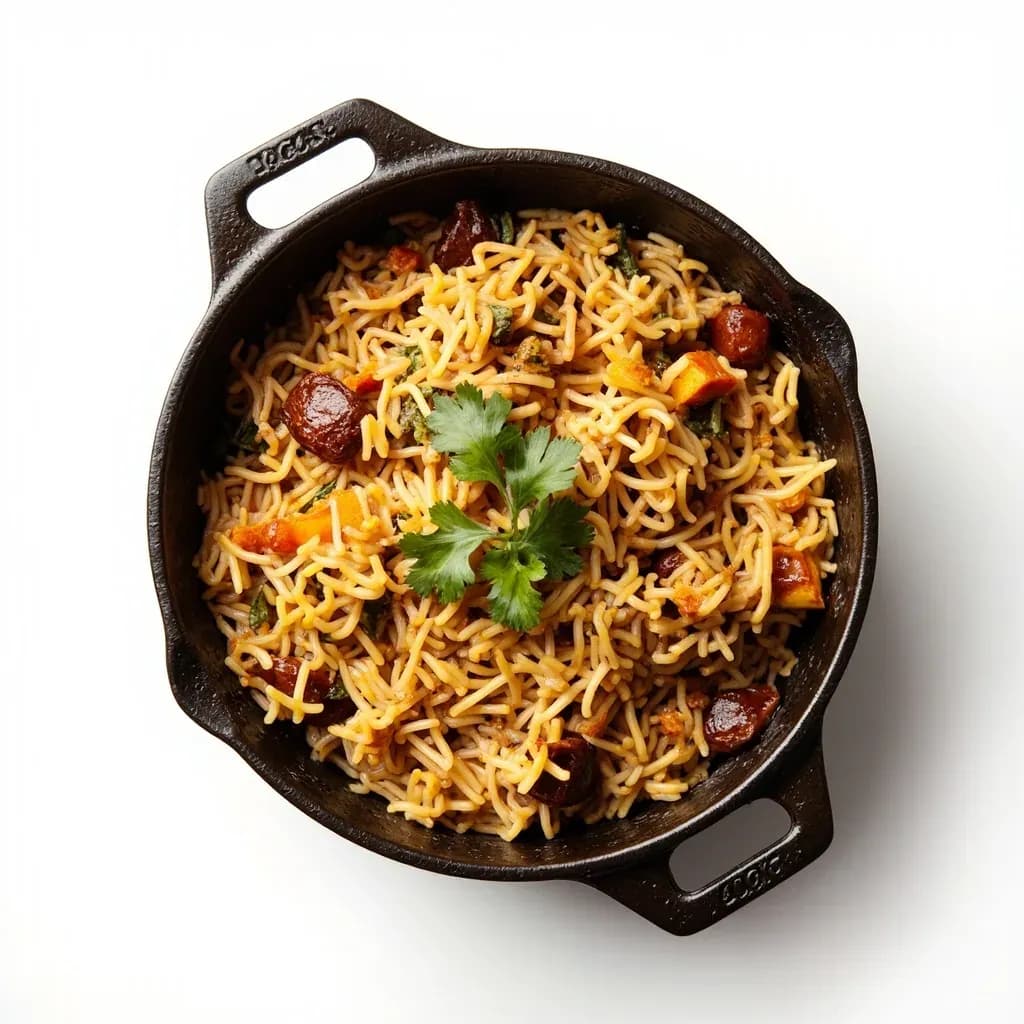
A kazan is a heavy, rounded cauldron from Central Asia and the Caucasus, traditionally cast iron or aluminum, used for cooking plov (pilaf), stews, and large festive meals. Its thick walls and bowl shape distribute heat evenly and are well suited to cooking over an open fire or a dedicated ring burner. The deep form allows rice and meat to steam and crisp together at the base.
A kazan is a thick-walled, heavy cooking pot — most often hemispherical with a round bottom — used across Central Asia for slow-cooked rice dishes, stews, soups, and deep-frying. Its defining feature is the combination of mass and geometry: a cast-iron body 4–8 mm thick stores heat steadily and releases it gently, while the curved walls send hot fat, water vapor, and steam in circulating currents that cook rice evenly from edge to center. The same thickness that makes it ideal for an open wood fire also makes it forgiving when the cook steps away — a kazan resists scorching in a way thin, flat-sided pans cannot.
In practice, the kazan matters most for plov (called osh in Uzbek, palov in Tajik, pilaf in broader use), where the rice is layered over browned meat and vegetables, simmered in stock, and finally steamed dry. The vessel's high sides give room for that layered architecture, and its thermal mass drives the final steaming stage with a consistency a Dutch oven struggles to match. Outside plov, the same pot is the workhorse for lagman, shurpa, dimlama, and ceremonial feeds where a single vessel must serve many.
A well-used kazan — blackened inside, oiled and seasoned across decades — is treated almost as a family heirloom in Uzbekistan, Tajikistan, and Afghanistan, and the cook who commands one (the oshpaz) holds a respected place in the community. The pot, the tripod stand (tuyanchi), the long flat paddle (kepchik), and the skimmer (shoshqak) form a complete kit, and most traditional plov recipes are written with that toolkit assumed.
Alternatives
Types & varieties
Hemispherical, round-bottomed, heavy; the standard for plov, set over a wood fire on a tripod stand.
Shallower walls and a flat base modified for gas or induction ranges; convenient at home, though it loses some convection.
Spun or cast aluminum; lighter, heats quickly, common in restaurants and for outdoor use, but easier to scorch rice if unattended.
Polished copper with tin or steel lining; quick heat response and a handsome finish, but requires more upkeep.
Closely related cauldron with two ring handles, used for kabuli pulao, qorma, and similar festive rice and meat dishes.
Very large (40–100+ L) cast-iron pots suspended over open fires by tripod or chain for cooking dozens of kilograms of rice at once.
Small (1.5–5 L) cast-iron or aluminum pots for home ranges, useful for small-batch plov or heating oil for frying.
How a kazan cooks plov
Plov in a kazan unfolds in three deliberate stages, and the pot's geometry supports each one. The heavy iron holds a stable temperature for the long frying stage, the curved walls redirect condensation back into the rice rather than dripping on the lid, and the mass drives the final steaming with even, sustained heat that flat-sided pots cannot replicate.
- Zhir (frying): meat is seared in rendered fat — usually lamb tail or cottonseed oil — until deeply browned; the kazan's thermal mass keeps oil hot without fluctuation as cold meat goes in.
- Deg (simmer): sliced onions and carrots are softened, then covered with measured water or broth and simmered to build a rich base; the rounded base concentrates the liquid and reduces it evenly.
- Bug'doy (steaming rice): rinsed rice is spread in a layer, broth is absorbed, and the pot is covered or sealed with a heavy lid to finish; the iron's residual heat finishes the grains without stirring, producing the prized golden crust (kazan-kayroq) on the bottom.
Seasoning and care
A new cast-iron kazan arrives gray and needs to be turned into the black, glassy, non-stick vessel that defines a mature plov pot. The process is a one-time burn-in followed by ongoing oiling — never soap, never long soaks, always heat-dry and oil.
- Burn-in: coat the interior thinly with a high-smoke-point oil (cottonseed, sunflower, or clarified butter), set over an open flame or in a 250 °C / 480 °F oven, and heat until smoking; repeat 3–5 times until the inside is uniformly matte black.
- Cleaning: rinse with hot water and scrub with a stiff brush, wooden scraper, or coarse salt; avoid dish soap and steel wool, which strip the patina.
- Drying: place over low heat until all moisture evaporates, then rub a thin film of oil inside while still warm to prevent flash rust.
- Storage: keep in a dry place; if stacking, slip a paper towel inside to absorb humidity and stop the lid from sealing shut.
Choosing between a kazan and a Dutch oven
A wide, heavy Dutch oven is the closest practical substitute on a Western stovetop and will produce good pilaf, but it changes the cooking in subtle ways. Cooks who switch back and forth usually notice the difference most in the crust and the rice texture.
- Walls: a kazan's curved sides push convection currents upward and inward; a Dutch oven's straight sides let steam condense and drip back, which can wet the top layer of rice.
- Crust: the kazan-kayroq that forms at the base of a kazan is drier and more distinct; a Dutch oven tends to produce a softer, more uniform bottom layer.
- Heat source: a round-bottomed kazan needs a tripod, ring, or dedicated kazan burner for stability; a Dutch oven sits flat and tolerates any home range.
Common uses
Tips & pitfalls
- Season a new cast-iron kazan by rubbing it with a high-smoke-point oil and heating it until smoking, repeating three to five times — and never wash it with soap, only hot water, a stiff brush, or coarse salt.
- Warm the kazan gradually before adding food; thermal shock from cold ingredients or sudden flame changes can crack cast iron, especially in older or thinner pieces.
- Use a round-bottomed kazan on a tuyanchi (tripod) over a wood fire for the most even heat and the most authentic kazan-kayroq crust; on a flat stovetop, set it on a heavy heat-diffuser ring to stabilize it and reduce hot spots.
- For plov, layer in the correct order — rendered fat, browned meat, onions, carrots in roughly equal weight to the meat, then broth, then rice — and stir only with a flat-bottomed kepchik or chopstick, scraping in a single direction to keep grains intact.
- Do not fill a kazan more than two-thirds full: hot oil splatters dangerously, and rice needs headroom to steam; overfilling is the most common cause of uneven plov.
- Skip metal scouring pads when cleaning; a wooden scraper or coarse-salt scrub handles stuck-on rice crusts without stripping the seasoning that gives the pot its non-stick quality.
- After every wash, dry the kazan over low heat and rub a thin film of oil inside to prevent rust, particularly in humid climates.
- If you cook more than plov, consider keeping a dedicated kazan for rice: residual flavors from strongly spiced stews or fried foods can transfer and mute the clean taste of pilaf.
Good to know
- Origin
- Central Asia; the word 'kazan' means 'cauldron' in Turkic and Persian languages and is used across Uzbek, Tajik, Kyrgyz, Kazakh, Afghan, and wider Turkic cuisines.
- Traditional material
- Cast iron, valued for slow, even heat retention and tolerance of open-flame temperatures.
- Modern materials
- Sand-cast or spun aluminum (lighter, faster-heating), copper (usually tinned or steel-lined), and carbon steel.
- Shape
- Hemispherical with a round bottom in the traditional form; flat-bottomed variants exist for stovetop use.
- Capacity range
- Typically 5–40 L; home kazans 8–15 L are common, while feast and wedding kazans run 20–50 L or more.
- Wall thickness
- Cast-iron walls are usually 4–8 mm, which distributes heat and resists scorching during long rice steaming.
- Heat source
- Traditionally wood or charcoal on a tripod stand; modern gas burners and dedicated kazan stoves (kazangas) are also used.
- Pre-cooking treatment
- Cast iron is seasoned by burning oil inside until a black patina forms, which protects the metal and builds non-stick properties.
Also called
kazan · pilaf-pot · polo-pot · rice-pot · qidr
Related

Steamer
Gentle moist heat that keeps vegetables, fish, and dumplings tender

Frying Pan
Shallow sloped pan for frying, sautéing, and quick sears

Saucepan
Tall, straight-sided pot for sauces, grains, and small batches

Sauté Pan
Wide straight-sided pan with room to brown and braise

Dutch Oven
Heavy lidded pot that turns tough cuts tender over hours

Stock Pot
Tall, roomy pot for stocks, pasta, and big-batch cooking

Wok
High-sided bowl pan built for blistering-hot stir-fries

Griddle
Flat, broad surface for pancakes, smash burgers, and breakfast