Cookware
Keg (Cornelius / Sanke)
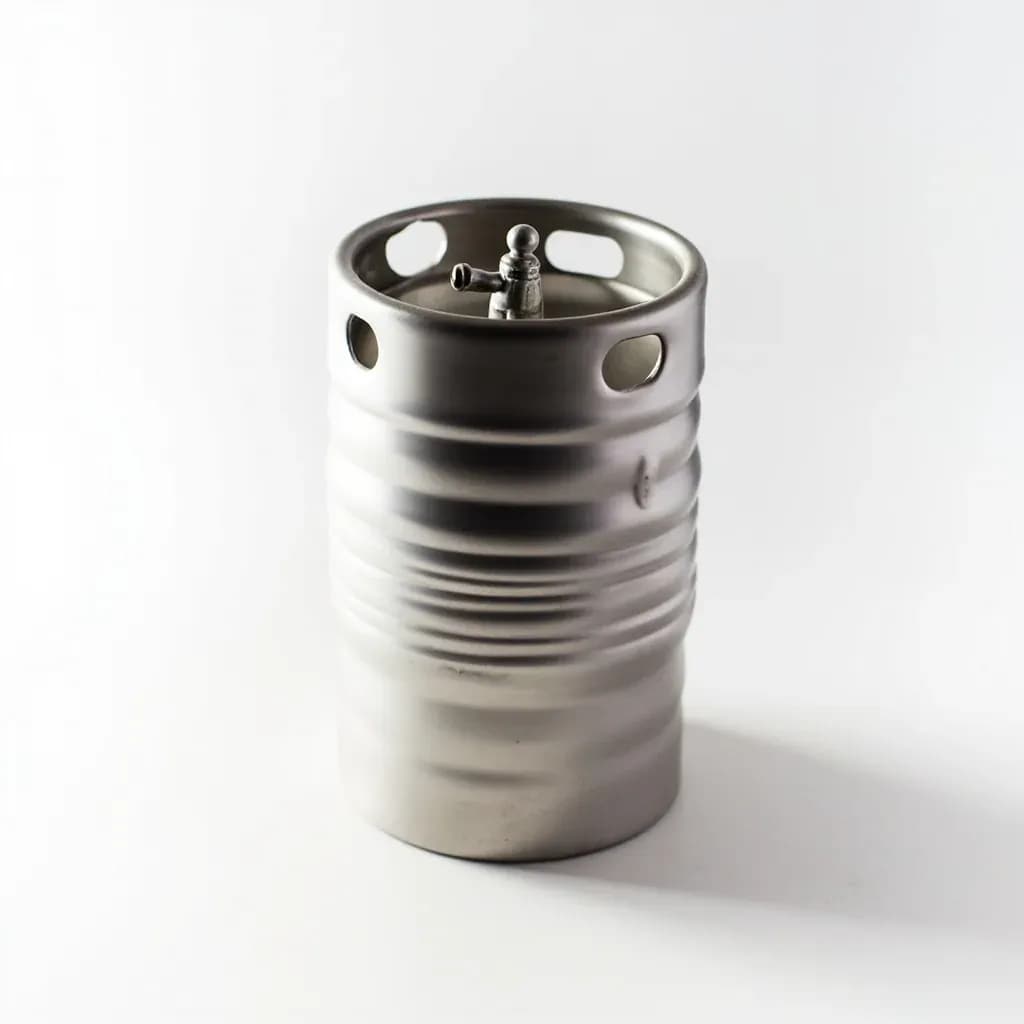
A pressurized stainless vessel for storing and dispensing beer, cold brew and carbonated drinks.
A keg is a sealed stainless steel container that holds beer, cold brew coffee, kombucha or carbonated water under CO2 pressure for tap dispensing. Cornelius (corny) kegs use ball or pin lock posts and suit homebrewers, while Sanke kegs use a single coupler valve for commercial beer. Force-carbonation and serving both run off the same gas line.
A keg is a pressurized stainless-steel vessel built to hold a carbonated liquid under gas pressure and dispense it on demand through a tap. Two families dominate working kitchens and bars: the Cornelius ("Corny")—a 5-gallon soda-syrup canister originally designed by IMI Cornelius for post-mix service, adopted by homebrewers in the late 1970s/early 1980s and then by the cold-brew and craft-cocktail world—and the Sanke, the industry-standard commercial beer keg (full-size ½ barrel, plus ¼ and ⅙ formats) that arrives full from a distributor and is leased as a shipping container.
In a kitchen context, the keg earns its place less for beer than for everything else that goes on tap: cold-brew coffee, nitro coffee, kombucha, hard seltzer, wine, and pre-batched carbonated cocktails. A kegged system keeps oxygen out of the product, delivers perfectly measured pours at high volume, and replaces dozens of bottles or cans with a single line. Modern draft systems also let a chef control carbonation level by regulating pressure and temperature—something no bottle or can offers.
Mechanically, the keg holds dissolved CO₂ in equilibrium with headspace gas at the dispense pressure (typically 10–12 PSI for most beers, higher for sparkling water and cold brew). Temperature is the controlling variable: at 38°F (3°C), beer holds roughly 2.5 volumes of CO₂; at 50°F (10°C), much of that CO₂ bursts out as foam on the way to the glass. Knowing that pressure–temperature relationship is what separates a clean pint from a foamy mess.
Alternatives
Types & varieties
The dominant modern Corny; spring-loaded poppet posts, hand-removable lid, fully serviceable. Descended from Coca-Cola–lineage soda kegs.
Older Pepsi-lineage style with spring-loaded pins; still widely used but spare posts and lids are increasingly hard to source.
Standard U.S. commercial beer keg; 15.5 gal / 58.7 L; single integrated spear.
Compact 7.75 gal / 29.3 L format common in small bars and restaurants.
Tall, slim 5.16 gal / 19.5 L format favored by craft breweries for limited releases and variety.
Tall 1/4 bbl variant; same 7.75 gal / 29.3 L volume as a pony, narrower footprint.
The U.S. standard valve; fits Bud, Miller, Coors, and most American craft beer.
Standard across most European breweries and many imports; not interchangeable with D-system.
Cornelius vs. Sanke in the kitchen
The practical split between the two families comes down to ownership and serviceability. A Cornelius is bought once and kept: the lid unscrews by hand, the gas and liquid posts pull out, and every surface that touches the product can be scrubbed, O-rings replaced, and the whole thing reassembled. This is why cafés, craft cocktail bars, kombucha makers, and homebrewers standardize on Cornies—they control the vessel and can clean it like any other piece of cookware.
A Sanke is essentially rented. The brewery or distributor owns the keg, ships it full, and takes it back empty. From the operator's side, the only inside access is through the spear at the top, which requires a special extraction tool or a commercial keg washer to remove and clean properly. Most kitchens skip this step entirely and rely on the next brewery fill to sanitize the vessel. That makes Sankes fine for finished commercial beer, but a poor choice for anything you make, age, or flavor in-house.
Setting up a dispense system
Every keg—whether for beer, coffee, or cocktails—needs the same supporting hardware on the cold side. Plan for this before buying the keg itself, because the keg is the cheapest part of the install.
- CO₂ cylinder (or a blended N₂/CO₂ tank for stouts and nitro coffee), sized to your weekly draft volume
- Two-stage regulator with at least one shutoff valve per keg to set and lock serving pressure
- Food-grade vinyl or barrier tubing for gas and liquid lines; keep runs as short as practical—long lines foam
- Tap or faucet; for cocktail programs consider a flow-controlled stout faucet for precise pours
- For Sanke kegs, a coupler matched to the valve system—D-system for most U.S. beer, S-system for most European imports
- A dedicated refrigerator or kegerator holding 34–38°F (1–3°C), with space for the gas cylinder mounted outside the cold box
- Spare O-rings, posts, lid gaskets, and washers for Cornies—one failed seal can shut down a tap line mid-service
Common uses
Tips & pitfalls
- Always fully depressurize a keg before opening—pull the PRV on a Corny or release the coupler on a Sanke. Opening a pressurized vessel can cause product to spray and risks injury.
- Sanitize, don't just rinse. An unsanitized Corny is the single most common cause of off-flavors in kegged beer and spoiled cold brew.
- Match the coupler to the valve system. A D-system coupler will not seal on an S-system spear, and ball-lock posts will not seat on pin-lock openings—forcing the fit damages the seals.
- Keep kegs cold, not just cool. Dissolved CO₂ stays in solution between 34–38°F (1–3°C); warmer storage causes foamy pours and inconsistent carbonation even at correct pressure.
- Set serving pressure around 10–12 PSI for most beers; cold brew and high-carbonation seltzers typically need 15–25 PSI. Too low and the dispense trickles; too high and you pour foam.
- If a Corny won't hold pressure, check the lid O-ring and both post O-rings before assuming a worse problem—they're cheap, common wear items, and easy to swap.
- For oxygen-sensitive products like cold brew and natural wine, purge the keg with CO₂ before filling to displace O₂ and extend shelf life by days or weeks.
- Sanke kegs are designed as one-trip shipping containers—plan a return-to-distributor workflow. Deep cleaning requires a keg washer or spear removal tool, which most kitchens don't have on hand.
Good to know
- Material
- Stainless steel, most commonly 304 grade
- Cornelius capacity
- 5 gal (18.9 L) standard; 2.5, 3, and 10 gal sizes also made
- Sanke U.S. sizes
- 1/2 bbl (15.5 gal / 58.7 L), 1/4 bbl (7.75 gal / 29.3 L), 1/6 bbl (5.16 gal / 19.5 L)
- Empty weight
- ≈ 9–10 lb (4–4.5 kg) for a 5 gal Corny; ≈ 30 lb (13.6 kg) for a 1/2 bbl Sanke
- Service pressure
- 10–12 PSI for most beer; up to 25–30 PSI for highly carbonated seltzers and cold brew
- Pressure relief
- Cornelius PRV pops at ~130 PSI as a safety; Sanke pressure is released through the coupler
- Connections
- Cornelius uses two posts (ball-lock or pin-lock, not interchangeable); Sanke uses a single integrated spear with a matched coupler
- Dispensing hardware needed
- CO₂ or blended gas cylinder, regulator, gas/liquid lines, tap or faucet, and (for Sanke) a coupler matched to the valve system
Also called
Cornelius Keg · Corny Keg · Sanke Keg · Beer Keg
Related

Steamer
Gentle moist heat that keeps vegetables, fish, and dumplings tender

Frying Pan
Shallow sloped pan for frying, sautéing, and quick sears

Saucepan
Tall, straight-sided pot for sauces, grains, and small batches

Sauté Pan
Wide straight-sided pan with room to brown and braise

Dutch Oven
Heavy lidded pot that turns tough cuts tender over hours

Stock Pot
Tall, roomy pot for stocks, pasta, and big-batch cooking

Wok
High-sided bowl pan built for blistering-hot stir-fries

Griddle
Flat, broad surface for pancakes, smash burgers, and breakfast