Baking & Pastry
Kuih Mould (Acuan Kuih)
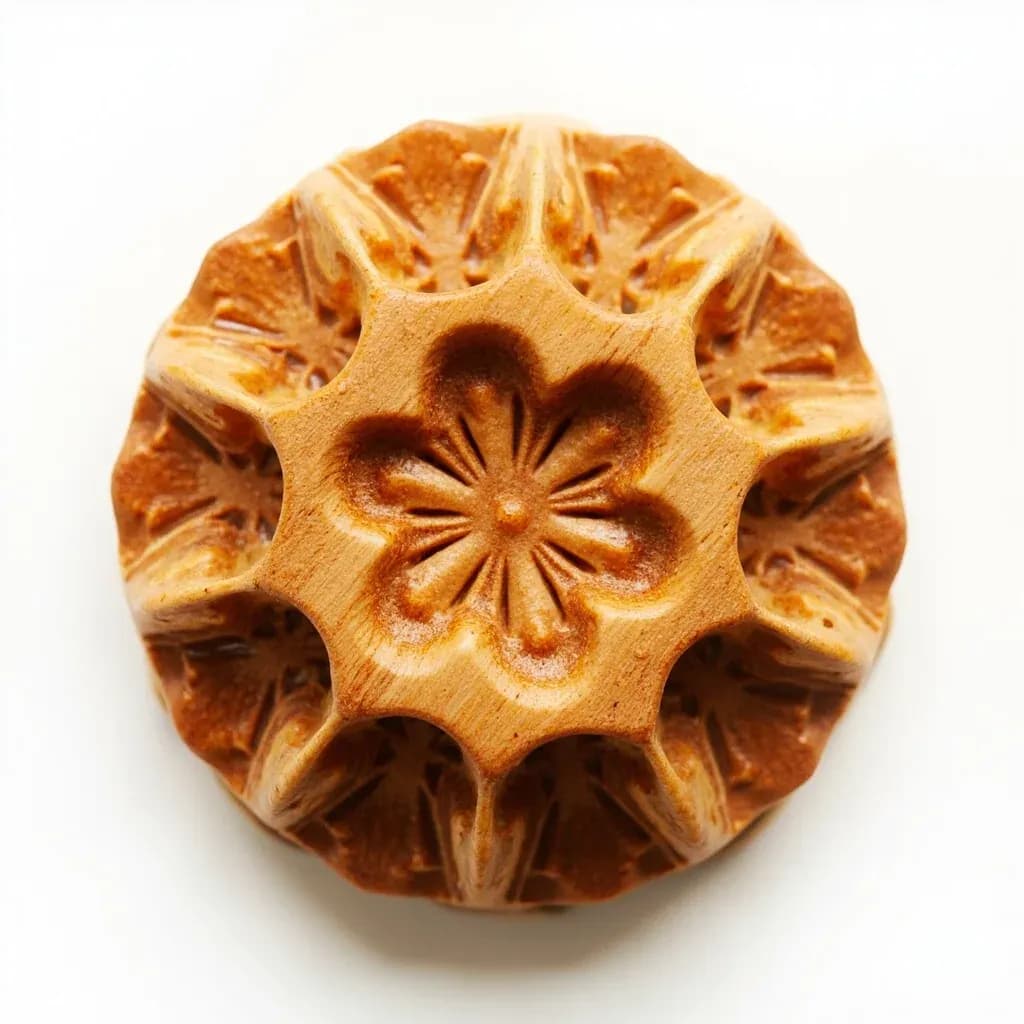
A carved Southeast Asian mold that stamps decorative shapes into kuih cakes and cookies.
A kuih mould, or acuan kuih, is a carved wooden, metal, or plastic mold used across Malaysia and Indonesia to shape and imprint patterns onto kuih, the region's bite-size sweet and savory cakes. Dough or steamed paste is pressed into the cavity and turned out with its motif intact. Designs range from flowers and fish to festive symbols, and many are family heirlooms.
A kuih mould — *acuan kuih* in Malay, *cetakan kue* in Indonesian — is a small carved tool used throughout Malaysia, Singapore, Indonesia and Brunei to stamp traditional cakes, cookies and rice-flour kuih with a single decisive motif. Most are hand-carved from hardwoods such as jackfruit (*nangka*) or coconut, with brass and aluminium appearing in older Peranakan (Nyonya) households; today food-grade plastic dominates the market, and silicone is increasingly available. Cavities typically measure 3–6 cm across and carry floral (bunga raya, rosette, lotus), geometric (star, hexagon, ketupat) or, more rarely, figural patterns that are pressed into soft dough in one firm, level action.
The Malay word *acuan* covers two quite different objects. The first is a stamp-style mould pressed by hand into dough or rice-flour paste — the kind used for festive cookies, *putu piring* and *onde-onde*. The second is a pair of hinged, heated iron plates clamped over charcoal to cook thin batter into the crisp *kuih kapit*, sometimes called the "love letter" biscuit. Choosing between them is dictated almost entirely by the dough: soft, high-butter cookie doughs suit shallow, finely carved wood or brass; steamed rice-flour pastes need perforated metal cups; thin batter for *kuih kapit* requires paired hot plates.
Vintage jackfruit-wood moulds are prized by collectors and serious bakers because the dense grain holds a sharper cut than cast plastic, which tends to round off at fine points and can warp with heat. A well-seasoned wooden mould, lightly oiled and never soaked, will outlast several generations of festive trays.
Alternatives
Types & varieties
Small open-top flower mould for pineapple-tart shells in Nyonya and Malay festive baking.
Deep, finely detailed mould for pressed coconut cookies that rise and hold a crisp imprint.
Floral star or rosette pattern for rich ghee-and-coconut-milk cookies piped or pressed in rows.
Used for black-sesame festive cookies, often with bolder geometric stamps.
Shallow round cup, traditionally with a perforated base, for steaming putu — rice flour filled with palm sugar.
Round crimped-edge cutter that seals and patterns the pastry edge in one press.
Pairs of hinged patterned iron plates heated over charcoal to make the thin 'love letter' biscuit.
Small rounded mould or hand-press used to shape glutinous rice balls before boiling.
Matching mould to dough
The depth of the carving, the material and whether the cavity is perforated all flow from what you are pressing. The summary below matches the right tool to each classic dough.
- Shallow wood or brass stamps (3–6 cm, fine floral cuts) — buttery cookie doughs such as tart nenas, kuih bangkit, kuih makmur, kuih semprit and kuih dangai. The shallow cavity releases cleanly and the sharp carving survives repeated pressing.
- Perforated metal cups (acuan putu) — wet steamed rice-flour paste. The holes let steam penetrate so the cake cooks through and releases from the cup without sticking.
- Round crimped cutters (acuan karipap) — laminated or shortening-based pastry for curry puffs. The fluted edge seals two discs of dough at once and gives the signature ridged border.
- Hinged heated iron plates (acuan kapit) — thin coconut-cream batter cooked dry between patterned hot surfaces. This is the only kuih mould that is also the cooking surface.
Care of wooden moulds
A carved wooden mould is a small piece of kitchen heirloom. Treat it the way you would a wooden spoon or a chopping board: never soak it, never run it through a dishwasher, and oil it occasionally so the grain does not dry and split.
- Wipe clean with a dry or barely damp cloth straight after use; air-dry upright so moisture drains out of the cavity.
- Rub with a thin coat of food-grade mineral oil or refined coconut oil every few uses to keep the grain conditioned.
- Store in a dry, ventilated spot — a sealed plastic bag will trap moisture and invite mould.
- Keep one mould for sweet work and another for savoury if you can; coconut and ghee residues linger in the wood and will scent the next batch.
Common uses
Tips & pitfalls
- Dust the cavity with rice flour or cornstarch for dry, buttery doughs like kuih bangkit; tap out the excess before pressing.
- For richer ghee-based doughs, a thin smear of ghee on the carving gives a sharper imprint and helps the cookie release cleanly.
- Pack the dough firmly into every line of the carving with your thumb — air pockets are the most common cause of cracked edges on release.
- Scrape level with a flat-edged knife or bench scraper in one pass, then tap the mould sharply on the bench to release. Never pry the piece out.
- For very intricate brass or aluminium moulds, chill the pressed dough in the mould for 2–3 minutes before tapping out for a cleaner release.
- If the imprint looks shallow, the dough is usually too cold or too soft — rest buttery doughs 10–15 minutes at room temperature before pressing.
- Wooden moulds should never be soaked; wipe clean, dry upright, and rub with food-grade mineral oil every few uses to prevent splitting.
- Hand-wash only; dishwashers strip the seasoning on wood and can pit brass.
Good to know
- Origin
- Southeast Asia — Malaysia, Singapore, Indonesia and Brunei; especially associated with Malay and Peranakan (Nyonya) kitchens.
- Also called
- Acuan kuih, acuan biskut, mould kuih, kueh mould, cetakan kue.
- Traditional material
- Carved hardwood, commonly jackfruit wood (nangka) or coconut wood; brass and aluminium also used in older Nyonya households.
- Modern materials
- Food-grade plastic, aluminium, and silicone (silicone is rare in traditional practice).
- Typical size
- Cavities roughly 3–6 cm across; a single mould may hold one pattern or a row of repeating motifs.
- Pattern style
- Floral (bunga raya, rosette, lotus), geometric (stars, hexagons), traditional motifs (bintang, ketupat), and occasional figural shapes.
- Heat use
- Wooden and plastic moulds are for shaping only — not for oven use unless explicitly bake-safe. Hinged iron plates (kuih kapit) are heated over charcoal.
- Primary function
- Pressing and stamping shaped dough or rice-flour paste for kuih and small pastries.
- Skill level
- Beginner; the technique is press-and-release, but clean, unbroken edges take practice.
Also called
Acuan Kuih · Kueh Mould · Kuih Mold
Related

Muffin Pan
Multi-cup pan for muffins, cupcakes, and egg bites

Bundt Pan
Fluted ring mold for showstopping cakes with a center hole

Springform Pan
Latch-release pan that frees delicate cakes without flipping

Pie Dish
Sloped round dish for crisp-bottomed pies and quiches

Tart Pan
Fluted pan with a pop-out base for clean-edged tarts

Rolling Pin
Rolls dough into even sheets for pastry and bread

Pastry Brush
Brushes on egg wash, glaze, butter, and marinades

Bench Scraper
Flat blade that divides dough and clears your work surface