Baking & Pastry
Grooved Lefse Rolling Pin
A ridged wooden rolling pin used to roll Norwegian lefse potato flatbread thin without tearing.
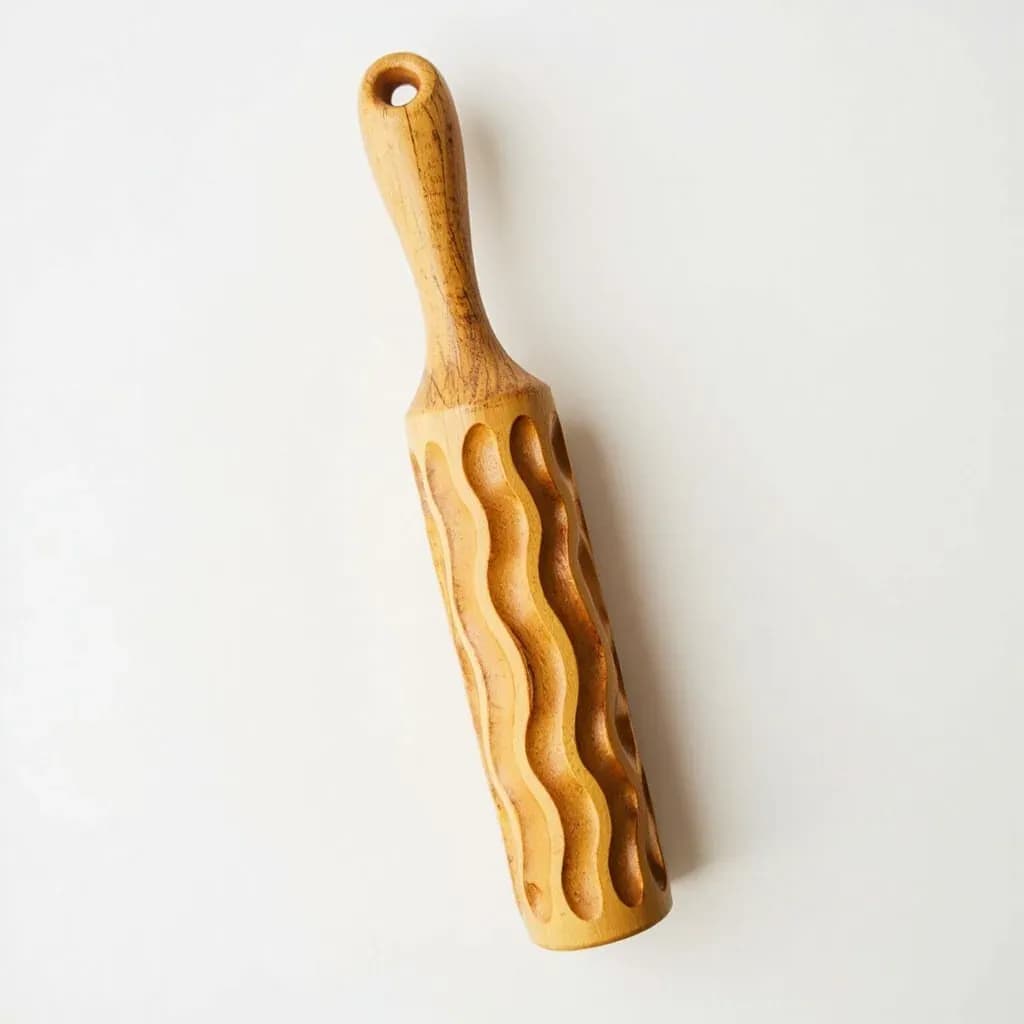
A grooved lefse rolling pin has deep parallel grooves carved along its surface, used to roll soft Norwegian lefse dough into paper-thin rounds. The grooves grip and stretch the delicate potato dough evenly while preventing it from sticking and bunching. It is a specialty Scandinavian tool usually paired with a cloth-covered board and a flat lefse stick for transferring.
The grooved lefse rolling pin is a specialized Scandinavian tool designed for one job done very well: sheeting cooked, riced potato dough into the paper-thin rounds that define Norwegian lefse. Unlike a smooth conventional pin, its hardwood barrel is turned with lengthwise flutes that run the full length of the rolling surface. As the pin moves across the dough, the channels grip and release in controlled increments, stretching the dough outward without dragging it. The result is the even, gossamer-thin sheet (typically about 1/16 inch / 1.5 mm) that cooks cannot reliably achieve with a conventional pin.
This behavior matters because lefse dough is uniquely unforgiving. It contains very little flour and a high proportion of moisture, so it sticks to a smooth pin, tears when dragged, and dries out when over-floured. The grooved pin sidesteps all three problems at once: the flutes let the cook work with a near-dry surface, the seasoned hardwood releases cleanly with minimal flouring, and the design rewards a back-and-forth rolling motion rather than downward pressure. A practiced lefse maker can turn out a finished round in under a minute, with the pin's weight doing most of the work.
Beyond lefse itself, the pin is a quietly useful tool for any sticky, low-gluten, or delicate flatbread dough, and it functions as a traditional heirloom in Norwegian-American households — particularly across the Upper Midwest, where church groups and heritage organizations treat a good pin as a generational kitchen staple. Quality versions are built to last decades with nothing more than a wipe-down and an occasional oiling.
Alternatives
Types & varieties
The classic Scandinavian style; numerous narrow channels release dough in thin, even layers and are the choice of most traditional makers.
Deeper channels that leave a faint textured pattern on the lefse surface; favored by some traditional makers.
Handles spin on bearings so the pin rolls freely without the cook lifting it off the dough — popular for beginners and anyone making large batches.
Traditional lathe-turned construction with no moving parts; the longest-lasting and most prized as an heirloom.
Modern alternative with a metal coil wrapped around a central rod; lighter than solid wood but less traditional and harder to season.
Budget options often bundled in lefse-making kits; functional for trying the craft, but not favored for long-term use.
How the grooves actually work
The flutes on a lefse pin are not decoration. They solve a specific mechanical problem: getting a wet, low-flour potato dough to spread evenly without sticking, tearing, or requiring so much bench flour that the final bread turns tough. Each channel has a leading edge that catches the dough and a trailing edge that lets go, so as you push the pin forward the dough is incrementally stretched along the length of the barrel. Multiple grooves mean many points of contact, which is why fine-grooved pins produce the thinnest, most uniform results.
This is also why a smooth pin fights you on lefse dough. A smooth barrel must either be heavily floured (which dries and toughens the dough) or it drags against the surface, lifting and tearing the sheet. The grooved pin reduces both problems, and lets the cook work in long, confident strokes rather than the constant lift-and-turn technique required with a conventional pin.
- Fine grooves = more contact points = thinner, more uniform sheets
- Coarse grooves = more dough displacement per pass = faster, slightly thicker results
- The pin's weight (not downward pressure) should do most of the work
- A properly seasoned hardwood surface is what allows minimal flouring
Common uses
Tips & pitfalls
- Resist flouring heavily — lefse dough should stay moist; dust a pastry cloth or canvas lightly instead so the dough does not dry out and crack at the edges.
- Roll the pin back and forth rather than pressing down; let the pin's weight do the work to keep thickness uniform across the round.
- Lift and reposition the pin frequently rather than dragging it across the dough — dragging is the single most common cause of tears in thin lefse.
- Clean the grooves promptly after each session with a dry brush or toothpick; hardened dough packed into the flutes will mar the next sheet and shed crumbs into the dough as you roll.
- Never soak the pin or run it through a dishwasher; wood will crack, warp, and lose its seasoning no matter how dense the grain.
- Condition a new (or dried-out) pin with a coat of food-grade mineral oil before first use, and re-oil every few months to keep the surface slick and water-resistant.
- Work on a smooth, flat pastry board — any dip, knot, or grain raise will imprint on the lefse and almost guarantees a tear when you lift the sheet.
- If the dough suddenly starts sticking, the pin's surface has likely dried out; a quick wipe with a barely damp cloth, followed by thorough drying, restores release.
Good to know
- Primary material
- Hardwood, traditionally Scandinavian birch, beech, or maple
- Typical length
- 14–20 inches (most commonly 18 in / 45 cm)
- Barrel diameter
- Approximately 1.5–2.5 inches
- Groove orientation
- Flutes run lengthwise along the barrel
- Cultural origin
- Norway; widely adopted by Scandinavian-American communities in the U.S. Upper Midwest
- Companion tools
- Pastry cloth or canvas, long turning stick, flat lefse/griddle stick
- Cleaning
- Wipe with a damp cloth and towel dry immediately; never soak
- Maintenance
- Rub periodically with food-grade mineral oil to prevent drying and cracking
Also called
Lefse Pin · Grooved Rolling Pin
Related

Muffin Pan
Multi-cup pan for muffins, cupcakes, and egg bites

Bundt Pan
Fluted ring mold for showstopping cakes with a center hole

Springform Pan
Latch-release pan that frees delicate cakes without flipping

Pie Dish
Sloped round dish for crisp-bottomed pies and quiches

Tart Pan
Fluted pan with a pop-out base for clean-edged tarts

Rolling Pin
Rolls dough into even sheets for pastry and bread

Pastry Brush
Brushes on egg wash, glaze, butter, and marinades

Bench Scraper
Flat blade that divides dough and clears your work surface