Cookware
Manti / Momo Steamer Tray
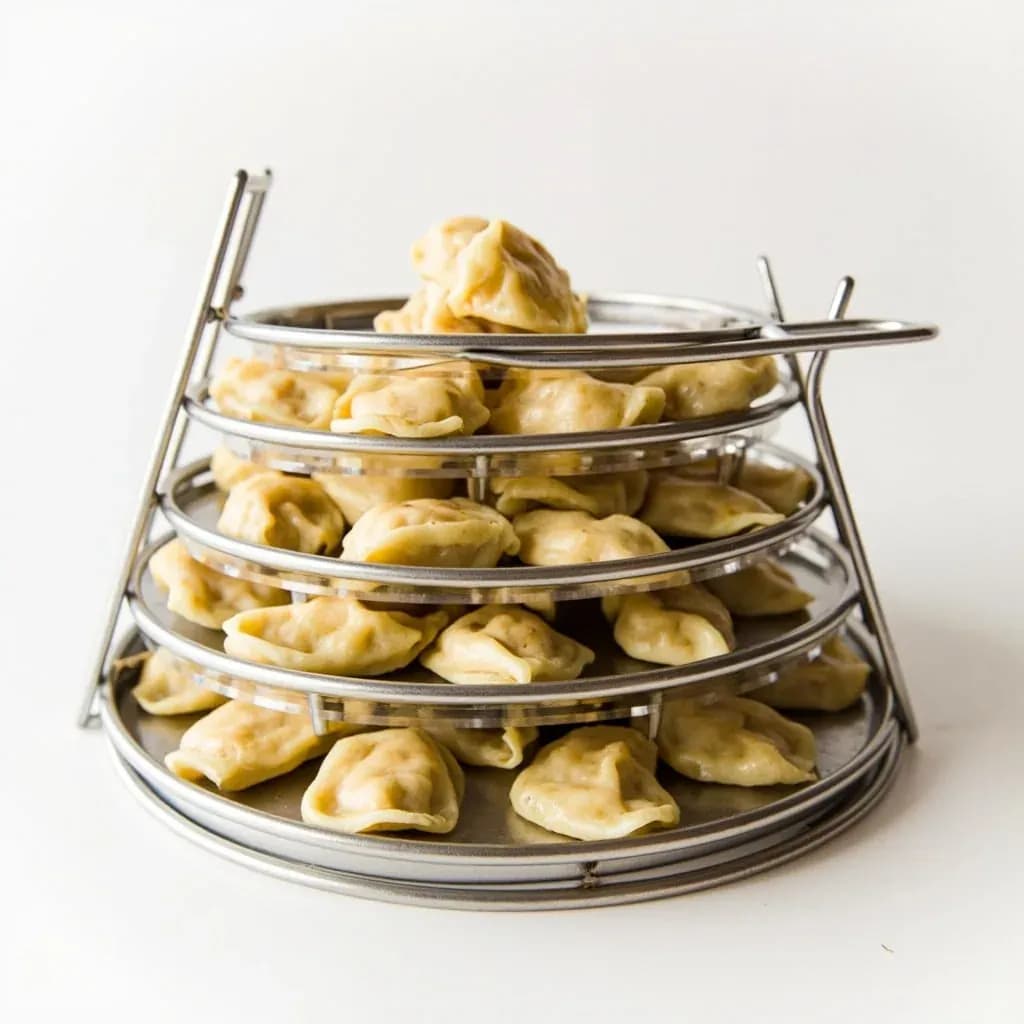
Stacking perforated trays for steaming filled dumplings like manti and momo.
A manti or momo steamer is a set of tiered trays with perforated or slotted bases that sit over boiling water to cook filled dumplings with gentle steam. The stacking design lets a cook steam many dumplings at once across multiple levels. Oiled trays keep the delicate dough from sticking while it sets.
A momo and manti steamer is a stack of shallow, perforated metal trays that nest one above the other inside a pot of boiling water. Each tray is pierced with small round holes — typically 2–4 mm across — wide enough for steam to rise freely but narrow enough to keep a dumpling from dropping through. Small legs or a raised rim on every tray holds the next one a centimeter or two above, leaving a clear channel for steam to circulate around each dumpling rather than smearing it against a solid surface. That vertical clearance is the whole point: it lets a single burner cook several times as many dumplings at once as a flat plate would, with even heat to every piece.
The tool exists because both momos (the filled dumplings of the Tibetan plateau, Nepal, Sikkim, and the wider Himalayan belt) and manti (the lamb, beef, or pumpkin dumplings of Uzbekistan, Kyrgyzstan, Afghanistan, and the Turkic world) are traditionally steamed, not pan-fried or boiled. A long, wet-steam cook of 12–20 minutes is what sets the wrapper and renders the filling without toughening the dough, and metal trays tolerate that environment better than bamboo. In Central Asia the trays are sized to drop into a tall dedicated pot called a manti qozon, which holds five or six tiers; in the Himalayas and South Asia the same trays are simply lowered into a wok or kadai with a domed lid. A close cousin is the South Indian idli stand, which uses identical perforated plates but adds shallow ring molds for idli batter — many sets are sold as combined idli and momo steamers.
Choosing one comes down to material and size. Stainless steel is the everyday workhorse: non-reactive, dishwasher-safe, and resistant to warping. Aluminum heats faster and costs less but can discolor acidic foods and buckle with thermal shock over years of use. Bamboo, used in parts of Nepal and Darjeeling, gives a faint grassy aroma reminiscent of dim sum service but absorbs moisture and needs air-drying. For a standard 30–32 cm wok, a two- or three-tier round set is the practical sweet spot; for feeding a crowd, a four- to six-tier insert in a dedicated stockpot or manti qozon is hard to beat.
Alternatives
Types & varieties
The most widely sold form: 2–3 perforated round trays sized to nest inside a 30–32 cm wok with a domed lid.
Square or oblong trays for large stockpots; the right pick when cooking 40+ momos at a time.
Tall aluminum pot with 4–6 perforated tiers and a heavy lid — the regional standard for Central Asian manti.
Light, fast-heating, and inexpensive; can react with acidic foods and warp with thermal shock over time.
More durable and non-reactive; the preferred everyday choice for kitchens that steam dumplings regularly.
Traditional in parts of Nepal, Sikkim, and Darjeeling; resembles a Chinese dim sum basket and lends a faint aroma.
Functionally identical tiers with shallow plate molds; doubles as a momo steamer when the dumplings fit the plates.
Choosing the right size and material
Match the tray diameter to your pot before anything else. A tray that barely clears the rim of a 30 cm wok will rattle and let steam escape; one that hangs over the edge will not seat properly. For a household of two to four, a 28–32 cm two-tier stainless set covers most momo nights and slips into a standard deep kadai when not in use. For a crowd or a full batch of Uzbek manti, step up to a four- to six-tier insert designed for a tall stockpot or a true manti qozon — the taller pot is what makes stacking that high practical without scorching the bottom layer. Material is the next decision: stainless steel for daily use, aluminum if weight and cost matter more than longevity, bamboo if you want the traditional dim-sum feel and are willing to hand-wash and air-dry.
- Stainless steel for daily use and dishwasher cleaning.
- Aluminum for lower cost and faster heat-up, accepting some warping over years.
- Bamboo for traditional aroma, with hand-washing and air-drying required.
Layer management and steam flow
Steam moves upward, which means the bottom tray always cooks faster than the top one. With two tiers the difference is small and can be ignored; with three or more, swap the top and bottom trays halfway through cooking so every dumpling gets equal time near the heat source. Leave a visible gap between dumplings — about 1–1.5 cm — because the wrappers swell as the filling heats and pieces placed too close will fuse together. Keep the water level at least 2.5–5 cm below the bottom tray; a rolling boil that splashes directly onto the dumplings is the single most common cause of soggy, torn bottoms.
- Bottom tray cooks fastest — rotate tiers top-to-bottom halfway for even results.
- Space dumplings 1–1.5 cm apart to prevent fusion as wrappers swell.
- Keep water 2.5–5 cm below the bottom tray to prevent splashing.
Wrapper integrity and condensation control
The two enemies of a good steamed dumpling are sticking and soggy tops, and both are solved before the lid goes on. Brush each tray with a thin film of neutral oil, or lay down parchment rounds, cabbage leaves, or lettuce leaves — the latter are traditional in Central Asian manti service and add a faint vegetal note. For the lid, wrap it in a clean kitchen towel secured with a rubber band or simply folded over the top; the towel absorbs the condensate that would otherwise drip back down and turn the wrappers gummy and translucent. Once the cook starts, leave the lid alone for at least the first two-thirds of the time — every peek drops the tray temperature and can split a thin, well-filled wrapper open at the seam.
- Oil the trays or line with parchment, cabbage, or lettuce leaves to prevent sticking.
- Wrap the lid in a kitchen towel to absorb condensation.
- Resist lifting the lid for the first two-thirds of the cook time.
Common uses
Tips & pitfalls
- Lightly oil each tray, or line with parchment rounds, cabbage, or lettuce leaves, so delicate wrappers release cleanly after cooking.
- Leave 1–1.5 cm between dumplings — wrappers swell as the filling heats, and tight spacing causes them to fuse together.
- Pour the water in first and bring it to a full rolling boil before lowering the loaded trays; this keeps the cook time predictable.
- Keep the water level 2.5–5 cm below the bottom tray — a boil that splashes directly onto dumplings is the most common cause of soggy, torn bottoms.
- Wrap the lid in a clean kitchen towel to absorb condensate; without it, steam drips back onto the dumplings and turns the wrappers gummy.
- Don't lift the lid during the first two-thirds of the cook — every peek drops tray temperature and can split a thin wrapper open at the seam.
- Rotate the top and bottom tiers halfway through when steaming three or more trays, since the top tray runs noticeably cooler than the bottom one.
- Use medium-high rather than maximum heat: a too-violent boil bounces the dumplings against each other and tears the dough, while a steady steam produces plump, evenly cooked results.
- Test doneness by cutting one dumpling open — the filling should be opaque and at least 74°C/165°F internally for meat, fully set for vegetable fillings.
- Refill hot water from a kettle between batches rather than lifting a cold tray to add water; this keeps the pot at temperature and reduces the risk of warping aluminum trays.
- After cooking, let the dumplings rest on the tray for 1–2 minutes so the wrapper firms up and they release cleanly when lifted.
- Skip non-stick coated momo steamers for very high heat — bare stainless steel or aluminum holds up better over years of daily use.
Good to know
- Tool type
- Stacked perforated steamer trays, usually sold as a set with 2–4 tiers and a domed lid
- Common materials
- Stainless steel and aluminum; less commonly bamboo or food-grade plastic
- Typical diameters
- 20–32 cm (8–13 in); wok-fit sizes around 28–32 cm are the most useful
- Tier count
- 2–4 tiers in most sets; Uzbek manti qozon inserts run to 5–6 tiers
- Perforation
- Round holes 2–4 mm wide — large enough for steam, small enough to hold dumplings in place
- Required pot
- Wok, deep kadai, large stockpot, or a dedicated Uzbek manti qozon
- Origin
- Modern metal adaptation of the Chinese bamboo steamer; parallel to the South Indian idli/dhokla stand
- Dishwasher safe
- Stainless steel and aluminum versions; bamboo should be hand-washed
- Approximate cook time
- 12–20 minutes of active steaming once the water returns to a boil
Also called
manti-steamer · momo-steamer · Dumpling Steamer
Related

Steamer
Gentle moist heat that keeps vegetables, fish, and dumplings tender

Frying Pan
Shallow sloped pan for frying, sautéing, and quick sears

Saucepan
Tall, straight-sided pot for sauces, grains, and small batches

Sauté Pan
Wide straight-sided pan with room to brown and braise

Dutch Oven
Heavy lidded pot that turns tough cuts tender over hours

Stock Pot
Tall, roomy pot for stocks, pasta, and big-batch cooking

Wok
High-sided bowl pan built for blistering-hot stir-fries

Griddle
Flat, broad surface for pancakes, smash burgers, and breakfast