Baking & Pastry
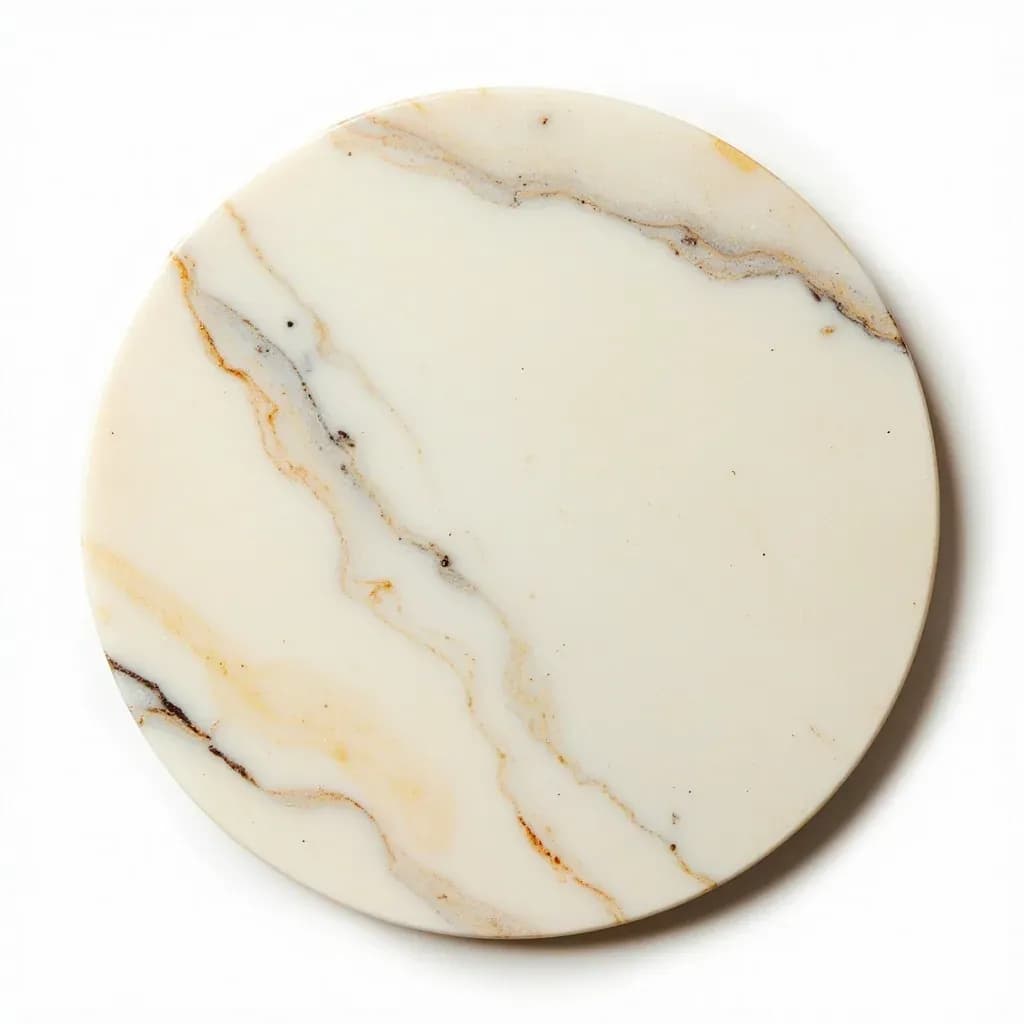
Marble Pastry Slab
A cool, smooth marble surface for rolling pastry, working chocolate, and pulling sugar.
A marble pastry slab is a heavy slab of polished marble whose naturally cool, smooth surface keeps butter and dough chilled while you work. Bakers roll out laminated and pie pastry on it to prevent the fat from melting, and chocolatiers and confectioners table chocolate and pull sugar on it to control temperature. Chilling the slab beforehand makes it even more effective on a warm day.
Marble has been the pastry bench of choice in European bakeries and chocolate shops for centuries, and the reason is pure physics: a thick slab of polished marble has high thermal mass, so it absorbs ambient heat slowly and stays noticeably cooler than the surrounding air, the bench, and the dough itself. That coolness is what allows a cook to roll out puff pastry or croissant dough in a warm kitchen without the butter melting into the flour, and what lets a chocolatier set tempered chocolate into a glossy snap without rushing the bench. Beyond temperature, marble is chemically inert, so it will not react with chocolate, caramel, or pulled sugar the way some metals can, and its smooth, flat surface gives nothing to fight a rolling pin or a sugar pour.
A marble slab is heavy — a 16-inch square piece can weigh 20 pounds — and that weight is a feature, not a bug: it stays put on the counter, and once chilled it holds its coolness through a long session of lamination or chocolate work. The trade-offs are real. Marble is slightly porous, so it can absorb oils and strong pigments (turmeric, beet, red wine) if left to sit. It etches when exposed to acids like lemon juice or vinegar. It dulls knives quickly and chips at the corners if dropped. None of this is a reason to avoid one, but it is reason to learn a few care habits.
For most home bakers a marble slab is a luxury rather than a necessity, but for anyone serious about pâte feuilletée, viennoiserie, hand-tempered chocolate, or pulled sugar, it is the single most useful surface in the kitchen. Buy it once, treat it well, and it will outlast every nonstick pan in the drawer.
Alternatives
Types & varieties
The classic pastry-shop choice: white background with soft grey veining, polished, food-friendly, and cool-running.
Cooler grey tones, often slightly harder and denser; favored in chocolate rooms where white surfaces show every smudge.
Technically a limestone but sold as 'marble'; deep matte black, very flat surface, traditional for chocolate work.
Spanish black marble with white calcite veins; striking on display, behaves like other marbles for pastry use.
Matte or satin surface rather than high polish; grips dough a touch more and hides light scratching.
Mirror-smooth; easiest for rolling thin doughs and working sugar, but shows scratches and water spots more readily.
Small portable pieces often have silicone bumpers underneath to prevent sliding and protect the bench beneath.
Large fixed or freestanding tables (often 3 ft × 5 ft or larger, 1½–2 in thick) used in professional bakeries and chocolatier rooms.
Why marble stays cool
The trick is not that marble is intrinsically cold — it isn't — but that it has high heat capacity and low thermal conductivity, so it warms up slowly. A chilled slab sitting in a 75°F kitchen will pull heat out of anything that touches it: butter, chocolate, sugar, dough. That is why a marble bench is sometimes described as a 'cold surface' even though it never drops below room temperature; the surface you feel stays a few degrees below ambient, and that gap is enough to keep laminated butter firm through a turn or two. The same physics makes it a perfect chocolate bench: melted chocolate poured thin loses heat fast, and the resulting seed crystals give you tempering control without a tempering machine.
Caring for the surface
Marble is forgiving in use but particular in upkeep. The two enemies are acid and standing water; the two friends are a damp cloth and a soft scrubber. Stains and scratches are not failures — they are patina — and most can be lifted or sanded out without affecting performance.
- Wipe with a damp cloth and a drop of mild dish soap, rinse the cloth, wipe again, and dry immediately.
- For oily stains (olive oil, butter, nut oils), make a poultice of baking soda and water, leave for 15–30 minutes, then wipe clean.
- For pigment stains (turmeric, beet, red wine), a paste of hydrogen peroxide and baking soda helps; avoid chlorine bleach on colored marble.
- Light surface scratches can be buffed out with 1000+ grit wet-dry sandpaper, worked in a circular motion, then re-oiled.
- Re-oil with food-grade mineral oil every few months to deepen color and slow staining; never use cooking oils, which oxidize and go rancid.
- Store flat on a stable surface, ideally with felt pads underneath; never lean a heavy slab on its edge — it can snap.
Common uses
Tips & pitfalls
- Pre-chill the slab in a cool room (or briefly in a cooler, wrapped) before rolling laminated doughs; warm marble defeats the purpose.
- Never use a marble slab as a cutting board — knives dull quickly on it and the surface can chip at the edges.
- Avoid placing acidic ingredients (lemon zest, citrus curd, vinegar reductions) directly on polished marble; the acid etches the surface.
- Wipe, don't flood — marble dislikes prolonged standing water. Dry promptly after washing to prevent edge dulling and water marks.
- Rub food-grade mineral oil into the surface every few months to deepen the color and reduce oil staining; skip cooking oils, which go rancid.
- Lift, don't drag, a heavy slab — and support it from beneath when moving; marble chips at corners if dropped on an edge.
- For chocolate work, dry the surface thoroughly; even a few drops of water will seize melted chocolate into a grainy lump.
- In very warm kitchens, set the slab on a damp towel or over a tray of ice to extend its cool working time.
Good to know
- Material
- Natural marble — metamorphosed limestone (calcium carbonate), polished smooth
- Thermal mass
- High heat capacity; stays noticeably cooler than room temperature, especially when pre-chilled
- Common sizes
- Portable slabs range from 12×12 in up to 24×24 in; professional pastry tables run 3 ft × 5 ft or larger
- Thickness
- Typically ¾ in to 1½ in; thicker slabs hold cold longer
- Weight
- A 16×16×¾ in slab weighs roughly 18–22 lb; a 24×24×1 in slab about 45–55 lb
- Reactivity
- Non-reactive with most foods; mildly sensitive to acids (lemon, vinegar) which can etch the polish
- Porosity
- Slightly porous — can absorb oils, turmeric, beet juice, and red wine if left in contact
- Cleaning
- Wipe with damp cloth and mild soap; avoid vinegar, lemon juice, and harsh abrasives
Also called
Marble Slab · Marble Pastry Board · Pastry Marble
Related

Muffin Pan
Multi-cup pan for muffins, cupcakes, and egg bites

Bundt Pan
Fluted ring mold for showstopping cakes with a center hole

Springform Pan
Latch-release pan that frees delicate cakes without flipping

Pie Dish
Sloped round dish for crisp-bottomed pies and quiches

Tart Pan
Fluted pan with a pop-out base for clean-edged tarts

Rolling Pin
Rolls dough into even sheets for pastry and bread

Pastry Brush
Brushes on egg wash, glaze, butter, and marinades

Bench Scraper
Flat blade that divides dough and clears your work surface