Cookware
Mash Tun
An insulated vessel that holds crushed grain and hot water to convert starches into sugar.
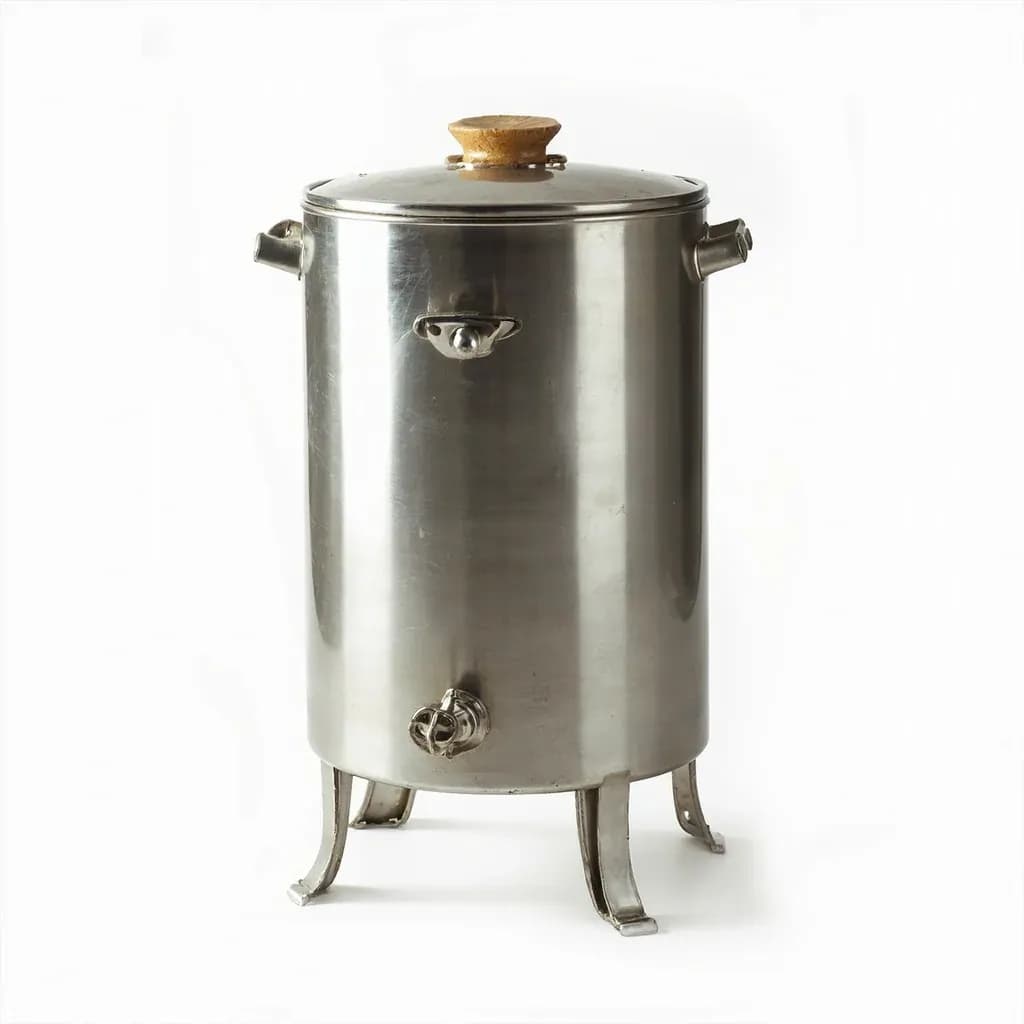
A mash tun holds crushed malted grain steeped in hot water so enzymes convert starches into fermentable sugars during brewing. Brewers hold the mash at target temperatures, then drain the sweet wort, often using a built-in false bottom. Good insulation keeps the mash at a stable temperature through the conversion rest.
A mash tun is the insulated vessel at the heart of all-grain brewing, where crushed malted grain meets hot water and the work of turning starch into sugar begins. Brewers rely on it for one property the rest of the brewery cannot easily provide: stable temperature over a long, quiet rest. Once malt and strike water are combined, the natural enzymes alpha and beta amylase need roughly an hour at saccharification temperature to break starch into fermentable maltose and dextrins, and even a small swing during that window shifts the character of the finished wort. The foam or poly insulation lining a mash tun is therefore a requirement rather than a luxury, since thin-walled kettles lose heat too quickly for a clean conversion.
The vessel does more than hold the mash. Its bottom carries a slotted false bottom or a manifold, with a spigot below, so once conversion is finished the sweet wort can be drained away from the grain bed in a clear, steady stream. The same tun is then used for sparging, the slow rinse of the bed with 168 °F water that lifts the last of the sugars from the husks. The word 'tun' is old English for a large cask, and the vessel's lineage runs from medieval wooden brewery tuns through Victorian copper kettles to today's stainless and foam-insulated cylinders. A homebrewer will rarely meet one outside of brewing, but anyone who has ever turned a sack of crushed grain into wort has spent an hour inside its quiet, warm interior.
Alternatives
Types & varieties
Converted picnic cooler, typically a 48-quart model. The polystyrene foam body holds temperature almost perfectly, and a copper or stainless manifold or false bottom sits inside. The dominant homebrew design because it is cheap, well-insulated, and reliable.
Commercial-grade, double-wall construction with foam or glycol insulation. Standard in craft breweries and pro brewpubs, often paired with HERMS or RIMS temperature control.
Traditional British infusion mash tun, copper or stainless, heated by a low burner beneath the vessel. Used in cask-ale breweries; requires steady stirring to avoid scorching on the bottom.
Historical and revivalist, often cypress or oak bound with iron or copper. Built like a wooden hot tub with a copper false bottom. Demands ongoing maintenance; seasoned wood can subtly influence the beer over years of use.
Heat Exchange Recirculating Mash System. Wort is pumped from the tun through a coil immersed in the hot liquor tank, allowing precise step-mash temperatures without applying direct heat to the grain.
Recirculating Infusion Mash System. A heating element inside the recirculation loop holds mash temperature within a fraction of a degree, favored for lagers and tightly controlled step mashes.
Separate vessel for boiling raw adjuncts such as corn or rice with a portion of the malt to gelatinize their starches before they are added to the main mash.
How a Mash Works
Mashing is enzyme chemistry, and the mash tun is simply a quiet, warm place for that chemistry to run. Two enzymes do the heavy lifting. Beta-amylase chops starch into maltose, the most fermentable sugar in wort, but it is fragile and fades fast above 158 °F. Alpha-amylase chops starch into longer dextrin chains, which give the finished beer body and mouthfeel, and it keeps working into the 160s. The classic 148–158 °F range is a compromise: mash low for a thin, dry, highly fermentable wort (good for hop-forward pale ales); mash high for a fuller, sweeter wort (good for malty bocks and Scottish ales). Stepped mashes use a sequence of rests, each favoring a different enzyme or protein reaction.
- Beta-amylase is most active 145–155 °F and produces the fermentable maltose.
- Alpha-amylase is most active 154–162 °F and produces longer dextrins for body.
- Mash-out at 168 °F stops enzyme activity and loosens the bed for clearer runoff.
- Mash pH of 5.2–5.6 is the window where both enzymes work efficiently and the finished beer tastes clean.
Lautering and Sparging
Once the rest is over, the mash tun becomes a filter. The false bottom or manifold holds the grain bed back while the wort runs through the spigot. The first cloudy runoff, called the first runnings, is recirculated back onto the top of the bed until the wort runs brilliantly clear, a step German brewers call vorlaufen. Cloudy wort carries fine grain particles and starches that cause haze and stuck fermentations, so patience here pays off. After the bed settles, sparging begins: 168 °F water is sprayed or poured gently over the grain to rinse residual sugars. The goal is a slow, even flow that keeps the bed intact; rush it and the bed compacts, channels, and stalls, producing a stuck sparge.
- False bottoms (a perforated plate) are easy to clean and give a deep, even grain bed.
- Manifolds (a ring or cross of slotted copper pipe) handle floury grains well but channel more easily.
- Fly sparging drips water continuously; batch sparging drains and refills the tun in steps and is more forgiving for beginners.
- Never squeeze the grain bag or scoop the bed; tannins from husks make the beer astringent.
Troubleshooting
Most mash problems show up at the spigot, not the thermometer. A slow, gurgling runoff, a stuck sparge, or a low-efficiency brew almost always traces back to the grain bed rather than the recipe. Knowing the usual suspects saves a batch.
- Stuck sparge: usually a too-shallow bed, too fine a crush, or floury grains without rice hulls. Add 5–10% rice hulls by weight and crush slightly coarser next time.
- Channeling: water finds a single path through the bed and leaves the rest dry. Slow the flow, stir gently, and keep at least an inch of water standing on top of the grain.
- Low efficiency: usually a cold tun, an inaccurate strike temperature, or a too-shallow grain bed. Preheat the tun, calibrate your thermometer against a reference, and aim for a bed depth of at least 12 inches.
- Astringent or husky beer: oversparging past the point where runoff drops below 1.010, or squeezing the grain. Stop the runoff earlier next time.
- Off pH: too high and conversion stalls and the beer tastes dull; too low and the beer tastes thin and sour. Adjust strike water with lactic acid or acidulated malt.
Common uses
Tips & pitfalls
- Preheat the mash tun with boiling water for 5–10 minutes before dough-in; an unheated tun can drag the mash down 5–10 °F in the first minutes and stall conversion.
- Dough in slowly while stirring to hit a porridge-like consistency with no dough balls and no dry pockets of grain hiding under the waterline.
- Insulate the lid as well as the body; most heat loss escapes through the top, and a wrapped or insulated lid can hold mash temperature within a degree or two over an hour.
- Calibrate your mash thermometer against a known reference; cheap dial thermometers drift over years and a three-degree error quietly wrecks efficiency.
- Recirculate (vorlauf) until the wort runs brilliantly clear, usually 1–2 quarts. Cloudy wort carries starch and debris into the kettle and shows up later as haze or stuck fermentation.
- Keep the grain bed at least 12–18 inches deep for a good natural filter; too shallow and the bed channels, too deep and runoff stalls.
- Add rice hulls at about 5–10% of grain weight whenever the recipe uses wheat, oats, rye, or any floury adjunct; without them the bed compacts and the sparge sticks.
- Start the sparge slowly and keep the grain bed covered with a thin layer of water. Never let it run dry; an air pocket breaks the filter and ruins runoff.
- Clean the false bottom or manifold thoroughly between batches; stuck-on grain husks create channeling next time.
Good to know
- Primary Function
- Holds crushed malted grain and hot water so amylase enzymes convert starches into fermentable sugars
- Mash Temperature Range
- 148–158 °F (64–70 °C); saccharification rest typically 60 minutes
- Water-to-Grain Ratio
- 1.25–1.5 qt of strike water per lb of grain (≈2.6–3.1 L/kg)
- Target Mash pH
- 5.2–5.6, measured at room temperature
- Enzyme Ceiling
- Above ~175 °F (80 °C) amylases denature; above ~212 °F starches gelatinize
- Common Homebrew Capacity
- 5–10 gallons (19–38 L)
- Key Components
- Insulated body, false bottom or manifold, bottom outlet/spigot, thermometer port, optional sight glass and recirculation port
- Related Process
- Mashing, followed by lautering (wort runoff) and sparging (rinsing sugars from the grain bed)
Also called
mash tun · mash vessel
Related

Steamer
Gentle moist heat that keeps vegetables, fish, and dumplings tender

Frying Pan
Shallow sloped pan for frying, sautéing, and quick sears

Saucepan
Tall, straight-sided pot for sauces, grains, and small batches

Sauté Pan
Wide straight-sided pan with room to brown and braise

Dutch Oven
Heavy lidded pot that turns tough cuts tender over hours

Stock Pot
Tall, roomy pot for stocks, pasta, and big-batch cooking

Wok
High-sided bowl pan built for blistering-hot stir-fries

Griddle
Flat, broad surface for pancakes, smash burgers, and breakfast