Cookware
Meen Chatti (Clay Fish-Curry Pot)
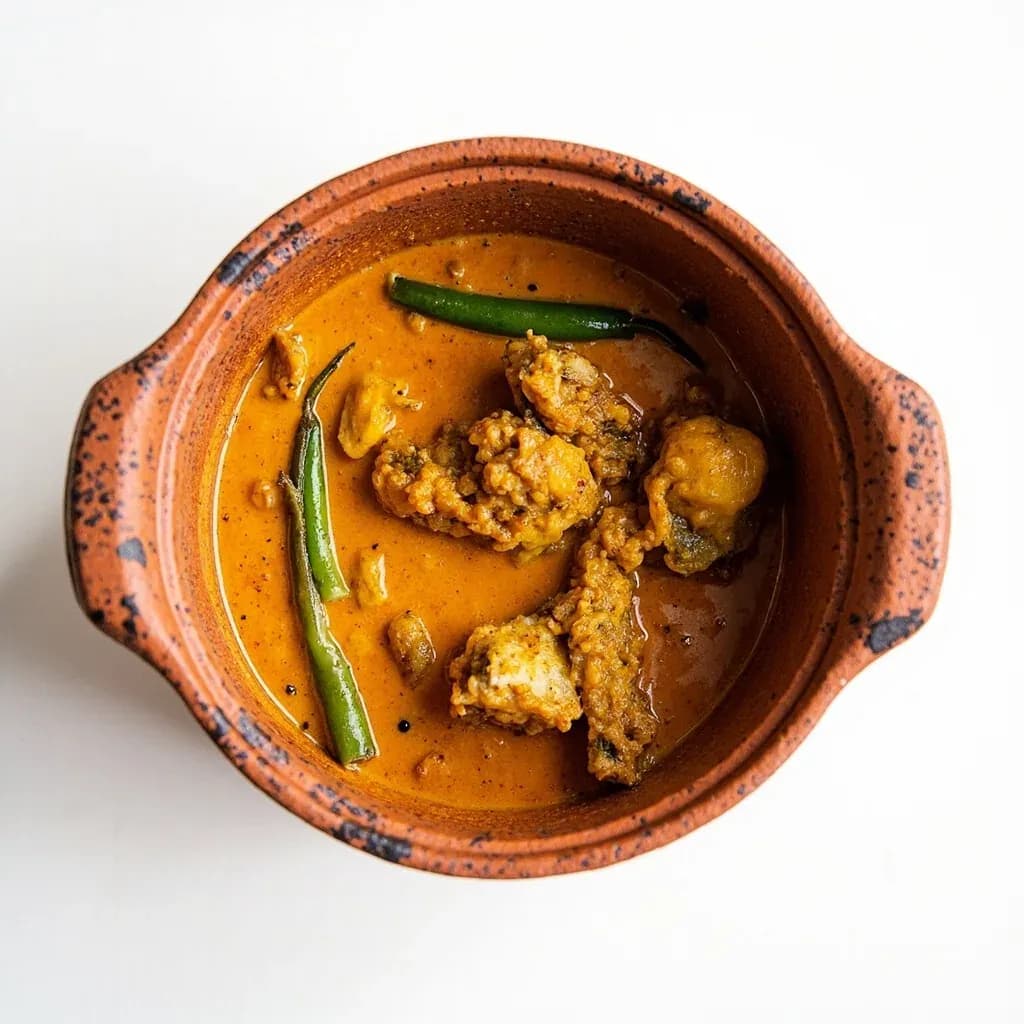
A wide, shallow earthenware pot from Kerala used to simmer fish curry without metallic off-flavors.
A meen chatti is a shallow, wide-mouthed unglazed clay pot from Kerala used specifically to cook fish curries. The porous earthenware retains gentle, even heat and is non-reactive, so the sour tamarind and kokum in fish curry do not pick up a metallic taste. Many cooks believe a well-used, seasoned chatti deepens the flavor of the curry over time.
The meen chatti is a wide-mouthed, unglazed terracotta pot from Kerala, South India, purpose-shaped for simmering fish curries. Its Malayalam name literally means "fish pot" (meen = fish, chatti = vessel), and it has been the default cookware for Kerala's tamarind- and kokum-laced fish curries for generations. The vessel's defining property is its porosity: the unglazed clay walls breathe, wicking excess coconut oil out of the gravy and keeping the sharp acids of kokum and tamarind — which can read as faintly metallic in a steel or aluminum pot — clean and rounded.
That porosity, however, is also what makes the chatti a temperamental tool. It must be seasoned before first use, never shocked by sudden temperature changes, and cleaned with water alone — soap would clog the pores and taint future curries. A well-tended chatti develops a dark, seasoned patina on the inside walls that experienced Kerala cooks prize as a sign of a "ripe" pot, the way a carbon-steel wok is prized in a Chinese kitchen. Because the clay holds heat evenly and releases it slowly, fish cooks in 15 to 25 minutes with minimal attention, the gentle thermal curve keeping the flesh from toughening.
Each chatti is hand-thrown in village workshops around Kumarakom, Irinjalakuda, and the Kannur belt, and is meant to be disposable: with daily use a pot lasts 6 to 18 months before hairline cracks force a replacement. That ephemerality, paradoxically, is part of the appeal — every new pot is a small reset, and cooks keep two or three in rotation so a cracked one is never a crisis.
Alternatives
Types & varieties
The shallower, wider version — ideal for thin fish steaks and quick-simmer curries where evaporation is desired.
Deeper-bodied version for whole fish, fish stews, and fish molee, where more gravy is needed.
Palm-sized chatti used to serve one portion of curry at the table, retaining heat until the last bite.
Variant from northern Kerala (Kumbla–Kannur belt) using local laterite-rich clay; slightly darker and denser than the central Kerala style.
Why Clay Works for Acidic Fish Curries
Kerala's signature fish curries lean hard on souring agents — kudampuli (Malabar tamarind / Garcinia), raw tamarind, kokum, and occasionally green mango or tomato. These acids can lift a faint but unmistakable metallic edge from stainless steel, and a more obvious one from aluminum and iron vessels. Unglazed terracotta is essentially non-reactive at cooking temperatures, so the sourness comes through clean. The same porosity that makes the clay non-reactive also acts as a wick: thin coconut oil and dissolved fish fats migrate into the wall as the curry simmers, leaving the gravy perceptibly lighter and cleaner-tasting. The clay itself contributes a faint earthy bass note, most noticeable in a brand-new pot and less so as the patina builds.
Seasoning a New Chatti
A brand-new meen chatti is dry, dusty, and slightly chalky. The pores must be filled before the first fish curry goes in, or the clay will absorb the curry's liquid and the pot may crack on the stove. The traditional kitchen method takes about 24 hours of patient soaking and two short boils.
- Soak the chatti in plain water for 8–12 hours (overnight) so the clay saturates evenly.
- Drain and fill with well-diluted rice-kanji (congee) or thin tamarind water.
- Bring slowly to a bare simmer on the lowest flame and hold for 20–30 minutes; allow to cool inside the pot.
- Discard the liquid, rinse with plain water, and let the chatti sun-dry completely before first use.
Day-to-Day Care and Lifespan
Treat the chatti the way you would treat a good wok: rinse, dry, and re-oil lightly. Soaps, dishwashers, and steel wool will strip the patina and clog the pores, so all cleaning is by hand with water and a soft scrub. The pot must never go back into the cupboard damp; trapped moisture breeds mildew and softens the wall, leading to cracks on the next heating. With these habits a chatti survives 6 to 18 months of daily use; without them, it can fail in weeks.
Common uses
Tips & pitfalls
- Always heat the chatti gradually — never place a cold pot on a high flame or set a hot one on a cold wet surface, as thermal shock will crack it.
- Cook on low-to-medium flame only; clay retains heat well, so aggressive heat is unnecessary and will burn the curry or craze the pot.
- Do not use soap or detergent — rinse with plain water and a soft scrub, then sun-dry completely to prevent mold and cracking.
- Reserve a chatti exclusively for fish (or for strongly flavored curries); once seasoned with fish oils, it will transfer those notes to a vegetable curry cooked in the same pot.
- Avoid metal ladles that can scrape the unglazed interior — use a wooden spatula or a stainless steel spoon used gently along the wall.
- If hairline cracks appear, the pot can sometimes be rescued by simmering a thick rice porridge (kanji) in it; the starch swells and seals fine fissures for a few more weeks of life.
- Rub the inside occasionally with a thin film of coconut oil after cleaning to maintain the patina and prevent the clay from drying out and splitting.
- Never store a wet chatti with the lid on; trapped moisture causes mildew and weakens the walls — store open or with a cloth cover that breathes.
Good to know
- Material
- Unglazed terracotta (fired clay)
- Origin
- Kerala, South India
- Name meaning
- Malayalam: 'meen' (fish) + 'chatti' (pot/vessel)
- Shape
- Wide-mouthed, shallow-to-medium depth, rounded bottom; typically with two small ear handles or no handles
- Typical size
- ~15 cm / 6 in (single-serve) up to ~22–25 cm / 9–10 in (family-size)
- Heat source
- Wood/clay stove (aduppu) or modern gas at low-to-medium flame; not suitable for induction
- Seasoning required
- Yes — must be seasoned before first use and after long disuse
- Flavor effect
- Non-reactive with kokum and tamarind; porous walls absorb excess coconut oil from gravies
Also called
Meen Chatti · Clay Fish Pot · Kerala Curry Pot
Related

Steamer
Gentle moist heat that keeps vegetables, fish, and dumplings tender

Frying Pan
Shallow sloped pan for frying, sautéing, and quick sears

Saucepan
Tall, straight-sided pot for sauces, grains, and small batches

Sauté Pan
Wide straight-sided pan with room to brown and braise

Dutch Oven
Heavy lidded pot that turns tough cuts tender over hours

Stock Pot
Tall, roomy pot for stocks, pasta, and big-batch cooking

Wok
High-sided bowl pan built for blistering-hot stir-fries

Griddle
Flat, broad surface for pancakes, smash burgers, and breakfast