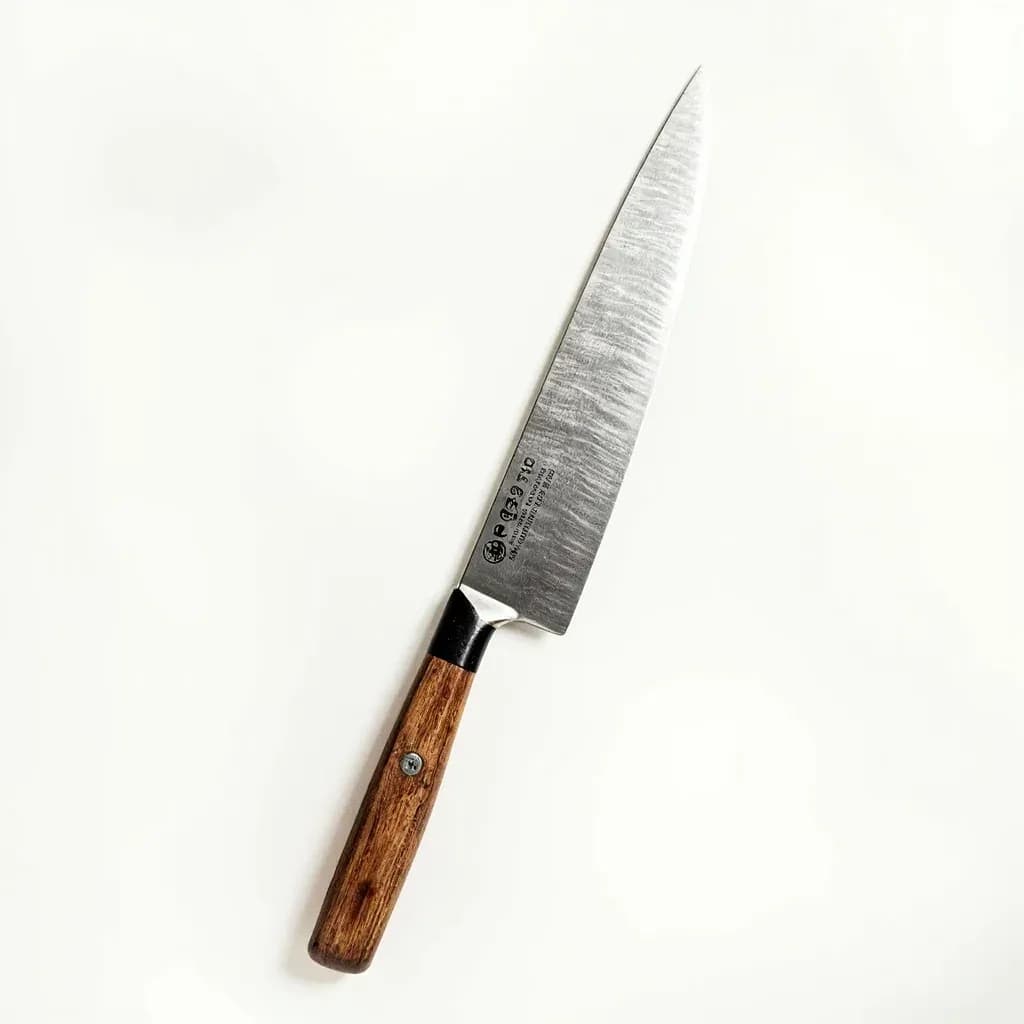
Knives & Cutting
Nakiri Knife
A flat, straight-edged Japanese vegetable knife built for clean push-cuts and fine slicing.
The nakiri is a Japanese double-bevel knife with a flat, rectangular blade designed specifically for vegetables. Its straight edge lets the whole blade contact the board in a single push or pull stroke, producing clean cuts without the rocking motion of a Western chef's knife. It excels at thin slicing, fine julienne, and dicing leafy or dense produce.
The nakiri is a Japanese vegetable knife distinguished by a perfectly flat cutting edge running from heel to tip and a tall, rectangular blade that drops straight down from the spine. That geometry is not stylistic — it is the point. The flat edge lets the entire length of the steel stay in contact with the board at once, so the cook makes a pure push cut: lift, drop, draw back. There is no rocking, no belly to follow, and no tip to lever against. The result is clean, unbroken slices on vegetables, with the kind of cell-wall preservation that keeps cabbage crisp and herbs green rather than bruised.
Most production nakiri are double-bevel and ground thin — typically 1.5 to 2.5 mm at the spine and sharpened to roughly 10–15° per side — which lets the edge glide through produce with very little downward force. The trade-off is durability: this is a specialist's blade, not a pry bar, and it will chip on bones, frozen food, and hard winter squash. In return you get a knife that excels at the daily vegetable prep that fills most of a home cook's cutting board time.
The broad, flat face is also a working tool. It scoops diced onion off the board and into a pan in one motion, and it can crush a garlic clove flat with a clean press. A cook who reaches for a nakiri for vegetables and a gyuto for everything else ends up using two purpose-built tools that each do their job better than a single compromise blade.
Alternatives
Types & varieties
Sharper, finer cuts descended from the usuba tradition; must be ordered right- or left-handed.
Symmetrical edge; the most widely sold version and the right starting point for most Western cooks.
Adds a clipped, angled reverse-tanto tip for scoring and finer detail work without sacrificing the flat belly.
VG-10 or SG2 core forge-welded to layered stainless cladding; the pattern is cosmetic, not a performance upgrade.
Easier to sharpen and holds a keener edge than stainless, but patinas and will rust if left wet.
Shorter 130–150 mm versions suited to precise herb prep, small produce, and tight cutting boards.
Nakiri vs. Santoku, Usuba, and Cai Dao
The nakiri sits among three look-alike tools, and choosing between them is a matter of what you actually do at the board.
- Nakiri vs. santoku: the santoku has a curved 'sheep's foot' tip and a slight belly, so it works well for rocking strokes and small portions. The nakiri's flat edge is more efficient for full-contact push cuts across the whole length of the blade — the right tool when you are cutting a stack of cabbage leaves or a row of scallions in one motion.
- Nakiri vs. usuba: the usuba is the traditional single-bevel ancestor. It is taller, single-beveled, and capable of extraordinarily clean cuts (and, in trained hands, katsuramuki paper-thin daikon sheets), but it demands handedness-specific geometry and a steeper learning curve. The double-bevel nakiri is essentially the user-friendly descendant.
- Nakiri vs. Chinese cai dao (vegetable cleaver): they look similar but the cai dao is heavier, thicker, and built to ride the board and transfer ingredients in restaurant volume. The nakiri is lighter and thinner and is not meant to touch bone or hard shell.
- Nakiri vs. Western chef's knife: a gyuto or chef's knife is the generalist — proteins, herbs, the occasional squash. A nakiri is a specialist for produce. Many experienced cooks keep both.
Choosing a First Nakiri
For most home cooks, a 165 mm double-bevel knife in a mid-range steel hits the sweet spot of capability, weight, and maintenance.
- Steel: VG-10 is forgiving and widely available; Aogami #2 carbon takes a keener edge and is more rewarding to sharpen on whetstones, at the cost of rust vigilance.
- Length: 165 mm is nimble and fits a standard home board; 180 mm gives more travel per stroke for larger vegetables.
- Handle: a wa-handle is lighter and balanced toward the blade (favored in Japanese kitchens); a yo-handle suits cooks who prefer a Western feel and full-tang reassurance.
- Budget makers to know: Tojiro and MAC for entry-level VG-10; Misono, Masamoto, and Sakai makers for the next step up. Shun sits at the high end of the production market.
Common uses
Tips & pitfalls
- Use a pure push cut: keep the entire edge flat on the board, drop straight down, then draw straight back. Do not rock — the flat profile does not allow it, and forcing a rock will chip the tip.
- Cut on a soft end-grain wood or high-density polyethylene board. Avoid glass, marble, ceramic, and bamboo, all of which will chip a thin Japanese edge quickly.
- Hone lightly every few uses with a ceramic rod and resharpen on whetstones (a 1000/3000/6000 progression works for most home cooks). Hard Japanese steels respond poorly to pull-through sharpeners.
- Hand wash, dry immediately with a cloth, and store on a magnetic strip, in a saya, or in a knife block. Never leave it wet in a sink or loose in a drawer.
- Single-bevel nakiri must match the user's handedness — a left-handed cook cannot safely use a right-handed single-bevel version; go double-bevel instead.
- Do not use it on bones, frozen food, coconut shell, or hard winter squash (butternut, kabocha, acorn). The thin edge will chip. Switch to a deba or Western chef's knife for those jobs.
- Keep the spine flat against the board when slicing through stacked material; lift only the handle slightly so the cut stays even from heel to tip.
- A carbon-steel nakiri will patina — that gray-blue staining is normal and does not affect performance. Wipe it dry the moment you finish cutting, and a light coat of camellia oil on the blade during storage prevents rust.
Good to know
- Origin
- Japan; part of the wa-bōchō (traditional Japanese kitchen knife) family.
- Etymology
- From 'naku' (leaf) + 'iri' (to cut) — literally 'leaf cutter.'
- Typical Blade Length
- 165 mm and 180 mm are most common; range roughly 150–210 mm.
- Blade Profile
- Rectangular with a flat, straight edge from heel to tip; tip is usually a slightly clipped 'k-tip' (reverse tanto) rather than a point.
- Blade Thickness
- Noticeably thinner than a Western chef's knife — typically 1.5–2.5 mm at the spine near the heel.
- Bevel
- Single-bevel (traditional, right- or left-handed) or double-bevel (more common for non-professionals).
- Edge Geometry
- Roughly 10–15° per side on double-bevel models — noticeably more acute than a Western chef's knife.
- Common Steels
- Stainless: VG-10, SG2/R2, AUS-10. Carbon: Aogami #2, Shirogami #1. Often sold as san-mai with Damascus-patterned cladding.
- Handle Styles
- Wa-handle (octagonal wood, magnolia or rosewood with a buffalo-horn ferrule) or yo-handle (Western full-tang).
- Cutting Motion
- Designed for straight up-and-down push cuts, not rocking.
Also called
Vegetable Knife · nakiri bocho
Related

Knife
The fundamental cutting tool every kitchen is built around

Chef's Knife
The do-everything blade for chopping, slicing, and mincing

Paring Knife
Small, nimble blade for peeling and detailed in-hand work

Serrated Knife
Saw-toothed blade that slices crusty bread without crushing

Cleaver
Heavy broad blade for chopping through bone and bulk prep

Cutting Board
The stable surface every cut starts on

Mandoline
Adjustable blade for paper-thin, perfectly even slices

Kitchen Shears
Heavy-duty scissors for poultry, herbs, and packaging