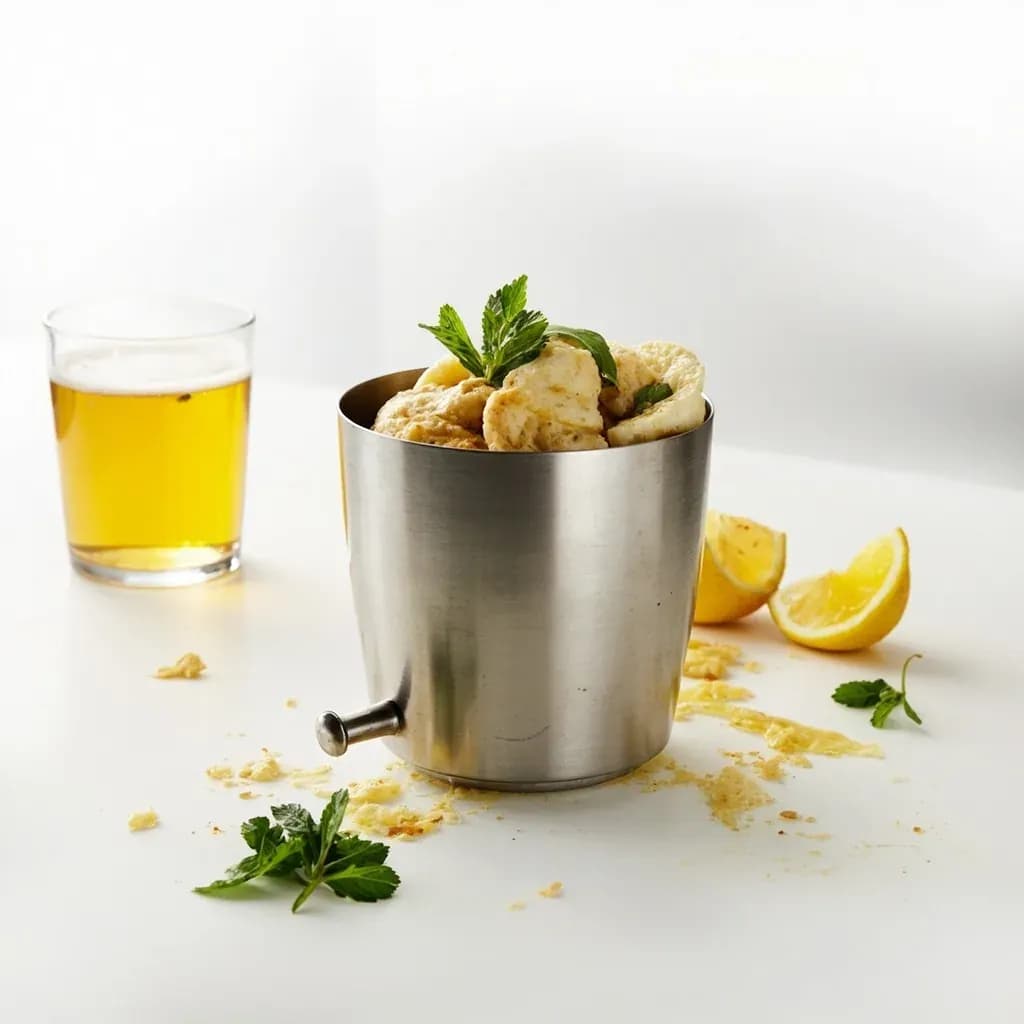
Cookware
Inert-Gas Conical Storage Tank
A sealed stainless steel tank that stores liquids under inert gas to prevent oxidation.
This conical-bottom stainless steel tank holds wine, oil, vinegar or beverages while a layer of nitrogen or CO2 blankets the surface to keep oxygen out. The inert gas prevents oxidation and spoilage during fermentation, aging and bulk storage. The cone bottom lets sediment settle and drain cleanly off the bottom.
An inert-gas conical storage tank is a sealed stainless-steel vessel that holds liquid under a blanket of nitrogen (or argon) to keep oxygen away from the product. The two engineering details that define it are a hermetic top fitted with a pressure-relief valve and a sample port, and a conical bottom that funnels every drop toward a single bottom outlet. Together they do two things a regular drum cannot: deny oxygen a path into the liquid, and let the tank drain to true emptiness so no stale film is left behind to contaminate the next batch.
The principle is borrowed from chemical and pharmaceutical processing, where inert-gas blanketing became standard in the late twentieth century as a way to extend shelf life without resorting to preservatives. Wineries, breweries, olive mills, and distilleries adopted it for the same reason: dissolved oxygen is the single most aggressive agent of flavor degradation in oils, wines, beers, vinegars, and spirits. The tank itself is unromantic hardware — usually 304 or 316L stainless, fitted with tri-clamp ferrules, often CIP-cleanable — but its effect on a fragile product is dramatic. Polyphenols in olive oil hold their bite, hops in fresh beer keep their brightness, and a house-aged vinegar can be held for months without acetobacter re-invading the headspace.
For most home cooks this is not a tool to buy; it is a tool to recognize. They live behind the scenes in production kitchens, olive mills, and the back rooms of fine-dining restaurants where chefs press, age, or infuse their own oils, vinegars, and reductions in small benchtop units. Understanding the logic of the tank — seal, gas, cone — explains a surprising amount of why professional oils taste the way they do and why house-made infusions from a serious kitchen arrive on the table in better shape than the supermarket version.
Alternatives
Types & varieties
Wine-industry staple: a sealed lid rests on the liquid surface and can be gas-pressurized, so the tank 'shrinks' as wine is drawn off while the headspace stays near zero.
The basic form — insulated or not — used for ambient storage of oils, vinegars, and finished beverages.
Adds a glycol or chilled-water jacket for temperature-controlled holding of juice, must, beer, or fresh-pressed oil.
Fitted with a top- or side-mounted stirrer for blending, lees stirring, or keeping sauces and slurries in suspension.
Often jacketed, nitrogen-blanketed, with a hermetic top and full-cone drain to keep oil away from light, heat, and oxygen from press to bottle.
Closed, gas-pressurized vessel used to carbonate, hold, and serve beer without oxidation.
Higher-pressure-rated version for holding high-proof spirits, with relief valves and ATEX-rated fittings suitable for alcohol vapour.
Small (20–60 L) unit used in tasting rooms, R&D kitchens, and fine-dining restaurants for house-aged vinegars, reductions, and infusions.
The Headspace, the Gas, and the Cone
Three pieces of engineering do the real work, and they only succeed together. The headspace is the pocket of gas sitting above the liquid inside the sealed tank; filling that pocket with nitrogen — which is tasteless, cheap, and unreactive — displaces the oxygen that would otherwise dissolve back into the product and drive oxidation. The slight positive pressure that sits on top of that headspace is what makes the barrier self-defending: if a gasket is imperfect, the leak runs outward (nitrogen escaping) rather than inward (air entering), as long as the regulator is set sensibly low.
The conical bottom is the part cooks rarely think about but producers care about deeply. A flat-bottomed drum drains down to a thin film that stays in contact with whatever air sneaks in through the next fill's headspace; that film oxidizes, harbours microbes, and taints the next batch. The cone, angled at 30–60° to a single bottom outlet, drains to the last drop. It is the geometry that lets a tank be reused for many batches without carryover, and it is the reason the same hardware shows up in wineries, breweries, and olive mills as essentially the same tool with different fittings.
Common uses
Tips & pitfalls
- Use only food-grade nitrogen or argon from a certified supplier; welding-grade shielding gas is not food-grade and can carry impurities that show up as off-flavours.
- Set the regulator low — just enough positive pressure to hold a barrier against inward air leak. More pressure wastes gas and stresses seals without buying any extra protection.
- Sanitize between batches with the same rigor as any food-contact surface: a CIP cycle of caustic wash, acid wash, and a final sterile-water rinse before the next product goes in.
- Check headspace pressure and headspace oxygen (with a handheld O₂ meter) at the start of each shift. A drifting reading is the first sign a seal has failed and the product is starting to oxidize.
- Drain completely through the cone before refilling. Even a thin film defeats the purpose of the conical bottom and becomes a contamination site for the next batch.
- Pair blanketing with proper temperature control. Inert gas buys you protection from O₂, not from heat-driven oxidation chemistry — this matters most for nut and seed oils.
- Do not assume a tank rated for wine is automatically rated for high-proof spirits. Alcohol vapour behaves differently under pressure and the relief valve must be sized for the specific product.
- Replace gaskets on a schedule (typically annually) rather than waiting for visible leaks. EPDM and silicone both age, and a slow leak is invisible until the product on the other side starts to oxidize.
- Avoid copper or brass fittings in contact with the product, particularly with wine and cider — they strip sulfur compounds and catalyze oxidation reactions.
- For restaurants: a small benchtop tank pays for itself only if you actually turn the product over. Stagnant liquid in a sealed tank is no better than stagnant liquid anywhere else.
Good to know
- Material
- Food-grade stainless steel, typically 304 or 316L; the latter is preferred for acidic liquids because of its higher corrosion resistance.
- Inert gas
- Nitrogen (N₂) is standard for its cheapness and tastelessness; argon and food-grade CO₂ are also used depending on the product.
- Operating pressure
- Held under a slight positive pressure — just enough to prevent outside air leaking inward, not enough to stress seals or fittings.
- Bottom geometry
- Conical, typically with a 30–60° apex, so the tank drains completely to a single bottom outlet with no flat surface to trap liquid.
- Closure
- Hermetic top with EPDM or silicone gaskets, a pressure-relief valve, and a hands-free sample valve as standard.
- Capacity range
- From roughly 20 L benchtop units in restaurant kitchens up to multi-thousand-litre vessels in wineries, breweries, and oil mills.
- Sanitation
- Most professional versions support clean-in-place (CIP) with internal spray balls for caustic, acid, and rinse cycles.
- Fittings
- Tri-clamp (sanitary) ferrules are the standard connection for food-grade versions, allowing quick disassembly for inspection and cleaning.
Also called
Nitrogen Blanketing Tank · Stainless Steel Storage Tank · Variable Capacity Tank
Related

Steamer
Gentle moist heat that keeps vegetables, fish, and dumplings tender

Frying Pan
Shallow sloped pan for frying, sautéing, and quick sears

Saucepan
Tall, straight-sided pot for sauces, grains, and small batches

Sauté Pan
Wide straight-sided pan with room to brown and braise

Dutch Oven
Heavy lidded pot that turns tough cuts tender over hours

Stock Pot
Tall, roomy pot for stocks, pasta, and big-batch cooking

Wok
High-sided bowl pan built for blistering-hot stir-fries

Griddle
Flat, broad surface for pancakes, smash burgers, and breakfast