Cookware
Non-Reactive Saucepan
A saucepan of stainless steel or enamel that won't react with acidic foods or discolor them.
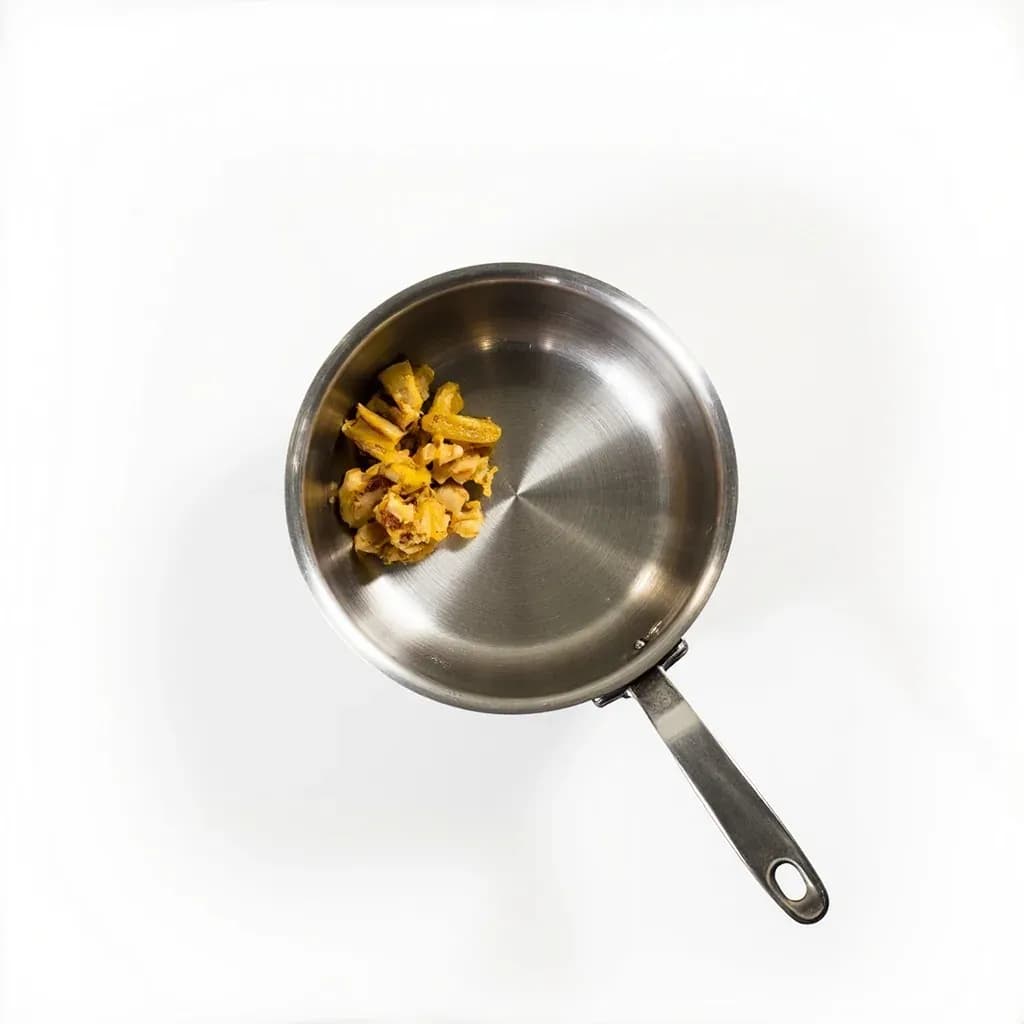
A non-reactive saucepan is made of materials such as stainless steel, enameled cast iron, or glass that do not chemically react with acidic ingredients like tomatoes, wine, citrus, and vinegar. Reactive metals such as bare aluminum or copper can impart a metallic taste or dull color when cooking acids, so a non-reactive pan keeps sauces and reductions clean-tasting. It is the default choice for simmering tomato sauce, caramel, and fruit preserves.
A non-reactive saucepan is defined less by its shape than by the chemistry of its cooking surface. Certain metals — bare aluminum, unlined copper, raw cast iron — are willing to trade ions with the food inside them. When that food is acidic (tomatoes, citrus, wine, vinegar) or alkaline (some legumes, certain vegetable purées), the exchange is fast and visible: a tomato sauce turns ashen, a lemon curd picks up a metallic note, and over months the pan itself develops pits and discoloration where the metal has dissolved. A non-reactive saucepan is simply one whose surface has been engineered to refuse that exchange. The qualifying materials are stainless steel, glass, ceramic, and any metal sealed beneath a fired enamel or hard-anodized coating.
The practical reason to care is flavor and color. A cream sauce finished in a reactive pan can develop a faint metallic note; a tomato ragù simmered in raw aluminum loses the bright red edge that makes it sing. Pale sauces stay clean, white wines reduce without going gray, and citrus curds keep their honest yellow. Beyond flavor, the right vessel also lasts longer — acidic liquids are quietly corrosive to reactive metals, so a non-reactive pan in a cookware drawer is a long-lived one.
In a modern kitchen this almost always means one of two things: a stainless steel saucepan, typically tri-ply or 5-ply with an aluminum or copper core sandwiched between steel layers, or an enameled cast iron or enameled steel pan. Both are oven-safe and induction-friendly; hand-washing preserves an enamel finish longest. Neither is naturally nonstick — stainless rewards careful preheating and fond-building, while enamel demands wooden or silicone utensils to keep the glass coating intact. For any recipe whose success depends on a clean flavor and an unchanged color, there is no real substitute.
Alternatives
Types & varieties
Stainless interior and exterior with an aluminum core; the workhorse of most home kitchens, balancing even heating, durability, and weight.
Adds more conductive layers for faster, more even heating with less scorching; favored in professional and serious home settings.
Cast iron core with a porcelain enamel coating; excellent heat retention and fully non-reactive, though heavy on the wrist.
Lighter than cast iron with the same non-reactive enamel surface; heats faster but holds heat less tenaciously.
Copper exterior for superior conductivity with a non-reactive stainless cooking surface; the choice of many restaurant kitchens.
The anodized layer and coating render the surface effectively non-reactive in practice, even though the base metal is aluminum.
Stainless vs. Enameled: How to Choose
Both families are non-reactive, oven-safe, and induction-compatible. They differ in everything else.
- Heat behavior: Stainless (especially multi-clad) responds quickly to burner changes; enameled cast iron heats slowly and holds heat long after the flame is off — ideal for braises and custards, less ideal when you need to pull a sauce off the heat fast.
- Weight: A 3-quart stainless saucepan weighs roughly 2–3 pounds; a comparable enameled cast iron piece is 5–7 pounds. Choose stainless if you lift the pan often.
- Sticking: Neither is naturally slick. Stainless releases food once properly preheated — a few drops of water should bead and skitter across the surface before oil goes in; enamel releases food easily but can chip if scraped with metal tools.
- Acidity: Both handle tomato, citrus, and wine without complaint. Stainless is the tougher surface for everyday knocks; enamel is glass-like and can chip if dropped, though it is well suited to long reductions where steady, even heat matters more than speed of response.
- Aesthetics: Enameled pans come in deep colors that go from stove to table; stainless is workmanlike and built to take abuse.
When You Really Need One
Some recipes merely tolerate a reactive pan; others fall apart in one. The cases below are the ones where reaching for a non-reactive saucepan is the difference between a good result and a disappointing one.
- Long-simmered tomato sauces, where acidity is high and contact time is measured in hours.
- Wine reductions and pan sauces, where a small volume of acid concentrates aggressively.
- Citrus curds, marmalades, and any preparation where the final color should be a clean yellow or orange.
- Pickling brines and vinegar-based reductions, both for flavor and to protect the pan from corrosion.
- Dairy sauces such as béchamel and Alfredo, where a faint metallic edge is most noticeable against a pale, neutral background.
Reading the Label
Marketing language on cookware is forgiving, so it pays to know what to look for in the spec sheet.
- '18/10 stainless' or '18/8 stainless' refers to the chromium/nickel ratio in the cooking surface — both are fully non-reactive and food-safe.
- 'Tri-ply' or '5-ply' describes the layered construction; the more layers, the more even the heat distribution.
- 'Encapsulated base' means a thick aluminum or copper disc is bonded to the bottom only; sides still heat unevenly. Genuine clad cookware runs the conductive layer up the sides.
- 'Hard anodized' aluminum has been electrochemically treated to form a hard oxide layer; it is non-reactive in practice even though the base metal is aluminum.
- Be wary of 'nonstick ceramic' coatings with no underlying clad metal — these are non-reactive but lack the heat distribution of clad stainless for serious sauce work.
Common uses
Tips & pitfalls
- Preheat the empty stainless pan over medium heat for 1–2 minutes before adding oil; the food-release properties of stainless depend on a properly heated surface, not on more fat.
- Avoid screaming-high heat with stainless steel. It doesn't conduct as quickly as aluminum or copper, so cranking the burner simply scorches the food at the hot spots — drop the flame a notch lower than you think you need.
- Add salt to water only after it has come to a boil; salt dropped into cold water in a stainless pan can cause pitting over time.
- Use wooden, silicone, or other non-metal utensils on enamel interiors to prevent chipping the glass coating — chips expose the cast iron underneath to rust.
- If food sticks to stainless steel, deglaze with wine, stock, or water instead of scrubbing. The fond lifts in seconds and is pure flavor for the sauce.
- A heavy-bottomed stainless pan gives a cleaner, brighter tomato flavor than aluminum, which tends to mute and gray long-simmered sauces.
- Match pan size to burner: an undersized pan on a large flame burns the food along the sides and overheats the handle. The flame should stay under the base, not licking the walls.
- Stainless steel is dishwasher-safe, but hand-washing preserves the polished finish and keeps rivets shiny for years.
Good to know
- Material class
- Stainless steel, enamel-coated metal, glass, or ceramic
- Reactive opposites
- Bare aluminum, unlined copper, and unseasoned cast iron
- Common lining
- Stainless steel 18/10 (18% chromium, 10% nickel) — the standard food-safe interior
- Construction
- Often multi-clad with an aluminum or copper core sandwiched between stainless layers for even heat
- Induction compatibility
- Fully stainless and enameled steel versions work on induction; aluminum-core-only pans do not unless a magnetic steel disc is bonded to the base
- Oven use
- Most stainless and enameled saucepans are oven-safe, typically to 350–500°F depending on handle material
- Typical capacity
- 1 to 4 quarts for saucepans
- Why non-reactive matters
- Acidic ingredients (tomato, citrus, wine, vinegar) can leach metal from reactive pans, causing off-flavors, gray discoloration, or pitted surfaces
Also called
Stainless Saucepan · Enamel Saucepan
Related

Steamer
Gentle moist heat that keeps vegetables, fish, and dumplings tender

Frying Pan
Shallow sloped pan for frying, sautéing, and quick sears

Saucepan
Tall, straight-sided pot for sauces, grains, and small batches

Sauté Pan
Wide straight-sided pan with room to brown and braise

Dutch Oven
Heavy lidded pot that turns tough cuts tender over hours

Stock Pot
Tall, roomy pot for stocks, pasta, and big-batch cooking

Wok
High-sided bowl pan built for blistering-hot stir-fries

Griddle
Flat, broad surface for pancakes, smash burgers, and breakfast