Cookware
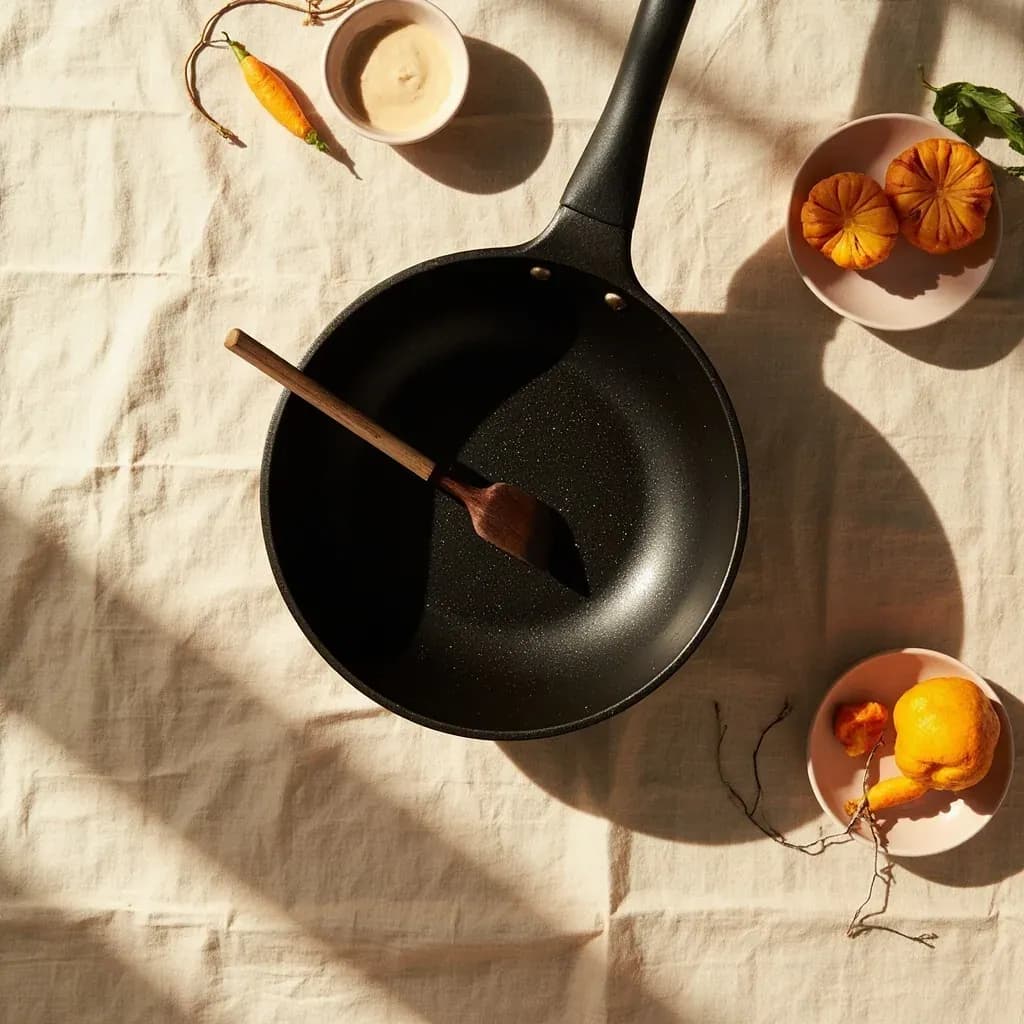
Nonstick Wok
A wok with a slick coating that frees you from constant seasoning and lets eggs and sticky sauces release cleanly; best at moderate heat, since high stir-fry flames degrade the coating.
A nonstick wok is a wok-shaped pan — deep sloping sides and a small flat cooking well — finished with a PTFE or ceramic sol-gel coating over an aluminum or carbon-steel body. The silhouette is borrowed from the Han Dynasty's hemispherical cooking vessel, but the slick interior is a thoroughly modern concession to weeknight convenience: eggs slide, sticky sauces release, and the daily seasoning ritual of a carbon-steel wok is unnecessary. It behaves less like a restaurant wok than like a generous, sloped skillet that forgives distraction and modest technique.
The trade-off is heat ceiling. PTFE begins to break down around 500°F, and ceramic coatings, though sometimes rated higher, lose their slickness quickly when pushed. That means a nonstick wok is built for medium and medium-high cooking — enough sizzle for a quick vegetable stir-fry, not enough for the roaring, smoke-wreathed flames that produce true wok hei. Treat it as a low-stress, easy-clean alternative rather than a path to high-heat Cantonese-style cooking.
For the cook who values practicality — small kitchens, glass-top ranges, beginners, or anyone who simply wants a pan that cleans in a minute — it is an honest, useful tool. The mistake is asking it to do what a carbon-steel or cast-iron wok was built to do.
Alternatives
Types & varieties
The dominant Western-stove design; stable on gas, electric, and induction coils
Traditional silhouette; needs a wok ring or a high-output burner to sit properly
Aluminum body is treated for extra hardness, then coated; more scratch resistant than plain aluminum
Thinner, more responsive body with a nonstick layer; lighter than cast iron and faster to heat
Heavier, retains heat well; common in mid-range consumer lines
PTFE-free coating marketed as more eco-friendly; slickness fades faster under sustained high heat
Base is bonded with a magnetic stainless or steel plate so it works on induction cooktops
Heat management and what the pan cannot do
A nonstick wok is, at heart, a low- to medium-heat pan shaped like a wok — and the difference matters more than the silhouette does. A traditional carbon-steel wok depends on temperatures that would destroy a PTFE coating within a few uses, which is exactly why the nonstick version was invented: to give home cooks the wok's tall sides and curved bottom for tossing and saucing, without the high-heat learning curve. Use it for eggs, tofu, fish, and saucy stir-fries; do not expect deep browning, hard sear marks, or the smoky breath of wok hei.
- Set the burner no higher than medium-high for most tasks; the deepest stir-fry you can do well in this pan is a fast vegetable sauté.
- When food sticks despite the coating, deglaze with a splash of water or stock and lift the fond with a silicone spatula rather than scraping harder.
- Save deep-frying in the wok for short, shallow batches — long oil heats shorten coating life and push past PTFE's safe ceiling.
Knowing when to retire it
Nonstick coatings are consumables, not heirlooms. Plan on replacing the wok when release fails, when the surface shows visible scratches, peeling, or flaking, or when the interior has darkened into a permanent tacky film. PTFE that is flaking is no longer safe to cook on; ceramic that has lost its slickness has simply become an awkward, slow-heating wok. Until that day, keep it out of the dishwasher, off the highest burner setting, and away from metal turners.
Common uses
Tips & pitfalls
- Keep the burner at medium or medium-high; never crank a nonstick wok to maximum flame — PTFE breaks down well below restaurant wok temperatures.
- Preheat with oil already in the pan rather than heating dry, which stresses the coating and shortens its life.
- Use wood, bamboo, silicone, or nylon utensils — metal and sharp edges will scar a PTFE surface within a handful of uses.
- Skip aerosol nonstick cooking sprays; the lecithin and propellant build up into a tacky, browned film that destroys slickness.
- Hand wash with a soft sponge, mild dish soap, and warm water — dishwasher detergents strip the coating quickly.
- Don't stack heavy cookware inside the wok; slip a paper towel or cloth liner between nested pans to prevent scratches.
- Replace the wok the moment the coating is visibly scratched, flaking, or has lost its release; damaged PTFE is not safe to keep using.
- Choose a 12–14 inch size for a family of four; a 10-inch wok only fits one or two portions and defeats the pan's purpose.
Good to know
- Coating materials
- Primarily PTFE (Teflon) or ceramic sol-gel over an aluminum base; some models layer nonstick over carbon steel
- Heat limit (PTFE)
- PTFE coatings begin to degrade above ~500°F / 260°C; sustained exposure near 660°F / 350°C releases fumes
- Heat limit (ceramic)
- Most ceramic-sol-gel coatings are rated to 600–800°F, but they lose nonstick performance faster than PTFE under sustained high heat
- Shape options
- Flat-bottom for Western stovetops (gas, electric, induction) and round-bottom, which needs a wok ring or a high-output burner
- Typical home diameter
- 10–14 inches (25–36 cm); 12–14 inches is the most useful size for a family of four
- Base materials
- Pressed or cast aluminum, hard-anodized aluminum, or thin carbon steel beneath the coating
- Lid
- Most include a tempered-glass or stainless lid; some are sold without one
- Weight
- Typically 3–5 lb (1.4–2.3 kg) for home sizes; lighter than cast iron or carbon-steel woks
- Care
- Hand wash only; not dishwasher safe; no metal utensils; no abrasive scouring
- Lifespan
- PTFE nonstick: roughly 2–5 years of regular use; ceramic: often 1–3 years before sticking returns
- Price range
- Roughly $25–$120 USD for home models; pro/commercial versions run higher
Also called
non-stick wok · coated wok · nonstick stir-fry pan
