Cookware
Noodle Cooking Pot
A tall pot or commercial boiler dedicated to cooking and quickly draining noodles.
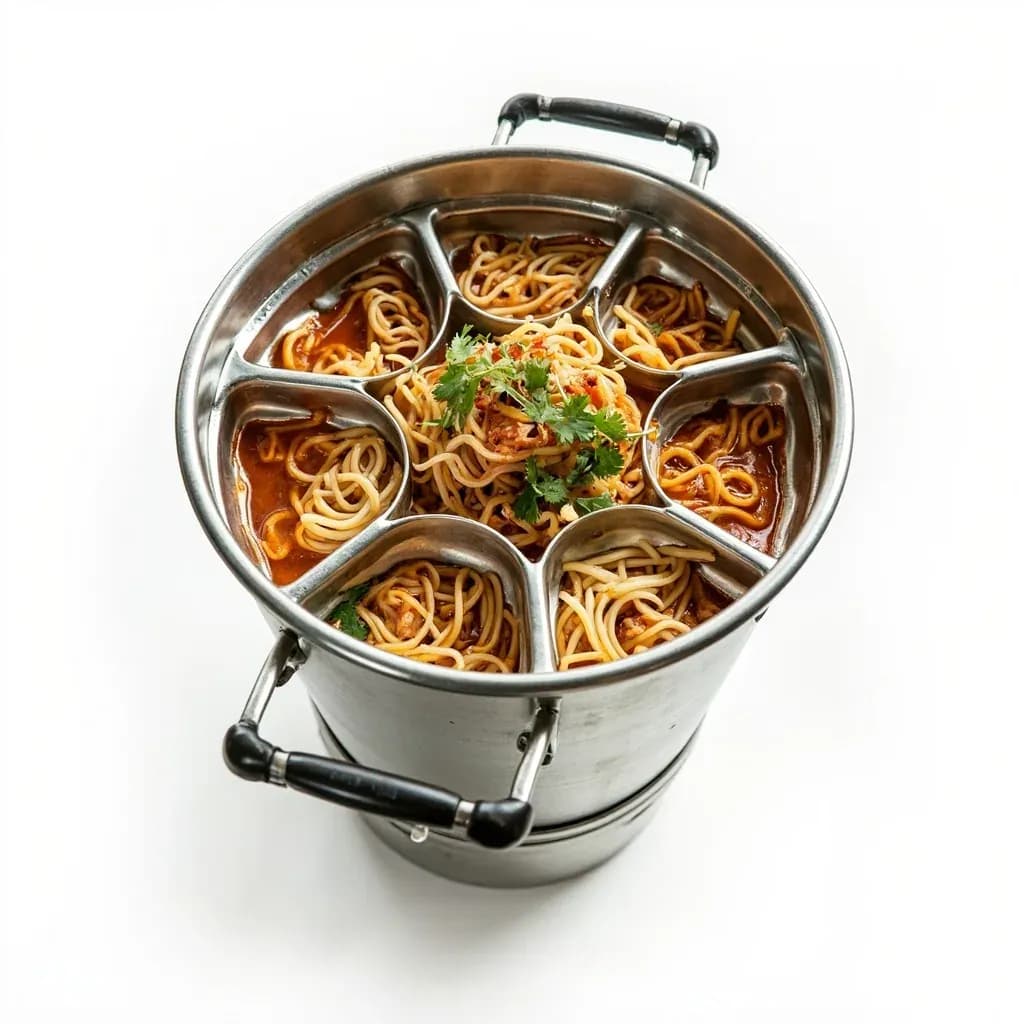
A noodle cooking pot is a deep vessel used to boil pasta, ramen, udon, and other noodles in plenty of rolling water. Commercial versions are continuous noodle boilers with multiple basket wells so individual portions can be lowered, timed, and lifted out separately. Home and restaurant cooks favor the height because it keeps long noodles submerged and lets starch disperse without boiling over.
A noodle cooking pot is a tall, narrow stockpot paired with a lift-out perforated basket — and the basket, not the pot, is the point. By letting you drop noodles into boiling water and lift them out in a single motion, it collapses the usual cook-drain-transfer sequence into one smooth move, which is exactly what noodle cookery demands: ramen, udon, lo mein, and rice sticks are unforgiving of the extra seconds a countertop colander costs.
The tall, narrow silhouette is deliberate. Long strands sit vertically with full submersion, so they soften evenly without folding back on themselves, and the footprint stays small enough for a home burner or a tight ramen-ya counter. Capacity is sized to the task — 6 to 12 quarts at home, 4 to 8 liters per well in a commercial setup — with enough water that noodles have room to swim rather than clump.
In a professional kitchen, the same idea scales up into a multi-well noodle stove descended from Cantonese noodle-station cookery: two to four round wells in a single cabinet, each with its own basket and thermostat, so a thin-skin wonton, a thick udon, and a quick-blanch rice noodle can all fire at once without stealing each other's cook time. For home cooks, a 10–12 quart stainless stockpot with a separately purchased mesh basket reproduces most of that function at a fraction of the cost and space.
Alternatives
Types & varieties
Tall stainless stockpot with a mesh or perforated metal basket that lifts noodles out; the most common at-retail form.
Countertop or floor model, one deep pot with a long-handled basket; used in small ramen or pho shops.
Two to four round noodle wells set in a shared heated water bath; each well holds a different noodle so orders fire simultaneously.
Cantonese-style format with individual gas jets under each round well, no shared water bath, faster recovery.
Compact electric unit with a built-in basket and timer, common in food courts and ghost kitchens.
Smaller Japanese-style variant, often a single deep well with a fine mesh strainer for thin somen or shabu-shabu blanching.
Why the basket matters more than the pot
Any deep stockpot will boil water. What makes a noodle pot a noodle pot is the strainer basket — a perforated metal insert sized to clear the rim of the pot with a single handle lift. That geometry turns draining from a three-hand maneuver (pot off the burner, pour into a colander in the sink, shake) into one: hook the handle, lift, hold for two seconds over the pot, and the noodles are ready to plate or shock.
- Home insert baskets are usually sold separately and rarely fit their host pot perfectly — expect a small gap at the rim and keep a towel or second pair of hands handy.
- Commercial baskets are matched to specific well diameters, and most shops keep a dedicated basket per noodle type to avoid cross-contamination of starch and residue.
- Mesh size matters: a coarse basket sheds water quickly but can snag thin noodles like somen or capellini; a finer mesh strainer is the standard for delicate work.
- The lift-and-drain motion is what makes portion control possible during service — one basket per serving means every bowl hits the pass at the same doneness.
Common uses
Tips & pitfalls
- Bring water to a full, rolling boil before adding noodles; noodles added to barely simmering water turn gummy and leach starch.
- Salt the water — roughly a generous handful per gallon, or about 1% by weight — so noodles are seasoned from the inside out.
- Use plenty of water: aim for at least 1 L per 100 g of dry noodles so strands can move freely instead of crowding and sticking.
- Stir within the first 30 seconds to separate the strands, especially with fresh egg noodles and rice sticks, which clump badly if left alone.
- Lift the basket the moment noodles reach al dente; carryover heat will finish them in 10–20 seconds if held in the basket.
- For cold dishes (hiyashi chuka, somen, bún), shock noodles in cold running water right after draining, then chill in ice water to stop the cooking and set the chew.
- Keep a dedicated basket per well in a multi-well cooker so a thin-skin wonton and a thick udon never share a strainer — different hole sizes, different residue.
- Skim starchy foam off the top during a busy service; high-starch water slows recovery to a boil and dulls noodle flavor.
- Don't leave noodles sitting in the hot basket on the side of the pot — they continue to cook and glue themselves together. Drain, portion, and plate immediately.
- Change the water once it goes visibly cloudy and starchy (every 15–20 batches in a single-well setup) — cloudy water coats the noodles in a dull film and slows recovery to a boil.
Good to know
- Category
- Cookware (specialty)
- Primary material
- Stainless steel (commercial); stainless or aluminum (home)
- Typical home capacity
- 6–12 qt (5.7–11 L), tall and narrow profile
- Core components
- Stockpot body, perforated insert basket, lid; commercial units add a drip tray and thermostat
- Heat source
- Gas, electric, or induction; countertop induction noodle cookers are common in food courts and ghost kitchens
- Why tall and narrow
- Long noodles (ramen, udon, lo mein) sit vertically with full submersion and minimal stovetop footprint
- Drain method
- Lift-out perforated basket; some pots add a side spout for pouring off water
- Time to boil (full pot, home gas)
- Roughly 10–15 minutes for 8 qt from a cold start
- Origin
- Specialized cookware that emerged from East Asian (Japanese, Chinese) noodle-shop kitchens; commercial multi-well units are a Cantonese evolution
- Also called
- Noodle cooker, noodle boiler, pasta/noodle insert pot, Chinese noodle stockpot
- Cleaning
- Hand-wash to preserve welds; commercial units typically have removable baskets and drip trays
Also called
Commercial Noodle Boiler · Commercial Noodle Cooker · Pasta Pot
Related

Steamer
Gentle moist heat that keeps vegetables, fish, and dumplings tender

Frying Pan
Shallow sloped pan for frying, sautéing, and quick sears

Saucepan
Tall, straight-sided pot for sauces, grains, and small batches

Sauté Pan
Wide straight-sided pan with room to brown and braise

Dutch Oven
Heavy lidded pot that turns tough cuts tender over hours

Stock Pot
Tall, roomy pot for stocks, pasta, and big-batch cooking

Wok
High-sided bowl pan built for blistering-hot stir-fries

Griddle
Flat, broad surface for pancakes, smash burgers, and breakfast