Cookware
Oak Barrel
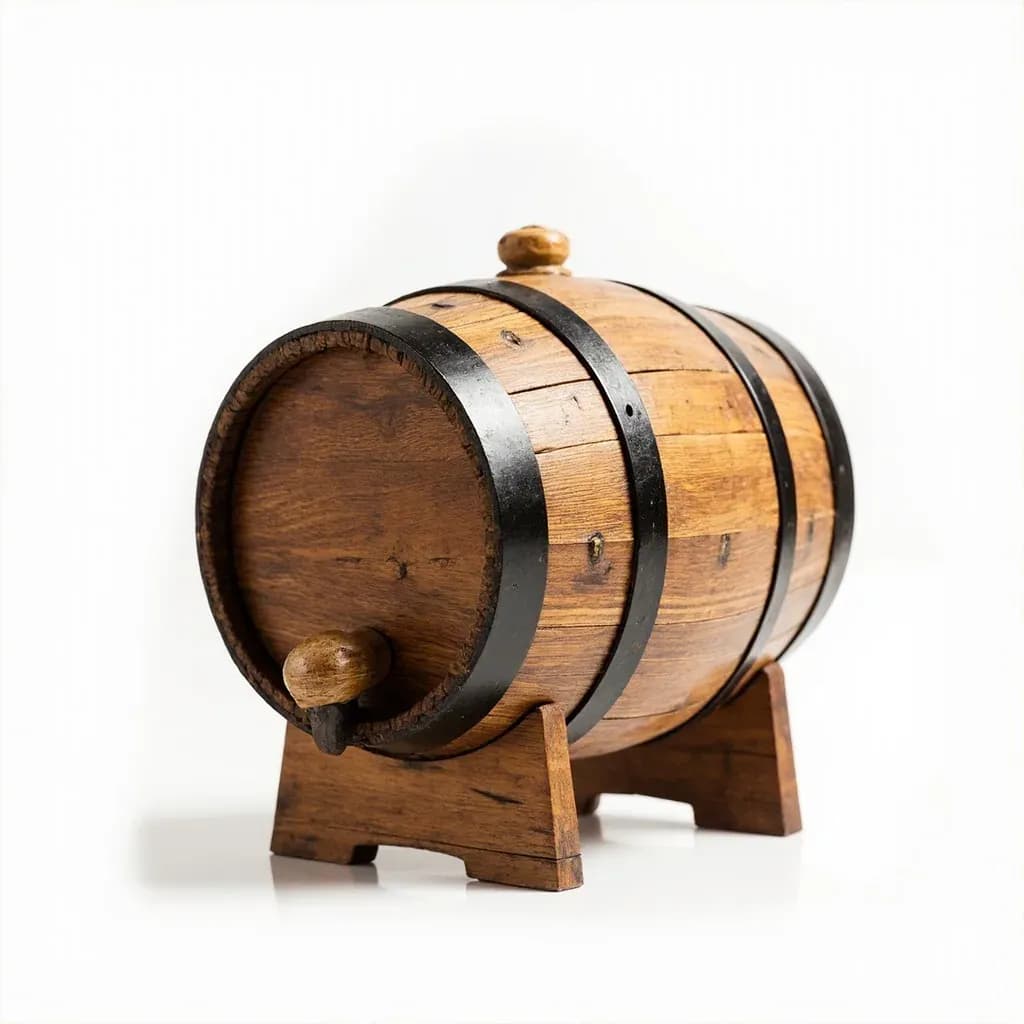
A staved wooden cask used to ferment and age wine, vinegar, spirits and sauces.
An oak barrel is a watertight cask of curved staves bound by metal hoops, used to ferment and age liquids such as wine, vinegar, beer and spirits. The wood slowly imparts tannins and vanillin while allowing micro-oxidation that mellows and develops flavor. Small barrels are also used to age hot sauces, soy and balsamic-style vinegars at home.
An oak barrel is a staved wooden cask built from curved oak planks (staves) bound by metal hoops, with flat end pieces (heads) and a stopper (bung) in the head. For cooks and producers, it is less a container than a flavoring and aging medium: oak is porous enough to admit a slow trickle of oxygen, which softens tannins in wine, rounds spirits, and tames harsh acidity in vinegars and sauces. At the same time the wood itself contributes vanillin, oak lactones (coconut and woody aromas), clove-like eugenol, and ellagitannins, all of which shape the final product over weeks, months, or years.
What the barrel actually does depends on a handful of variables: oak species (American white oak gives more vanilla and coconut; French oak gives more spice, tannin, and structure), barrel size (smaller casks extract far faster than large ones), toast or char level on the inner surface, and how many times the barrel has been filled before. Wine producers commonly age red wines in 225 L barriques for 12–24 months, topping up regularly to compensate for evaporation; distillers char the inside to create a carbon filtering layer; a home cook with a 5 L cask may finish a hot sauce or vinegar in a matter of weeks. The same object behaves very differently at different scales.
Once the exclusive property of wineries and distilleries, oak barrels have migrated into restaurant kitchens, craft hot-sauce shops, and home pantries, mostly in the form of used bourbon and wine barrels sold by cooperages and distilleries at modest cost. Understanding how the wood works — and how to keep it wet and sound — is what separates a tool that quietly improves a product from one that leaks, molds, or turns everything bitter.
Alternatives
Types & varieties
Quercus robur from forests like Limousin, Tronçais, Allier, or Vosges; tighter grain, more tannin and spice; dominant in Bordeaux and Burgundy.
Quercus alba from Missouri, Kentucky, or Minnesota; wider grain, stronger vanilla, coconut (oak lactone), and dill notes; standard for bourbon.
European oak, often seasoned with oloroso, fino, or amontillado sherry before being sold as used casks; used to age Scotch, rum, and vinegar for layered oxidative character.
Made by disassembling used bourbon barrels and re-coopering them with new heads; common for Scotch secondary maturation.
Often Limousin oak; traditional for brandy and increasingly for aged cocktails and vinegar.
Petite format with metal or wooden hoops, marketed for home aging of vinegar, hot sauce, soy sauce, bitters, and cocktails.
American vs French Oak
The two dominant species behave differently because of how the trees grew. European oak from the Limousin, Tronçais, Allier, and Vosges forests grows slowly and produces tight grain (around 6–10 growth rings per inch); this dense wood releases more ellagitannins and gives wines more structure, spice, and length on the palate. American white oak, mostly Quercus alba from the Ozarks and upper Midwest, grows faster with wider grain (3–5 rings per inch) and yields more oak lactones — the compounds that read as coconut, vanilla, and a distinctive dill note from cis-3-methyl-4-octanolide (whiskey lactone), which is more concentrated in American oak. For spirits and bolder products — bourbon, rye, rum, imperial stout, hot sauce — American oak's forward vanilla character is usually a good match. For delicate wines, fine brandy, or subtle vinegars, French oak's restraint is preferable.
Toast and Char Levels
The inner surface of a barrel can be left raw, toasted, or charred, and the choice shapes everything the wood contributes. Toasting is done over embers or controlled heat and is standard for wine: light toast preserves green, woody notes; medium toast brings caramel and brown sugar; heavy toast pushes toward smoke, coffee, and dark chocolate. Charring, used for whiskey, is more dramatic — the inside of the barrel is set on fire for 15 to 55 seconds, creating a layer of carbon that acts as a filter during aging. A #1 char is light; a #4 'alligator char' leaves a deep, cracked carbon crust. Used wine or bourbon barrels can be 'refreshed' by cooperages who sand the interior and re-toast or re-char to revive extraction — worth considering when buying second-hand.
Small-Format Barrels at Home
The 3–15 L barrels sold for home and kitchen use are not just shrunken barriques — they behave differently in important ways. Because surface area to volume is far higher than in a 225 L cask, the wood extracts much more aggressively, so what would take many months in a barrique takes 2–8 weeks in a kitchen barrel. The wood also saturates faster; by the third or fourth fill of hot sauce or vinegar, the barrel is essentially neutral and is best retired or refreshed. Keep these barrels topped up, expect to re-swell them after any dry period, and taste weekly once the product has had a month of contact. For most home users, a used bourbon barrel that has already been 'broken in' is far more forgiving than a brand-new small oak barrel.
Common uses
Tips & pitfalls
- Keep the barrel full or sealed — a dry barrel shrinks within days, leaks, and can grow mold or acetobacter that ruins everything inside.
- Swell a new or dried barrel by filling it with hot water over 24–72 hours, rotating it so every stave gets wet, and checking the bung for leaks before adding product.
- Match toast or char level to the product: heavy char suits bourbon, dark rum, and imperial stout; medium toast suits red wine and barrel-aged cocktails; light toast suits white wine, delicate brandy, and most vinegars.
- Store on the bilge (side) or upright on a stand in a cool cellar (12–16 °C / 55–60 °F) with moderate humidity; avoid sunlight, vibration, and temperature swings.
- Top up wine barrels every 1–2 weeks ('ouillage') to replace evaporation through the staves — expect 2–5% loss per year as the 'angel's share.'
- Do not confuse oak chips or cubes with barrel aging — their surface-area-to-volume ratio is far higher, so extraction happens in days, not months, and the result tastes different.
- Taste periodically after 2–3 months of contact; over-oaking is irreversible and turns spirits, sauces, and vinegars woody and bitter.
- Keep the bung hole facing up when storing — the head joint (where the staves meet the head) is the most leak-prone area, and keeping liquid in contact with that point keeps the wood swelled and sealed.
Good to know
- Material
- Oak wood — typically American white oak (Quercus alba) or European oak (Quercus robur / Q. petraea)
- Construction
- 24–33 curved staves, two flat heads, galvanized or cast-iron hoops, and a bung
- Common sizes
- Bordeaux barrique 225 L, Burgundy pièce 228 L, American Standard 200 L, Hogshead 250 L, Sherry butt 500–600 L, Cognac 300 L
- Toast levels
- Untoasted, light, medium, heavy — controlled heat browns the inner surface of the staves; standard for wine barrels
- Char levels (whiskey)
- #1 (~15 s), #2 (~30 s), #3 (~35 s), #4 'alligator char' (~55 s) — open flame creates a carbon filtering layer
- Storage
- Must be kept wet; a dried-out barrel shrinks, leaks, and can harbor mold or acetobacter (vinegar-spoilage bacteria)
- Lifespan
- Typically 3–5 fills for wine (5–8 years total); bourbon barrels must be new once by law, then often reused for Scotch, beer, vinegar, and sauces
- Cost range
- New French oak barrique ~$800–1,400; used bourbon barrel ~$100–250; 3–15 L kitchen barrel ~$60–200
Also called
Oak Vinegar Barrel · Wine Barrel · Aging Cask
Related

Steamer
Gentle moist heat that keeps vegetables, fish, and dumplings tender

Frying Pan
Shallow sloped pan for frying, sautéing, and quick sears

Saucepan
Tall, straight-sided pot for sauces, grains, and small batches

Sauté Pan
Wide straight-sided pan with room to brown and braise

Dutch Oven
Heavy lidded pot that turns tough cuts tender over hours

Stock Pot
Tall, roomy pot for stocks, pasta, and big-batch cooking

Wok
High-sided bowl pan built for blistering-hot stir-fries

Griddle
Flat, broad surface for pancakes, smash burgers, and breakfast