Cookware
Onggi (Korean Earthenware Pot)
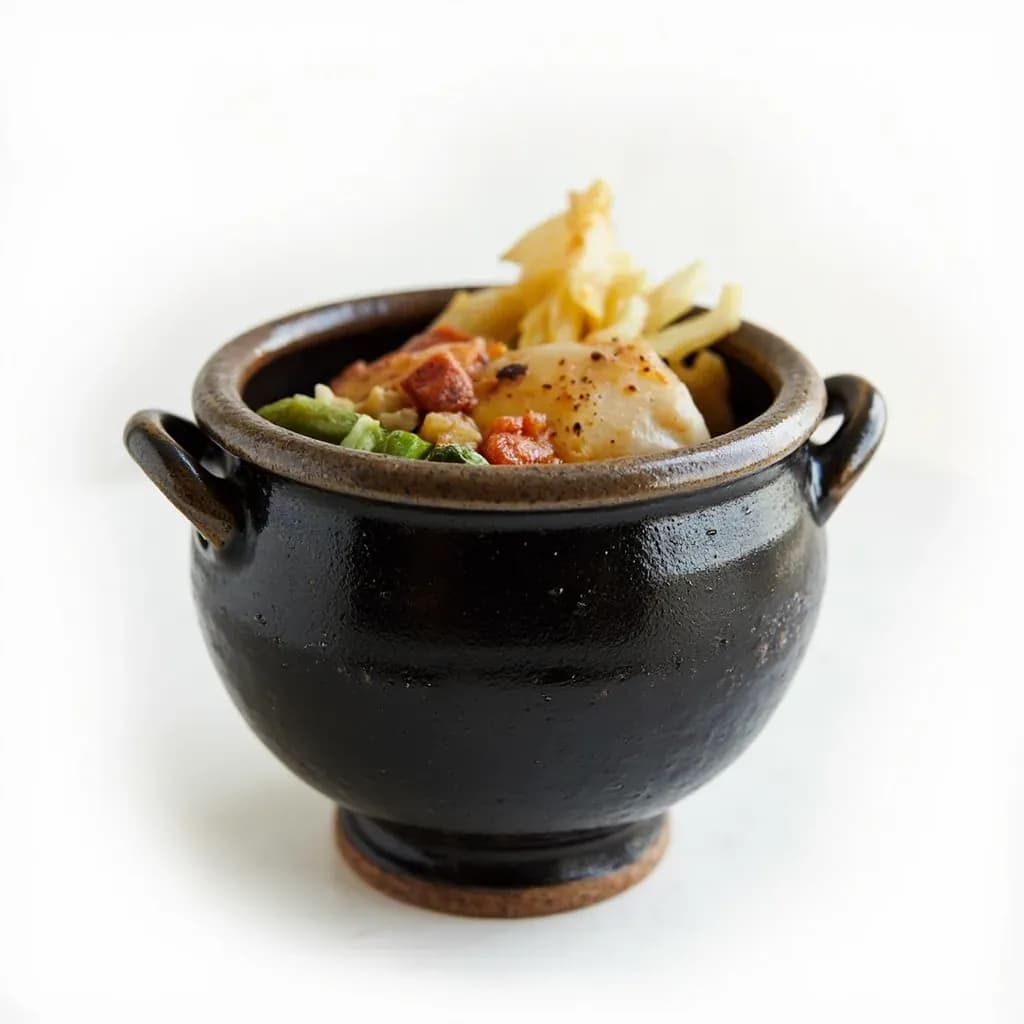
A breathable Korean earthenware crock used to ferment and store kimchi, doenjang, and gochujang.
An onggi is a traditional Korean fermentation vessel made of porous, unglazed or partly glazed earthenware that lets air pass through its walls while keeping liquid in. This breathability supports the slow fermentation of kimchi, soybean paste, soy sauce, and gochujang. Onggi are often buried or kept outdoors to maintain stable temperatures.
The onggi is a Korean earthenware vessel that functions less like a pot and more like a slow, living membrane between fermenting food and the outside air. Made from loess-rich clay fired at relatively low temperatures (around 800–900 °C), its walls remain microporous: oxygen seeps inward in tiny amounts while carbon dioxide from active fermentation works its way out, but liquid and contaminants stay locked inside. That gentle gas exchange, combined with the clay's slightly alkaline chemistry, is what gives long-aged Korean ferments — kimchi, doenjang, ganjang, gochujang — their particular depth, mellow acidity, and resistance to surface spoilage.
In a traditional Korean household, onggi are rarely kept indoors. They live on a jangdokdae, an elevated, shaded outdoor platform — usually on the north side of a hanok courtyard — where temperature swings are gentle and humidity is reasonably stable across the seasons. The vessel is treated as a partner in fermentation rather than a passive container: the unglazed clay absorbs character from past batches the way a well-used unglazed clay tagine does, and a seasoned onggi passed down through generations is considered a family heirloom on par with a grandmother's stone mortar.
For cooks outside Korea, the practical question is whether an onggi is worth sourcing over a Western fermentation crock. For week-long napa-cabbage kimchi, the gap narrows — a water-seal crock with a ceramic weight produces excellent results. But for long-aged soybean pastes and soy sauces (anything beyond a few months), the onggi's combination of controlled micro-oxygenation, pH buffering, and slow evaporative concentration is genuinely hard to replicate in glass or glazed ceramic.
Alternatives
Types & varieties
Squat and wide-mouthed so halved napa cabbages can be pressed down under brine without bruising or folding
Tall, narrow-waisted jars; the constricted neck limits air contact and evaporation during months-to-years aging of soybean paste and soy sauce
Medium-bodied jars, often partially buried in soil or stored deep in shade so the chili paste ferments slowly and evenly
Small 1–5 L table or countertop versions for single batches, doenjang-jjigae starter, or gukganjang refills
Half-buried in the ground or in an earthen mound for winter kimchi; surrounding soil buffers freeze-thaw cycles
Eumseong (Chungcheong-do) is famed for large storage jars; Jeju onggi uses volcanic clay with a distinct mineral character
How the onggi actually works
Three features of the clay wall do the work, and understanding them makes every other rule about the vessel make sense.
- Microporosity: at 800–900 °C the clay never fully vitrifies, leaving a network of microscopic channels. Oxygen trickles in at a rate that keeps aerobic yeasts and molds from colonizing the surface, while CO₂ from lactic fermentation vents outward — the same logic as a wine barrel, but at a much finer scale.
- Alkalinity: loess clay carries calcium and magnesium carbonates. These buffer the ferment toward a slightly higher pH than glass would allow, which shifts the competitive balance in favor of the lactic bacteria doing the work.
- Evaporative concentration: the same pores let a small, steady amount of water vapor escape. Over months this gently concentrates the solids in doenjang and ganjang, deepening color and umami in a way sealed containers cannot.
Curing and seasonal care
An onggi is bought once and used for decades, but only if you bring it into service slowly and respect its seasonal rhythms.
- First-use cure: fill with rice-water (or plain water) and change it daily for 5–7 days so the clay saturates and any residual earthy flavor leaches out. Skip this and your first batch of kimchi will taste of dust.
- Porosity test on a used or vintage crock: flick a few drops of water on the outer wall. They should darken the clay and slowly absorb within a minute. If they bead up, the pores are clogged (usually with soap or oil) and need a long hot-water soak before use.
- Winter burial: for kimchi meant to last through the cold months, sink the crock up to its shoulder in a mound of soil, sand, or packed straw. The thermal mass prevents the freeze-thaw cycling that cracks unglazed earthenware.
- Off-season dry storage: when empty for long stretches, leave the lid off and the crock in shade so the wall dries evenly. Storing it wet and sealed invites black mold on the exterior (cosmetic, not harmful, but a sign of poor airflow).
Common uses
Tips & pitfalls
- Cure a new onggi for 5–7 days in changing rice-water or plain water before any food touches it; the first fermentation in an uncured crock will taste of raw clay.
- Never try to make the crock airtight. The microporous wall is the entire point; pair it with a heavy stone or earthenware lid weighted with a stone ring, not a rubber gasket.
- Keep the inner wall in contact with food at all times. An empty rim zone dries out, loses local porosity, and becomes the spot a crack starts.
- Avoid soap and detergent. Hot water, a stiff brush, and coarse salt are enough; soap clogs the pores and will haunt the next several batches of kimchi.
- If a hairline crack appears, patch it with a paste of rice flour and wood ash (the traditional fix) or food-grade beeswax. Do not reach for silicone — it seals the wall and silently ruins the vessel for fermentation.
- Lift, never roll. Onggi are heavy, brittle, and unforgiving at the rim; a small impact there will spider-crack the wall.
- Top up brine or paste level as it drops during long aging. A low level exposes the upper wall and the lid-stone will develop a sour, yeasty film that drips back in.
- Rinse and air-dry the exterior after rain or heavy dew. Persistent outer dampness invites black mold on the outside wall — cosmetic, but a reliable sign the crock is in a poorly ventilated spot.
Good to know
- Origin
- Korea; onggi-making tradition documented since at least the Three Kingdoms period (c. 57 BCE–668 CE)
- Material
- Unglazed, low-fired earthenware from loess-rich clay, traditionally tempered with sand or chamotte (grog) to keep the wall porous
- Key property
- Microporous walls that allow slow gas exchange (O₂ in, CO₂ out) while excluding liquid and external contaminants
- Color
- Typically dark brown to charcoal gray, a result of reduction firing
- Firing temperature
- Around 800–900 °C, far below porcelain; this preserves the open pore structure that is the vessel's whole point
- pH effect
- Slightly alkaline clay helps buffer acidic ferments and discourages surface spoilage microbes
- Common household size
- 10–30 L for kimchi; 30–100 L for pastes and soy sauce; small 1–5 L onggi-dol for table use
- Lid
- Usually a flat stone or earthenware disc weighted with a stone ring — heavy enough to maintain contact while still letting fermentation gas escape
- Traditional placement
- Jangdokdae — an elevated, shaded outdoor platform, usually on the north side of the house
- UNESCO status
- Inscribed on the Representative List of the Intangible Cultural Heritage of Humanity in 2022 as 'Onggi, traditional Korean earthenware'
Also called
Korean fermentation crock · hangari
Related

Steamer
Gentle moist heat that keeps vegetables, fish, and dumplings tender

Frying Pan
Shallow sloped pan for frying, sautéing, and quick sears

Saucepan
Tall, straight-sided pot for sauces, grains, and small batches

Sauté Pan
Wide straight-sided pan with room to brown and braise

Dutch Oven
Heavy lidded pot that turns tough cuts tender over hours

Stock Pot
Tall, roomy pot for stocks, pasta, and big-batch cooking

Wok
High-sided bowl pan built for blistering-hot stir-fries

Griddle
Flat, broad surface for pancakes, smash burgers, and breakfast