Cookware
Earthenware Fermentation Crock (Onggi)
A breathable Korean clay crock for fermenting kimchi, soy paste, and other preserves.
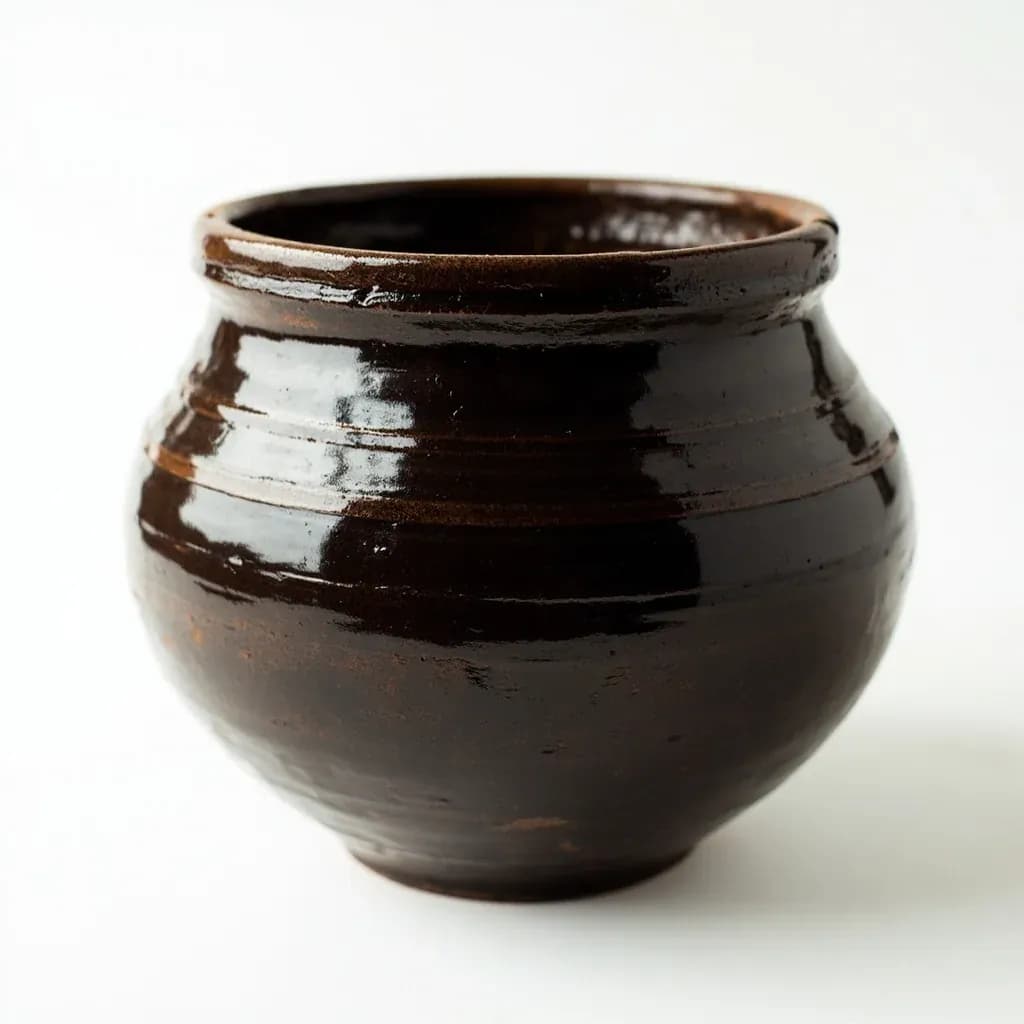
An onggi is a large, breathable Korean earthenware jar traditionally used to ferment and store kimchi, doenjang, gochujang, and soy sauce. Its porous clay walls let air pass slowly while keeping the contents sealed, creating ideal conditions for slow lactic fermentation. Historically buried or kept outdoors, onggi maintain a stable temperature for months-long aging.
An onggi is an unglazed Korean earthenware vessel engineered specifically for fermentation. Its defining feature is not the shape or the clay but the microporous wall: fired without an interior glaze, the body breathes, allowing carbon dioxide produced by active ferments to escape while restricting oxygen ingress. That same porosity gives lactic-acid bacteria and yeasts a textured mineral surface to colonize, so a well-used onggi carries a stable resident microflora that older generations of cooks considered part of the seasoning. The wide belly provides room for stirring paste-style ferments and for packing vegetables under their brine, while the narrow neck limits headspace, keeps solids submerged, and concentrates the protective layer of liquid or weighted cover.
Shape, size, and lid design all follow function. Kimchi crocks typically carry a water-seal rim (cheongsu) — a groove around the mouth that holds a thin layer of water, creating a simple anaerobic barrier against spoilage molds. Jang-aging crocks for doenjang, ganjang, and gochujang usually omit the water seal and rely on a domed inner lid and weighted outer cover instead, since these pastes and liquids do not need the same liquid lock. Sets of graduated jang onggi are a traditional feature of Korean courtyards, where the vessels are sometimes partially buried in a shaded onggi-bang for thermal stability across the seasons.
Outside Korea, the term is often used loosely. Many pots sold as "kimchi pots" or "Korean crocks" are glazed stoneware that performs like an ordinary jar — useful for refrigerator storage but missing the breathability and microbial habitat that define a true onggi. Authentic pieces are heavier, feel slightly chalky on the broken rim, and may show a faintly textured or "hairy" exterior where working clays were deliberately left rough. When sourced from Korean pottery villages or reputable Korean kitchen suppliers, a single well-cared-for onggi can serve a household for decades, deepening in character with each season of use.
Alternatives
Types & varieties
Smaller to mid-sized crocks, frequently with a wide water-seal groove around the rim to keep fermenting vegetables submerged and anaerobic.
Larger vessels for aging doenjang, ganjang, and gochujang; usually without a water seal and traditionally sold and used in graduated sets.
Shallow or wide-mouthed forms used for the initial fermentation of soybean bricks (meju) before they are broken up and aged into paste.
Mass-produced "onggi-style" crocks are often glazed inside; the glaze defeats the breathability that defines a true onggi and converts the vessel into an ordinary storage jar.
The Science of the Clay
What makes an onggi different from any other ceramic pot is the wall itself. Onggi is low-fired earthenware, not vitrified stoneware, and that lower firing temperature is the key: the clay particles fuse just enough to hold liquid — surface tension keeps brine inside the micropores — while the body remains open enough at the micron scale to pass gas. During an active lactic fermentation, CO2 produced by Leuconostoc and later Lactobacillus must escape; if it cannot, pressure builds and the brine turns overly acidic and yeasty. A glazed pot traps it. An unglazed onggi lets it diffuse out gently. At the same time, the slow ingress of small amounts of oxygen supports the aerobic yeasts and molds that contribute to the deeper flavor of long-aged jang, while keeping the bulk environment anaerobic enough to favor lactic bacteria in vegetable ferments. The same porous surface is a habitat: a long-used crock is biologically seasoned, and traditional cooks would never scrub a treasured jang onggi back to sterile clay.
Identifying a True Onggi
Because the category is widely imitated, it pays to know what to look for before committing to a vessel that may be used for years.
- Tap the wall with a fingernail: unglazed earthenware gives a duller, slightly chalky ring than vitrified stoneware or porcelain.
- Inspect the rim and any chipped edge — true onggi shows the same earthy body color throughout, with no glassy interior coating.
- Pour a thin line of water on the outside; on a genuinely porous piece it will darken the clay within seconds as the wall wicks it in.
- Check for a cheongsu groove if you intend to ferment kimchi; the water-seal rim is a functional feature, not decoration, and is the traditional way to keep a kimchi crock anaerobic during active fermentation.
- Avoid vessels labeled dishwasher-safe or microwave-safe — those markings imply a vitrified or glazed body designed to keep water and food fully separated from the clay.
Caring for an Onggi
An onggi is a working tool that improves with age, but only if treated with attention to its material nature. Three rules do most of the work: keep it thermally stable, keep it chemically simple, and keep it dedicated.
- Season a new crock by soaking it 24–48 hours in salted rice water or a weak brine; this hydrates the clay evenly, reveals any hidden cracks, and pre-loads the wall with salt.
- Wash only with plain water and a coarse-salt scrub for stuck residue. Soap and detergent penetrate the porous wall and will leach into future ferments.
- Avoid thermal shock: never pour hot liquid into a chilled vessel, and do not move an empty crock from a cool cellar into a hot kitchen. Warm and cool it gradually with rinses of tepid water first.
- Dedicate specific crocks to one product family when possible. A kimchi crock seasoned over years will carry cabbage aromatics that can overpower the more delicate profile of doenjang or ganjang.
- Dry thoroughly before long storage — wipe, then air-dry inverted in a shaded, ventilated spot. Trapped moisture in the wall can encourage mold growth that is difficult to remove.
Common uses
Tips & pitfalls
- Before first use, season a new crock by soaking it in salted rice water or a weak salt solution for a day or two, then rinsing; this tempers the clay and reveals cracks before you commit a ferment to it.
- Use only unglazed, truly porous onggi for active fermentation — a glazed interior blocks gas exchange and turns the vessel into an ordinary airtight jar.
- Avoid thermal shock: never move a cold or empty crock into a hot environment, and never pour hot liquid into a chilled vessel, as unglazed clay can crack along the rim or body.
- Wash with plain water only; soap and detergent are absorbed into the clay and will taint future ferments. A coarse salt scrub handles stuck residue.
- Dedicate specific crocks to one product family when possible — a long-used kimchi crock will carry kimchi aromatics that can overwhelm doenjang or ganjang.
- Weigh down fermenting vegetables with a stone or fitted weight so they stay submerged under their own brine; exposed surfaces invite surface yeast and mold.
- If your kimchi onggi has a water-seal groove, keep it filled with clean water and refresh it regularly; a dry or dirty seal breaks the anaerobic barrier the crock is designed to provide.
- Beware of imitations sold as onggi but finished with interior glaze or made of vitrified stoneware — they look similar but lack the breathability and microbial stability of authentic onggi.
- Lift and move onggi carefully — they are heavy and brittle. Support the base, never the rim, and avoid dragging the vessel across hard surfaces.
Good to know
- Origin
- Korea; onggi-making traditions date back over a thousand years and are recognized as Korean intangible cultural heritage.
- Material
- Unglazed fired clay, traditionally reddish-brown or gray, with a microporous body.
- Shape
- Wide rounded belly with a narrow neck; usually a domed inner lid and an outer cover, with a water-seal rim (cheongsu) on kimchi crocks.
- Key Property
- The unglazed wall is permeable to gases, allowing CO2 to escape during fermentation while limiting oxygen ingress and providing a surface for beneficial microbial colonization.
- Typical Capacity
- Household vessels range from roughly 3 L to 30 L; traditional commercial and temple-size onggi can exceed 50–100 L.
- Best Storage Environment
- Cool, stable temperature; traditionally kept in shaded outbuildings, cellars, or partially buried in the ground (onggi-bang).
- Primary Contents
- Kimchi, doenjang (fermented soybean paste), ganjang (soy sauce), gochujang (chili paste), cheonggukjang, and other jang family condiments.
- Lifespan
- Decades if handled carefully; seasoned crocks develop a deepening patina and a stable resident microflora.
Also called
onggi-jar · onggi-crock · kimchi-jar · Onggi · Fermentation Crock
Related

Steamer
Gentle moist heat that keeps vegetables, fish, and dumplings tender

Frying Pan
Shallow sloped pan for frying, sautéing, and quick sears

Saucepan
Tall, straight-sided pot for sauces, grains, and small batches

Sauté Pan
Wide straight-sided pan with room to brown and braise

Dutch Oven
Heavy lidded pot that turns tough cuts tender over hours

Stock Pot
Tall, roomy pot for stocks, pasta, and big-batch cooking

Wok
High-sided bowl pan built for blistering-hot stir-fries

Griddle
Flat, broad surface for pancakes, smash burgers, and breakfast