Knives & Cutting
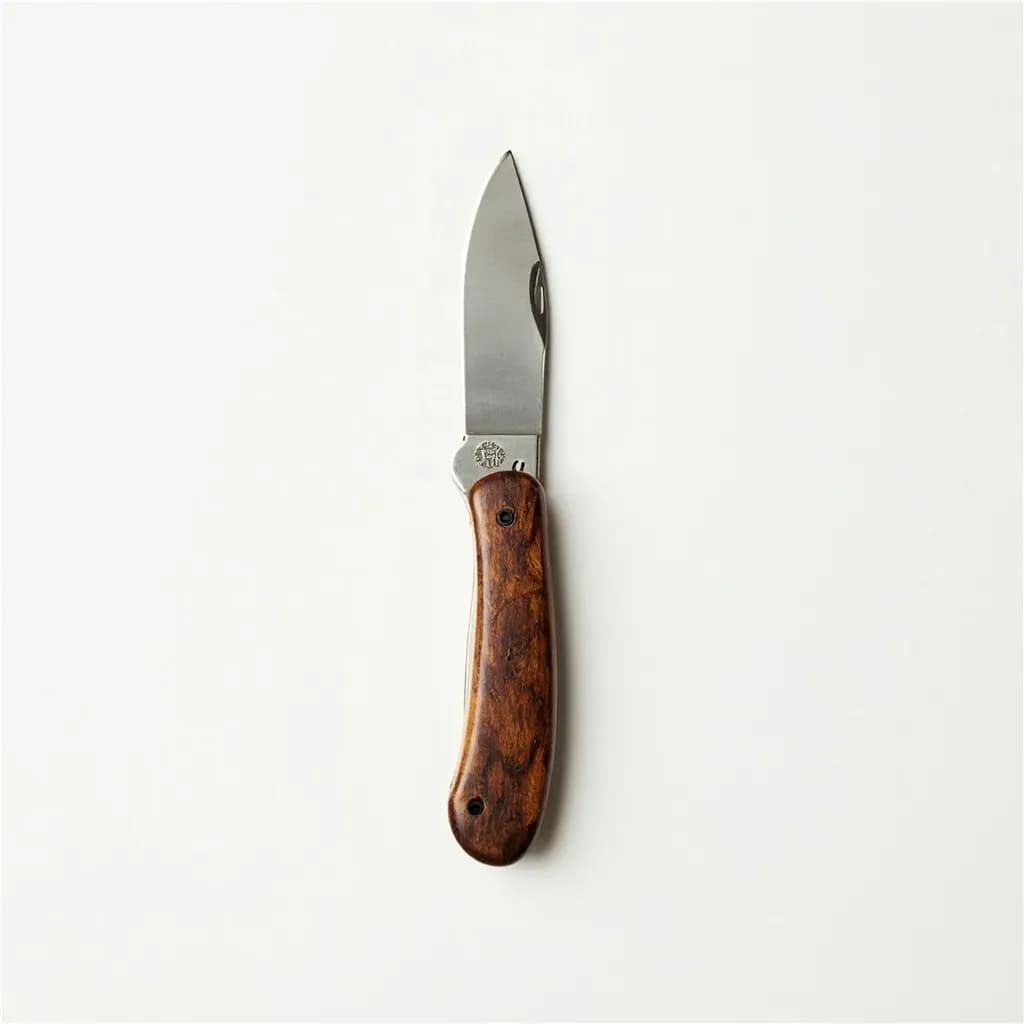
Opinel Folding Knife
A classic French wood-handled folding knife used for everyday paring, picnics, and outdoor cooking.
An Opinel folding knife is a simple, inexpensive French pocket knife with a carbon or stainless blade and a beechwood handle, secured by a twist-lock collar. Cooks reach for it as a handy paring and utility blade for trimming, peeling, and slicing, especially outdoors and for picnics. The locking ring keeps the blade fixed during use and lets it fold safely for storage.
The Opinel is a lightweight, single-blade folder with a beechwood handle and a slim, slightly bellied blade that traces its silhouette to the traditional Savoyard Yatagan-style profile — a single-edged shape with a broad heel and a tapering point, once carried by farmers and cheesemakers in the French Alps. Conceived in 1890 by Joseph Opinel in the village of Albiez-le-Vieux, the knife was sold to size rather than to vague categories — a retail innovation that let buyers match the handle to their own grip and turned the No. 8 into a quiet national object. In the kitchen it behaves less like a chef's knife and more like a nimble side tool: the broad heel handles shallots, garlic, mushrooms, and small fruit, the tapering point reaches into cores and stems, and the short, rigid blade gives a cook more control over a clove of garlic than a 20-cm chef's knife ever will.
What makes the Opinel endure is the combination of a simple, repairable construction (one blade, one pivot, one beech handle) and the Virobloc rotating ring, patented by Marcel Opinel in 1955, which locks the blade both open and closed. That second feature transformed it from a worker's knife into something safe to carry in a pocket, a drawstring bag, or a kitchen drawer. It is a folding knife rather than a dedicated kitchen tool, but it is the side knife of choice in countless bistros, cheese counters, and outdoor kitchens precisely because it disappears into a pocket, sharpens quickly on a small rod, and does the small, fiddly jobs that wear a heavy knife out.
Alternatives
Types & varieties
Compact paring size; the right pick for cheese boards and small fruit on the go.
A slightly nimbler alternative to the classic, with a smaller handle for smaller hands.
The iconic everyday size — Opinel's bestseller since the early 20th century and the default recommendation.
Larger hand-friendly folder, comfortable for cooks with bigger grips who still want a folder.
Approaches the feel of a small utility knife; good for a cook who wants one folding blade to do real prep work.
A serious field-blade size, favoured for hunting and campsite food prep.
The ceremonial 'Yatagan' — heavy, dramatic, and largely a collector's piece.
XC90 high-carbon blade; prized for its keen edge, but demands the oil-and-wipe care of any carbon knife.
The low-maintenance default in Sandvik 12C27; the right choice for damp kitchens and humid climates.
Premium hardwood handles — walnut, olive, oak, hornbeam, ash, amourette — paired with the stainless blade.
Slim, pointed paring profile aimed at fine kitchen work rather than outdoor use.
Child-sized folder with a blunted tip and Virobloc, designed for learning-knife use in the kitchen.
Stainless No. 8 with a pealess whistle, firestarter rod, and integrated shackle key built into the handle.
Stainless No. 12 with a notch at the spine that doubles as a screwdriver and wire-stripper.
Handles decoratively engraved or pyrographed with regional or pictorial motifs; collector appeal.
Carbon versus stainless: the choice that defines the knife
The single decision that matters most when buying an Opinel is the steel. The carbon 'Tradition' line (XC90) is closer in spirit to a traditional French kitchen knife: it sharpens easily on a small ceramic rod, takes a finer edge, and rewards regular honing. In return, it develops a grey-blue patina on vegetables like onions, garlic, and shallots, and it will rust if left wet. The stainless 'Classique' line (Sandvik 12C27) is softer than modern powder-metallurgy chef's knives, so it dulls a touch faster, but it tolerates a damp pocket, a wet dishcloth, and an occasional missed towel-dry without complaint. For a working cook in a busy kitchen, stainless is the practical default. For a home cook who sharpens often, wipes the blade after every use, and wants a keener edge for slicing saucisson or shaving Parmigiano rind, carbon is the more rewarding choice.
- Carbon: sharper, easier to hone, patinas, will rust — choose it if you dry the knife after every use.
- Stainless: lower maintenance, slightly softer edge, no patina — choose it for damp kitchens, picnics, and pockets.
- Both steels sharpen well on a fine ceramic rod or 1000-grit waterstone; skip coarse pull-through sharpeners.
- The Virobloc ring is stainless on every model, so the lock will not rust even on a carbon-blade knife.
Sizing philosophy: how to pick your Opinel
Opinel numbers describe the handle, not the blade alone, and the right size is the one that fills the closed hand comfortably. Lay the closed knife in your palm; the handle should reach roughly from the heel of the palm to the base of the fingers, with a thumb's width of room. In a kitchen context this means most cooks settle on the No. 7, No. 8, or No. 9: large enough to peel a kilo of mushrooms, small enough to live in an apron pocket. The No. 6 is the right size for a cheese board or picnic where weight matters; the No. 10 and above cross into field-blade territory and are heavier than a kitchen drawer really needs.
Common uses
Tips & pitfalls
- Pick size by laying the closed knife in your palm — the handle should match the width of your hand at the knuckles, with a thumb's width of slack.
- Always engage the Virobloc ring in both positions: locked open during use, locked closed in a pocket or drawer so the blade cannot drift out.
- Hand wash and towel-dry immediately; the beech handle will swell and crack, and the Virobloc will corrode, if the knife is soaked or run through a dishwasher.
- Hone the blade on a fine ceramic rod rather than a coarse steel — the stainless steel is softer than most chef's knives and a coarse steel will chip the edge.
- Avoid twisting the blade sideways through hard items like winter squash rind or bones; the pivot screw is set for vertical cuts, and lateral torque is the most common cause of a loose Opinel.
- Use the spine of the blade for prying and scraping; the narrow tip is the most fragile point on any folder and should be reserved for piercing and detail work.
- Revive a dry, pale beech handle with a thin rub of raw linseed or food-grade walnut oil — never vegetable oil, which goes rancid, and never soak the wood.
- For cheese service, give the blade a quick rinse and dry between cheeses; strong-smelling wheels like Reblochon and Roquefort will lend their flavour to anything you cut next, and a wet blade will spot the beech.
Good to know
- Origin
- Savoie, French Alps (Albiez-le-Vieux, then Chambéry); founded 1890 by Joseph Opinel.
- Standard steel
- Sandvik 12C27 modified stainless, hardened to about 57 HRC.
- Traditional steel
- XC90 high-carbon; takes a keener edge, develops a grey patina, can rust if neglected.
- Handle
- Unfinished French beechwood, PEFC-certified; the Luxe line is offered in premium hardwoods including walnut, olive, oak, hornbeam, ash, and amourette.
- Locking system
- Virobloc rotating stainless ring (patented 1955 by Marcel Opinel) locks the blade both open and closed.
- Sizing
- Numbered 2 through 13, keyed to handle length; No. 8 (8.5 cm blade) is the bestseller and archetypal size.
- Weight (No. 8)
- Roughly 45 g / 1.6 oz — light enough to live in a back pocket.
- Care
- Hand wash and towel-dry only; dishwashers swell the wood and corrode the Virobloc.
Also called
Opinel · French Folding Knife
Related

Knife
The fundamental cutting tool every kitchen is built around

Chef's Knife
The do-everything blade for chopping, slicing, and mincing

Paring Knife
Small, nimble blade for peeling and detailed in-hand work

Serrated Knife
Saw-toothed blade that slices crusty bread without crushing

Cleaver
Heavy broad blade for chopping through bone and bulk prep

Cutting Board
The stable surface every cut starts on

Mandoline
Adjustable blade for paper-thin, perfectly even slices

Kitchen Shears
Heavy-duty scissors for poultry, herbs, and packaging