Prep Tools
Oven Thermometer
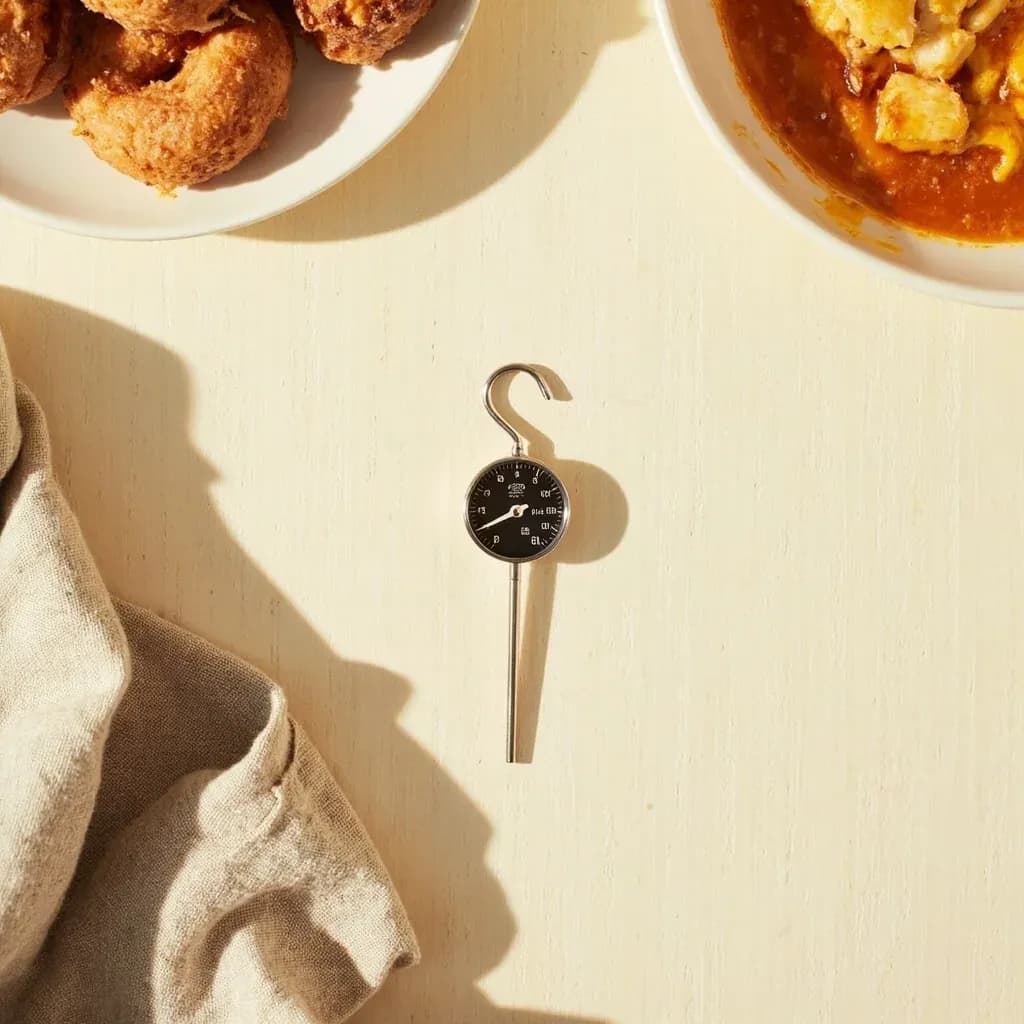
Standalone dial or analog gauge that hangs on a rack to reveal an oven's true temperature, catching the calibration drift that throws off baking; it measures the chamber, not the food.
An oven thermometer is a small temperature gauge that lives inside the oven cavity to report what the air is actually doing, independent of the dial on the front panel. Home ovens are notoriously imprecise instruments — a 25°F gap between the set temperature and the real cavity temperature is routine even on a new range, and the gap often widens as the appliance ages, the element cycles through thousands of on-off cycles, and the thermostat sensor drifts. The thermometer reveals that gap and turns the oven from an instrument you have to guess at into one you can read. For baking, where chemistry runs on tight temperature windows, knowing the true heat is the difference between a soufflé that rises and one that collapses, a custard that sets cleanly and one that curdles, a roast that browns and one that stews in its own juices.
The most common style is a round dial face driven by a coiled bimetallic strip that expands and contracts with heat. Digital versions use a thermocouple or thermistor on a probe tethered to a readout on the counter; these respond faster and often include programmable high/low alarms. Either way, the thermometer measures the chamber, not the food. For internal doneness, pair it with a leave-in probe or instant-read thermometer — two different jobs, two different tools.
Alternatives
Types & varieties
Coiled bimetal strip drives a needle on a round face; hangs from a rack or sits on a shelf; inexpensive, durable, and the most common style
Metal probe on a heat-resistant cable sits inside the oven while a digital readout rests on the counter or attaches magnetically; faster, more precise, often programmable with alarms
Small dial with a hook that suspends it from a rack so the face can be read through the oven window
Flat-base dial that sits on the oven floor; useful for low-heat work but slower to register at high temperatures
Handheld IR gun pointed at the rack or food; reads surface temperature only and is an adjunct rather than a true oven thermometer
Why Oven Drift Matters
A home oven's thermostat cycles on and off around a target, and the dial reports the target, not what the food actually experiences. The thermostat sensor sits inside the cavity but reflects only its own location — it doesn't capture hot pockets near the broiler element, cool corners behind a large roast, or the temperature drop when the door opens. The result is that '350°F' on the dial might produce 325°F on a back corner of the rack and 365°F directly under the broiler. In roasting this manifests as uneven browning; in baking it flattens meringues, over-sets custards, and throws off the timing in yeasted doughs that depend on a specific oven-spring curve. A thermometer doesn't fix the oven — it lets you compensate by adjusting the dial, rotating pans, or moving racks.
Convection vs. Conventional
Convection fans move air quickly past the food, increasing heat transfer efficiency. Food typically cooks about 25% faster than in a conventional oven at the same dial setting, which is why most recipes call for a 25°F reduction when using convection. The air temperature a thermometer reads in a convection oven can sometimes appear slightly lower than in a conventional oven at the same setting — the fan evacuates heat as it cycles — but the effective heat delivered to the food is greater than the air reading alone suggests. Use the thermometer to confirm the baseline, then shorten cooking time rather than chasing a higher number on the dial.
Common uses
Tips & pitfalls
- Hang or place the thermometer at the center of the middle rack, not against a side wall where radiant heat skews the reading
- Let the oven preheat for at least 15–20 minutes after the indicator light or beep — ovens signal 'preheated' before the chamber has fully equalized
- Check accuracy once a year against a rolling boil (212°F / 100°C at sea level); replace the unit if it's off by more than 10°F
- For convection ovens, remember the fan creates cooler air-temperature readings than a conventional oven at the same setting — reduce the dial temperature by 25°F and shorten the time accordingly
- Remove the thermometer before running the oven's self-clean cycle; sustained heat above ~600°F can warp a bimetallic coil
- If a dial thermometer has been dropped, assume it's off — impact can bend the coil and permanently skew readings
- Use a second thermometer on a different rack when troubleshooting persistent uneven browning; the gap between them reveals the hot-spot gradient
- Route any digital probe cable away from heating elements and the door gasket to avoid melting the insulation
Good to know
- Primary Function
- Measures actual air temperature inside the oven cavity, independent of the thermostat setting
- Typical Range
- 100°F to 600°F (40°C to 315°C) on most consumer models
- Common Oven Drift
- 25°F or more between set and actual temperature is routine, even on new ovens
- Reading Method
- Bimetallic coil (dial) or thermocouple/thermistor (digital probe)
- Placement
- Center rack, suspended or freestanding, never touching walls, elements, or pans
- Response Time
- Dial models stabilize in 5–10 minutes; digital probes typically 1–2 minutes
- Calibration Check
- Verify against a rolling boil (212°F / 100°C at sea level); replace if off by more than 10°F
- Cleaning
- Wipe with a damp cloth only — not dishwasher safe
- Self-Clean Safe
- No — remove before running self-clean; sustained heat above ~600°F can warp a bimetallic coil
Also called
oven gauge · oven temperature gauge · hang-in oven thermometer
