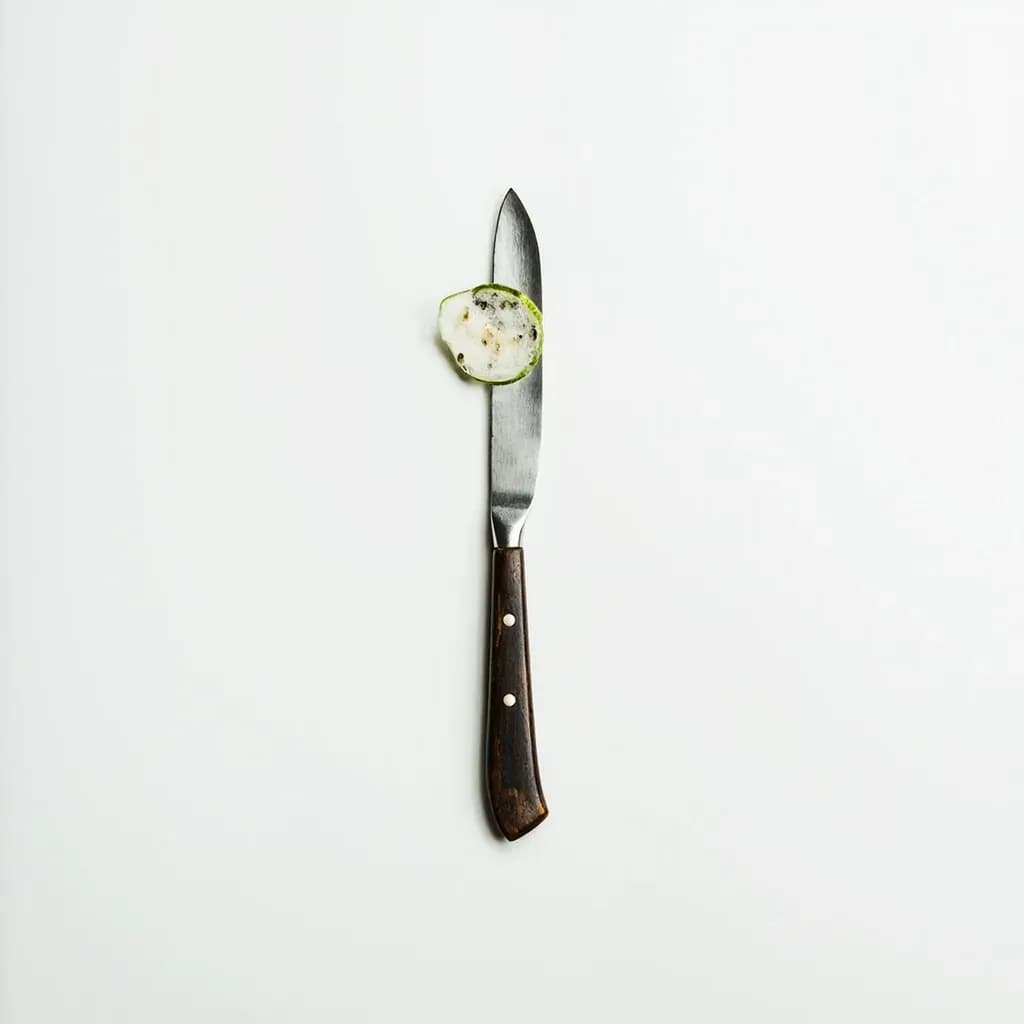
Knives & Cutting
Oyster Shucking Knife
Short, stout blade for prying open oyster shells and severing the muscle inside.
An oyster knife is a short, thick-bladed knife with a blunt, pointed tip and often a guard, made to pry apart tightly closed oyster shells. The cook inserts the tip at the hinge, twists to pop the shell, then runs the blade along the top to cut the adductor muscle. Its sturdy, non-flexing blade resists snapping under the leverage required.
The oyster shucking knife is a small, brutally specialized tool: a short, thick, rigid blade mounted on a stout handle, designed to do exactly one job — defeat a tightly clamped bivalve shell without snapping, skating, or punching through into the meat. Its defining traits are non-negotiable: a stiff spine that won't flex under torque, a blade short enough to be controlled inside a cupped shell, a handle heavy and broad enough to transmit wrist force, and a tip that is usually blunt or gently rounded rather than needle-sharp. Together these features turn the knife into a lever and wedge rather than a cutter, which is precisely what shucking requires.
A paring knife or boning knife is the wrong tool for this work, and not just because it is the wrong size. A thin, tapered blade flexes when you torque it, so the tip either bends or skates across the shell and lands in your thumb. A serrated edge chews up the hinge lip instead of splitting it. Oyster knives are engineered against both failure modes: the thick spine resists flex, the short length keeps the working tip inside the hinge, and the rounded tip can be worked in by feel without stabbing through. Once you understand that the knife is a pry bar that also happens to have an edge, the design starts to make sense.
There are two main opening philosophies that the blade shape reflects. The American hinge-pop style (New Haven, Galveston, Boston) drives the tip into the hinge and twists, popping the shell open with a snap. The French rocking style (Boudeuse, Marseilles) uses a strongly curved blade that is pried sideways into the lip and rocked through. Your choice of knife is partly a function of which motion you've learned and partly a function of the oyster — Gulf Cupped oysters with their thick, deep cups reward the leverage of a longer Galveston blade, while small, hinge-bound Atlantic oysters open cleanly with a New Haven.
Alternatives
Types & varieties
The dominant American style — short, flat, stiff blade with a slightly rounded tip and a wooden handle. Designed to be inserted into the hinge and twisted; the workhorse of East Coast oyster houses.
Longer blade (around 8–9 cm) for opening the larger, thicker-shelled Gulf oysters such as Cupped and Texas-size. Same hinge-and-twist principle as New Haven.
Close to New Haven but with a slightly more tapered, pointed tip, useful for oysters with tight or damaged hinges.
Short, strongly curved blade with a rounded tip; traditional in Brittany and the Mediterranean. Pried rather than stabbed, using a short rocking motion.
Thicker, dagger-like blade (sometimes called a Boston 'stabber') for sliding straight into the hinge in a single thrust — favored by some shuckers who prefer a stabbing motion over a wiggle-and-twist.
Slightly longer, thinner models marketed for both oysters and clams; less leverage than a true oyster knife, but adequate for the home cook who wants one tool.
Anatomy of a working oyster knife
Every part of the knife is a response to a specific failure mode, and once you see the engineering, you start to use the tool more deliberately.
- Thick spine: resists flex when you twist. A thin blade is the single most common reason home shuckers break tips or send the knife across the kitchen.
- Short blade: keeps the working end inside the cupped shell so you can see and feel what you're doing. Long blades are wasted in a shell that is only 8–12 cm across.
- Rounded or blunt tip: lets you work the blade into the hinge gap by feel. A needle-sharp point invites a stab into the mantle or, worse, the heel of your hand.
- Heavy, broad handle: delivers leverage. Shucking is a wrist-and-forearm motion; a light handle forces you to push with the tip, which is exactly the failure mode the design is trying to prevent.
- Flared guard or bolster: gives the holding hand a stop and keeps the knife from punching back through the handle if the hinge resists.
Common uses
Tips & pitfalls
- Always protect the holding hand with a chainmail glove, a cut-resistant glove, or at minimum a doubled-up kitchen towel — the blade will slip before the shell gives, and most shucking injuries happen to the bracing hand, not the knife hand.
- Chill oysters thoroughly before shucking: a 20-minute ice bath or several hours in the refrigerator firms the meat, keeps the liquor in the cup, and helps the adductor muscle release cleanly.
- Discard any oyster that stays open when tapped firmly before you begin — a gaping shell is almost always a dead animal and should not be eaten.
- Cup the oyster with the flat side up, hinge toward you. Wiggle the blade into the hinge, then twist the handle; do not pry with the tip, which can snap or send the knife skittering across the room.
- Keep the edge genuinely sharp. A sharp knife bites the shell and stays put; a dull knife skates across the wet surface and into your thumb.
- After popping the hinge, slide the blade flat along the inside of the top shell to cut the top adductor flush — this is what makes the finished oyster look clean on the half shell.
- Flip the oyster and slip the blade under the meat to release the bottom muscle so the oyster sits flat in the cup rather than swimming in its own liquor.
- Strain and reserve the liquor — it carries a lot of briny, mineral flavor and is the right base for mignonette, chowders, pan sauces, and oyster pan roasts.
Good to know
- Type
- Short, rigid-blade specialty knife designed for prying open bivalve shells
- Blade length
- Typically 5–9 cm (2–3.5 in), depending on style
- Overall length
- Around 18–20 cm (7–8 in) including handle
- Blade material
- Usually high-carbon stainless steel; sometimes carbon steel in traditional French models
- Handle material
- Hardwood (rosewood, walnut), polypropylene, or rubber; often with a flared guard or bolster
- Blade profile
- Thick spine, flat or slightly curved edge, short and stiff — no flex under torque
- Origin
- Specialized form emerged in the 19th century; named regional styles from the U.S. East Coast and Brittany, France
- Care
- Hand-wash and dry immediately; high-carbon blades patina and can stain if left wet
- Typical pairing
- Used with a chainmail or cut-resistant glove on the holding hand
Also called
Oyster Shucker · Shucking Knife
Related

Knife
The fundamental cutting tool every kitchen is built around

Chef's Knife
The do-everything blade for chopping, slicing, and mincing

Paring Knife
Small, nimble blade for peeling and detailed in-hand work

Serrated Knife
Saw-toothed blade that slices crusty bread without crushing

Cleaver
Heavy broad blade for chopping through bone and bulk prep

Cutting Board
The stable surface every cut starts on

Mandoline
Adjustable blade for paper-thin, perfectly even slices

Kitchen Shears
Heavy-duty scissors for poultry, herbs, and packaging