Baking & Pastry
Perforated Baking Tray
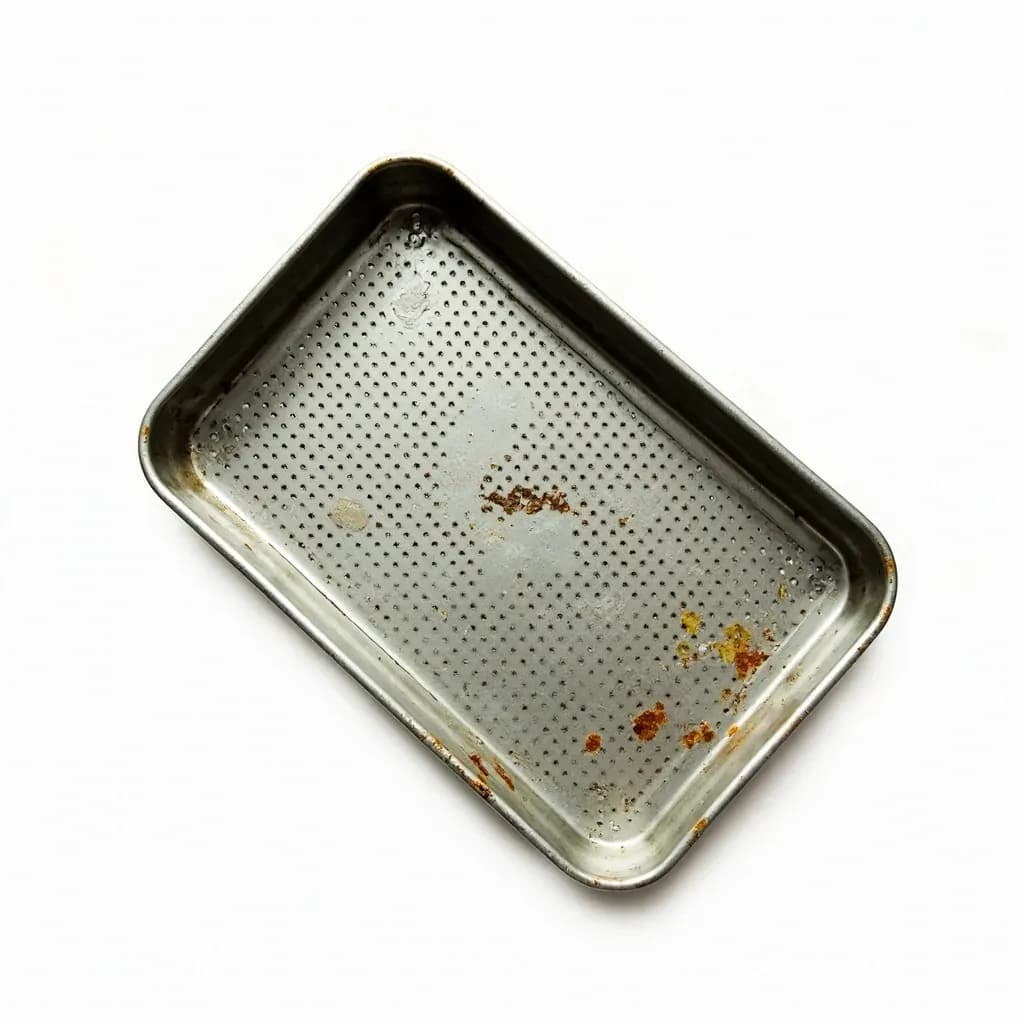
A baking tray punched with holes so hot air circulates underneath for an evenly crisp bottom crust.
A perforated baking tray is a sheet or trough-shaped pan covered in small holes that let heat and moisture escape from beneath the dough. Bakers use it for baguettes and rolls so the bottoms brown and crisp instead of steaming. The same airflow makes it good for crackers, par-baked breads, and reheating pastries without sogginess.
A perforated baking tray is a sheet pan or shallow tray whose floor has been mechanically or laser-punched with a grid of small holes. The holes turn an otherwise solid metal surface into a vented one: instead of trapping steam and radiant heat against the bottom of the food, the tray lets hot oven air circulate underneath, so the base browns, dries, and crisps rather than steaming soft. In practice that means a noticeably better crust on pizza, baguettes, rolls, puff pastry, roasted vegetables, and anything you are reheating from a state that was once crisp.
The tool is a direct descendant of two older European bakery items — the perforated baguette tray and the pizza screen — both of which have been used in professional ovens for decades to coax dry, even heat onto bread bottoms. Home cooks tend to add a perforated half-sheet alongside a regular rimmed sheet pan rather than in place of it, because the solid pan is still better at catching drips, holding loose ingredients, and managing sheet-pan dinners with sauces. The perforated tray is the specialist you reach for when the underside of the food is the part that matters most.
Choosing one is mostly a question of material. Bare aluminum heats fast and browns well but reacts with acidic foods and can warp in thin gauges. Hard-anodized aluminum is more durable, less reactive, and warp-resistant. Stainless steel is the heaviest and most inert, preferred for acidic bakes and for bakers who want a tray that will last decades. Nonstick coatings release food easily but cap at lower oven temperatures and are best on trays with small, well-supported holes.
Alternatives
Types & varieties
Standard home size (~18 × 13 in / 46 × 33 cm); the most common all-purpose style, typically with a 1-inch rim
Commercial bakery and catering size; rimmed or rimless, used in rack ovens and convection ovens
Long, narrow tray, often with 2–5 longitudinal channels/ridges, punched with small holes; shaped specifically for baguettes and ficelles
Round, often rimless, with larger perforations; used directly on a rack or set onto a baking stone
Smaller perforations sized so soft enriched dough does not slump through; common in proof-and-bake cycles
Marketing name for rimless perforated sheets sold for reheating pizza, fries, and pastries in home ovens and air fryers
Aluminum electrochemically treated for a harder, darker, more corrosion-resistant surface; resists warping better than bare aluminum
Coated to reduce sticking; lower max oven temperature and shorter coating lifespan than bare metal
Heavier and more warp-resistant than aluminum; preferred where reactivity with acidic ingredients is a concern
How it works, in the oven
A solid sheet pan behaves like a heat sink: it warms up and then conducts heat into the food mostly from below, while any steam released from the food is trapped against the base and has to escape sideways. A perforated tray breaks both effects. The metal between the holes still conducts heat, but the holes also let dry, oven-temperature air move in under the food and let moist air out, so the surface dries as it bakes. The result is closer to what a pizza screen or a bakery baguette tray has done for decades, and is the reason perforated trays shine on anything that suffers from a soft, soggy underside.
- Convection ovens magnify the effect because the fan pushes hot air straight through the holes; in a still oven, place the tray on a preheated stone or steel to boost bottom heat.
- Hole size is a trade-off: small holes (2–3 mm) support soft dough and small cookies; large holes (5–8 mm) give maximum airflow for pizza and crisping reheated foods.
- A rimmed perforated tray still catches drips and is easier to slide onto a rack; a rimless 'crisping' tray is lighter and lets more air around the edges.
Material choices and what they change
Bare aluminum is the default in most kitchens because it heats fast, browns well, and is inexpensive. Its weaknesses are reactivity with acidic foods (a faint metallic taste and gray discoloration on tomato- or lemon-based bakes) and a tendency to warp in thin gauges, especially under heavy loads. Hard-anodized aluminum addresses both problems with an electrochemical surface treatment that is darker, harder, and non-reactive for most practical purposes. Stainless steel is the heaviest and most warp-resistant option; it heats a touch slower, which can actually help with even browning on longer bakes, and it is the safest choice for acidic ingredients. Coated (nonstick or silicone) trays release delicate items easily but cap at lower oven temperatures, usually around 230 °C / 450 °F, and the coating will eventually degrade.
Common uses
Tips & pitfalls
- Line with parchment paper or a silicone mat when baking wet batters, very soft doughs, or small items that could slump into the holes; air still flows around the edges and through any cutouts in the liner.
- Avoid aerosol nonstick sprays on coated perforated trays — they build up inside the perforations and are very hard to remove. Brush oil on the food instead or use a pump-style oil sprayer.
- Bare aluminum reacts with acidic ingredients (tomato, lemon, vinegar), producing a metallic taste and discoloration. Use stainless, hard-anodized, or a parchment liner for acidic bakes.
- Slide the tray onto the rack before loading it with heavy or wet food; never pick up a full tray by one end when it is hot — this is the most common way to warp a sheet pan.
- Soak the tray in hot soapy water and scrub the perforations with a soft brush after use; baked-on residue clogs the holes and quietly ruins the whole point of the pan.
- In a home oven without convection, set the perforated tray directly on a preheated baking stone or steel to maximize the bottom heat that the holes let through.
- Do not over-oil sheet-pan dinners on a perforated tray — excess oil drips through, smokes on the oven floor, and can coat the heating element.
- When shopping, pick the heavier gauge you can afford: thicker aluminum resists warping and browns more evenly than thin, flimsy trays.
- For very wet or delicate batters, stack two perforated trays (one above the other). The lower tray shields the bottom from the bake element, and the upper one vents steam — a useful trick for sponge cakes and financiers.
Good to know
- Material
- Most commonly aluminum (often hard-anodized) or stainless steel; silicone-coated and nonstick variants exist
- Hole size
- Typically 2–4 mm round perforations; larger 'pizza' styles run 5–8 mm
- Common sizes
- Home: half-sheet (~18 × 13 in / 46 × 33 cm) and quarter-sheet; commercial: full-sheet (~18 × 26 in) and GN 1/1 (~53 × 32.5 cm)
- Heat tolerance
- Aluminum and stainless tolerate up to ~260–300 °C / 500–570 °F; nonstick coatings usually cap at ~230 °C / 450 °F
- Weight (half-sheet aluminum)
- Roughly 0.5–1 kg depending on gauge and rim
- Dishwasher safe
- Most uncoated aluminum and stainless versions are dishwasher safe; coated versions benefit from hand-washing
- Also called
- Perforated baking pan, perforated sheet pan, perforated baking sheet, crisping tray, perforated oven tray
- Origin
- Perforated sheet-metal baking trays became widespread in European professional bakeries and pizzerias in the 20th century as convection ovens gained popularity
Also called
perforated baguette tray · baguette tray · perforated sheet pan
Related

Muffin Pan
Multi-cup pan for muffins, cupcakes, and egg bites

Bundt Pan
Fluted ring mold for showstopping cakes with a center hole

Springform Pan
Latch-release pan that frees delicate cakes without flipping

Pie Dish
Sloped round dish for crisp-bottomed pies and quiches

Tart Pan
Fluted pan with a pop-out base for clean-edged tarts

Rolling Pin
Rolls dough into even sheets for pastry and bread

Pastry Brush
Brushes on egg wash, glaze, butter, and marinades

Bench Scraper
Flat blade that divides dough and clears your work surface