Baking & Pastry
Piping Tip Set
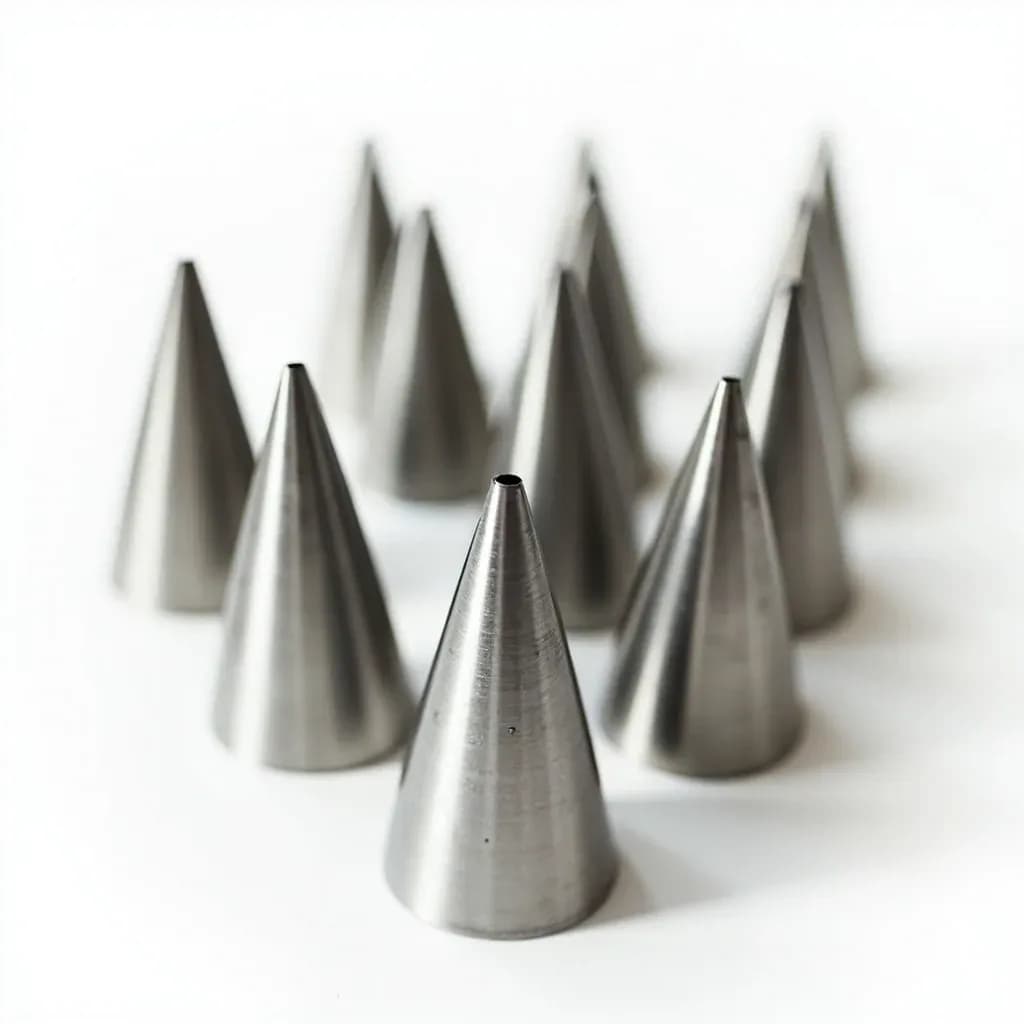
A collection of metal nozzles that fit a pastry bag to pipe frosting, batter, and fillings in shapes.
A piping tip set is an assortment of cone-shaped metal nozzles in different openings, round, star, leaf, petal, and more, that attach to the end of a pastry bag. Bakers swap tips to write with icing, pipe rosettes and borders, fill eclairs, or portion meringue and choux. A coupler lets the decorator change tips without emptying the bag.
A piping tip set is the pastry bag's most important companion — a collection of shaped metal nozzles that determine what comes out of the bag and, just as importantly, what it looks like when it lands. The bag supplies pressure, but the tip's silhouette controls the shape, texture, and visual character of every line, dot, rosette, and border a baker lays down. A well-chosen set spans an enormous range, from a pin-prick round for writing royal-icing signatures to a wide drop-flower nozzle that lays down a generous buttercream swirl in a single squeeze.
Most tips are stainless steel, with premium copper versions prized by pastry professionals and disposable plastic tips reserved for single use or quick color changes. They attach either directly to a narrow-tipped pastry bag or, more practically, to a plastic or metal coupler seated inside the bag so the baker can swap tips mid-project without emptying it. Opening diameters run from about 2 mm for fine work up to 25 mm or more for specialty and Russian-style nozzles, and each shape behaves differently depending on pressure, hand angle, and how close the tip is held to the surface.
Alternatives
Types & varieties
Smooth round opening in sizes from a pin-prick (writing, dot work, stringwork) up to about 1 cm for filling doughnuts, piping choux, and stuffing pastries.
Fluted opening that lays down a ridged line; workhorse for borders, meringue, whipped-cream rosettes, and even duchess potatoes.
Star points meet at the center, producing a finer, sharper star than the open star; classic for buttercream borders and choux pastry.
Wide opening with a star or petal edge that extrudes a single flower as you squeeze and pull up; Wilton 2D and 1M are the most famous examples.
Narrow, slanted V-shape with one flat side and one toothed side for shaping realistic petals and leaves on cakes.
Long, flat opening with one smooth edge and one serrated edge; produces the ribbon-and-fence pattern used on traditional celebration cakes.
Curved, scoop-shaped opening with star ridges; piped in a tight spiral to form rose blossoms from a single squeeze.
Large, multi-nozzle tips that produce complex shapes (tulips, clovers, full flowers) in one motion; more common in modern cake decorating.
Long, narrow round tip designed to reach deep into doughnuts, cream puffs, and entremets for injecting jam, pastry cream, or ganache.
Building a starter set
A piping tip set is a system rather than a single tool, and a small, well-chosen roster covers the vast majority of cake and pastry work. The most useful starter lineup is a small writing round, a medium round, an open star, a petal, a drop flower, and a basket weave — six tips that handle everything from cupcakes to a fully decorated layer cake.
- A small writing round (Wilton #2 or Ateco #0/#1) for fine lines, signatures, and dot work in royal icing.
- A medium round (Wilton #3 or #4, Ateco #4) for outlining, lettering, filling, and piping small dots of batter.
- An open star (Wilton #16, #18, or #21) for borders, whipped-cream rosettes, meringue, and mashed-potato piping.
- A petal/leaf tip (Wilton #104 or Ateco #113) for leaves and ribbon-style flowers.
- A drop flower (Wilton 1M or 2D, Ateco 826) for the classic cupcake swirl and full buttercream roses.
- A basket weave (Wilton #47/#48) for the traditional ribbon-and-fence cake pattern.
Numbering systems: Wilton vs. Ateco
The two most widely referenced numbering conventions in the United States belong to Wilton (the dominant home-baking brand, founded 1929) and Ateco (a professional-supply maker dating to the early twentieth century). A Wilton number and an Ateco number in the same range often describe entirely different shapes, and the two brands also favor different specialties: Wilton skews toward accessible home-decorating shapes like the 1M drop flower, while Ateco offers a deeper catalog of professional-grade piping tips used widely in French and American pastry kitchens. Always check a cross-reference chart before assuming a number translates between brands.
- Wilton 1M = a large drop flower with a pronounced swirl; Ateco 826/827/828 fills the same role but with slightly different ridge profiles.
- Wilton #16, #18, #21 are popular open stars; Ateco's equivalent open stars are numbered in a different range and may be wider or narrower than the Wilton of the same number.
- If a recipe calls for a tip by number, look up which brand it specifies; substituting across brands often changes the size and sometimes the shape.
- Copper Ateco tips are a professional favorite: the metal is machined to tighter tolerances than most stainless sets, and the hand-finished edges hold their shape over years of heavy use.
Technique at a glance
Three small habits separate clean piping from ragged piping: the angle of the bag, the distance from the surface, and the source of the squeeze. Most bakers squeeze from the middle of the bag, which is the fastest way to blow a tip off the end and splatter the work.
- Hold the bag perpendicular (90°) to the surface for dots, and at roughly a 45° angle for borders, lines, and stars.
- Keep the tip close to the surface for stars and borders; lift away as you pipe for petals, leaves, and flowers so the shape can open up.
- Twist the top of the bag closed before piping and grip from the top down — squeezing from the middle forces the tip off the bag.
- For consistent volume and pressure, fill only two-thirds of the bag at a time.
Common uses
Tips & pitfalls
- Chill buttercream 10–15 minutes before piping stiff decorations; it holds a peak and detailed ridges far better than room-temperature frosting.
- Use a coupler whenever a project calls for more than one tip; it lets you swap nozzles without refilling the bag or losing a tip in a full one.
- If a tip clogs, never blow into the bag — push a toothpick through from the outside instead. Blowing sends the blockage (and pressure) straight back at your face.
- For very fine writing, drop down a tip size rather than squeezing harder; pressure changes thickness more than width, and over-squeezing distorts letters.
- Dry tips and bags thoroughly before storage to prevent rust at the seams, especially on lower-cost stainless sets where the rolled edge can trap moisture.
- To keep a tip from working loose mid-piping, push it firmly into the bag until the narrow neck seats, then secure with a coupler ring — a tip that backs out mid-swirl ruins the line.
- For sharp, well-defined roses with a rose tip, hold the bag vertically with the narrow end pointing up and the wide curved opening facing the surface; pipe a tight spiral starting at the center and working outward, then release pressure cleanly to finish.
Good to know
- Material
- Stainless steel is the standard; disposable plastic tips exist for single use; copper tips (notably Ateco) are premium and prized by pastry professionals.
- Size range
- Opening diameter runs roughly 2 mm to 25 mm across a standard set; specialty and Russian-style tips can be even wider.
- Numbering systems
- Wilton and Ateco each run their own numbering systems, so the same number does not mean the same shape across brands.
- How it attaches
- Screws onto the narrow end of a pastry bag, or onto a plastic/metal coupler that sits inside the bag so tips can be swapped without emptying it.
- Common workhorses
- Wilton 1M and Ateco 826/827/828 for large drop-star cupcake swirls; #2–#5 round for writing; #16–#21 star for borders; #101–#104 petal/leaf.
- Cleaning
- Rinse or soak in warm soapy water immediately after use; stainless tips are generally dishwasher-safe. Dried buttercream hardens inside the tip and can block flow.
- Portion guidance
- A standard large drop-star tip dispenses roughly 2–3 oz (55–85 g) of buttercream per generous cupcake swirl.
- Cost
- Entry sets of 6–12 stainless tips run roughly $5–$15; professional sets and copper tips range from $25 to several hundred dollars.
Also called
piping nozzle set · icing tips · decorating tips · pastry tips
Related

Muffin Pan
Multi-cup pan for muffins, cupcakes, and egg bites

Bundt Pan
Fluted ring mold for showstopping cakes with a center hole

Springform Pan
Latch-release pan that frees delicate cakes without flipping

Pie Dish
Sloped round dish for crisp-bottomed pies and quiches

Tart Pan
Fluted pan with a pop-out base for clean-edged tarts

Rolling Pin
Rolls dough into even sheets for pastry and bread

Pastry Brush
Brushes on egg wash, glaze, butter, and marinades

Bench Scraper
Flat blade that divides dough and clears your work surface