Knives & Cutting
Pizza Cutter Wheel
A rolling circular blade on a handle for slicing pizza and flatbreads cleanly.
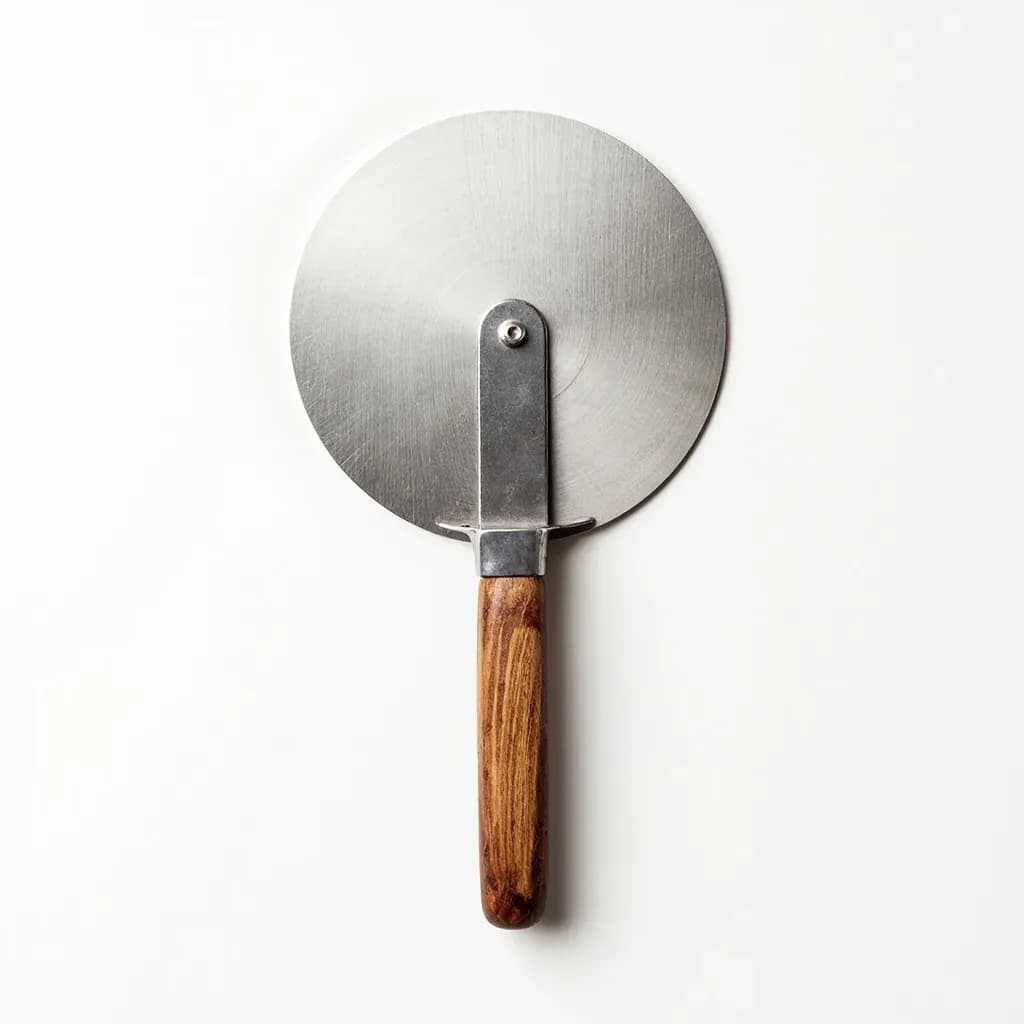
A pizza cutter wheel is a sharp rotating disc mounted to a handle that slices through baked pizza, flatbread, and dough without dragging or displacing toppings. The cook rolls it across the pie in straight passes, and it also handles tasks like cutting pasta sheets, scoring laminated dough, and trimming pastry. Larger rocker-style versions cut a whole pizza in a single motion.
A pizza cutter wheel is a small, rotating circular blade mounted on a handle, designed to slice through baked pizza and flatbreads with a single rolling pass. In practice it is a specialized pastry wheel: the same tool geometry that scores pie dough or cuts lattice strips, scaled down and often given a slimmer, sharper edge to glide under melted cheese and toppings. The rolling action matters because it does not compress the slice downward; the blade enters at the leading edge and exits at the trailing edge, so a well-sharpened wheel can shear a thin-crust pie in one stroke without dragging mozzarella off the surface.
The tool's behavior depends heavily on blade diameter, sharpness, and how it is pushed. A 2.5- to 3.5-inch wheel is the sweet spot for home use: large enough to bridge a standard slice, small enough to track straight without wandering. Pressing straight down is the most common failure — the wheel stops rolling and becomes a blunt chisel, smashing toppings and tearing the crust. A short, committed roll from center outward lets the geometry of the circle do the work.
The rolling wheel is widely associated with American pizzeria culture: David S. Morley of Kent, Ohio patented a dedicated pizza wheel cutter in 1893, and it became the default in American pizzerias and home kitchens. It was not, however, the original pizza-cutting tool. The rocker-style blade — the mezzaluna in Italy and the ulu in the Arctic kitchen — predates it by centuries, and many pizzaioli, especially those working with rectangular Roman pinsa or shatteringly crisp Neapolitan crust, still prefer it. Choosing between them is mostly a matter of personal preference and the style of pizza being cut.
Alternatives
Types & varieties
A single circular blade on a forked or straight handle. The standard American pizzeria and home-kitchen style.
A half-moon or full-moon blade rocked end-to-end. Preferred for rectangular Roman pinsa, very crisp crusts, and large sheet-pan pies because it cuts in one uninterrupted pass.
Wheel slides off the axle for cleaning or replacement. Common on mid- to high-end brands; easier to wash and to swap a dull blade for a fresh one.
Two parallel wheels that produce even strips in one pass. Used for focaccia, sandwich bread, and pastry work where uniform strip width matters.
Scissor-style cutter with a lower blade and a flat spatula base that lifts the slice as it cuts. Especially useful for deep-dish and heavily topped pies.
Contoured or cushioned handle designed to reduce wrist strain for users with arthritis, limited grip strength, or repetitive-use fatigue.
One-piece stainless body, often dishwasher safe, favored in commercial kitchens for durability and sanitation.
Zirconia blade that holds its edge far longer than steel. Brittle — will chip or shatter if dropped onto a hard surface.
Wheel vs. Rocker: When to Choose Which
Both tools do the same job but solve different problems. The rolling wheel excels on round pies and any cut where a short, straight, vertical stroke is needed — a 14-inch New York slice, a pan of Sicilian, a sheet of bar cookies. The rocker excels on long, unbroken cuts and on crusts that shatter under rolling pressure: rectangular Roman pinsa, large focaccia, very thin and crisp Neapolitan pies. If your cutter keeps dragging cheese off the slice, the issue is almost always a dull wheel or a sawing motion; if your crust keeps cracking ahead of the blade, switch to a rocker.
- Round pies, single slices, and short cuts → rolling wheel.
- Large rectangular pies, thin crispy crust, one-pass cuts across a full sheet → rocker.
- Deep-dish, pan pizza, or heavily loaded pies → pizza scissors, which lift the slice as they cut.
- Strip work (focaccia, sandwich bread, pastry) → double-wheel cutter for uniform width.
Anatomy and What Actually Matters
Three details determine whether a pizza wheel cuts cleanly or tears. Blade diameter controls reach and tracking; sharpness controls whether the wheel shears or smushes; and the joint between blade and handle controls wobble. A loose central rivet is the single most common cause of ragged, wandering cuts on otherwise good wheels — and it cannot be fixed by sharpening.
- Blade diameter: 3–3.5 inches is the most versatile home size.
- Joint: a tight, well-seated axle or rivet; wiggle the wheel before buying.
- Edge geometry: a slightly tapered, thin edge shears cheese better than a thick blunt one.
- Handle ergonomics: should let the wrist roll the wheel, not press down on it.
Common uses
Tips & pitfalls
- Roll the wheel from the center outward in one smooth motion; pressing straight down smushes toppings and drags cheese off the slice.
- Use a single decisive pass — sawing tears the crust and pulls cheese and toppings with the wheel.
- Dust the wheel lightly with flour or semolina on oily or very wet pizzas to stop sticking.
- Cut on a wooden pizza peel or polyethylene board, not on glass, stone, or ceramic, all of which dull the edge quickly.
- Let the pizza rest 2–3 minutes after baking so the cheese sets; cutting immediately causes cheese to pull off with the slice.
- If the wheel sticks partway through, slide a thin metal spatula under the slice as you finish the cut — especially on heavily sauced pies.
- Hand-dry carbon-steel wheels immediately after washing to prevent rust spots, and never put wood-handled cutters in the dishwasher.
- For deep-dish, pan, or very thick pizza, switch to a rocker knife or pizza scissors — a small wheel will not reach the bottom crust cleanly.
- If the wheel wobbles or no longer tracks straight, tighten the central rivet or replace the cutter; a loose axle causes ragged cuts no matter how sharp the edge.
- Store with a blade guard or in a drawer sleeve so the edge does not dull against other utensils.
Good to know
- Origin
- Patented in 1893 by David S. Morley of Kent, Ohio — the first dedicated pizza wheel cutter in the United States.
- Ancestor
- The rocker-style blade (mezzaluna / ulu) predates the wheel by centuries and is still preferred by many pizzaioli for crisp or rectangular pies.
- Typical blade diameter
- 2 to 4 inches for home kitchens; 4 to 5 inches in pizzerias. 2.5 and 3.5 inches are the most common retail sizes.
- Common blade material
- Stainless steel (most common), carbon steel (sharper edge, rust-prone), and zirconia ceramic (stays sharp longer, brittle on impact).
- Handle materials
- Wood, molded plastic, riveted stainless steel, or cast metal; some models include a built-in blade guard.
- Weight
- Roughly 2 to 8 ounces (60–225 g); heavier models cut by momentum, lighter ones by sharper edges.
- Sharpening
- Edges can be refreshed with a small round file or a fine diamond rod, but most home cooks simply replace dull wheels.
- Dishwasher safe?
- Generally no — detergent and prolonged moisture dull blades and damage wood handles.
Also called
Pizza Wheel Cutter · Pizza Wheel · Pizza Cutter
Related

Knife
The fundamental cutting tool every kitchen is built around

Chef's Knife
The do-everything blade for chopping, slicing, and mincing

Paring Knife
Small, nimble blade for peeling and detailed in-hand work

Serrated Knife
Saw-toothed blade that slices crusty bread without crushing

Cleaver
Heavy broad blade for chopping through bone and bulk prep

Cutting Board
The stable surface every cut starts on

Mandoline
Adjustable blade for paper-thin, perfectly even slices

Kitchen Shears
Heavy-duty scissors for poultry, herbs, and packaging