Knives & Cutting
Pizza Scissors
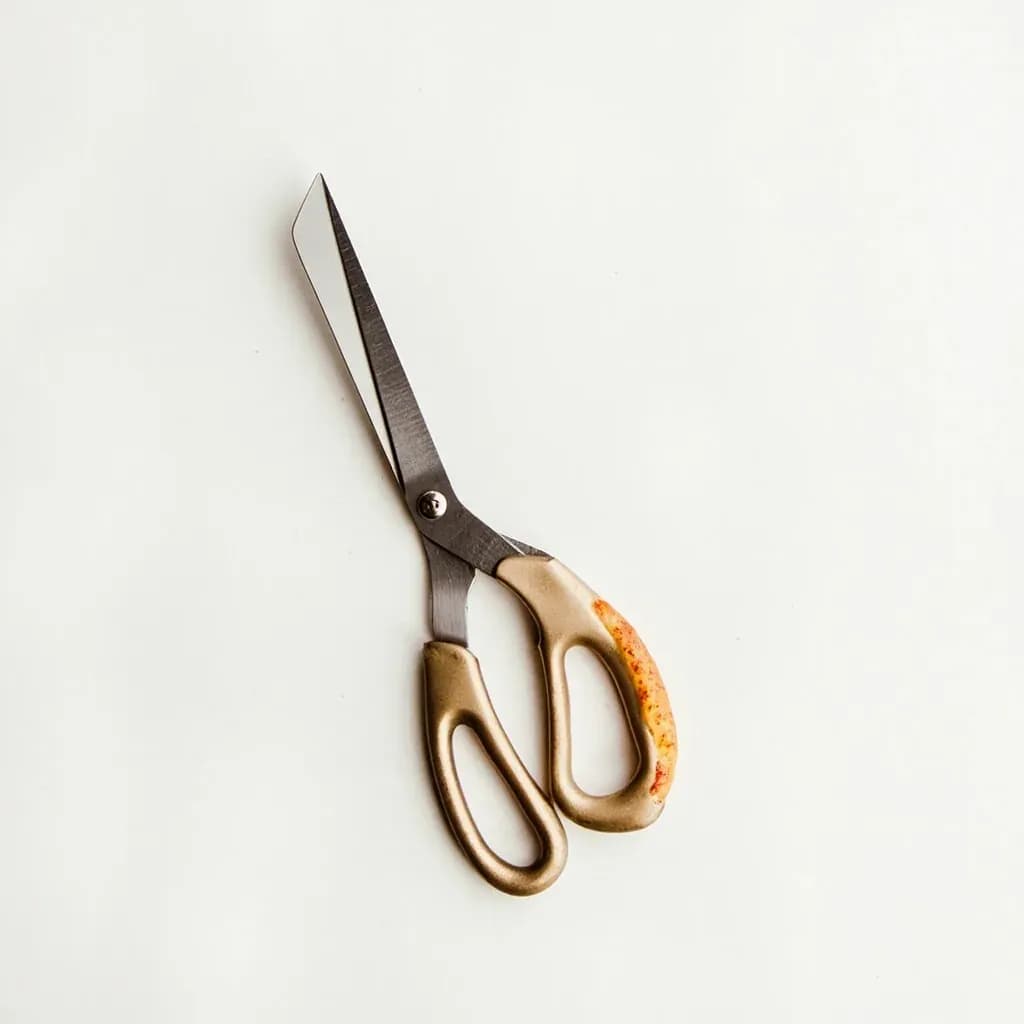
Heavy shears with a built-in spatula blade that cut and lift pizza slices in one move.
Pizza scissors are oversized kitchen shears with one blade shaped as a flat server, so they slice cleanly through crust while supporting the slice underneath. Snipping rather than rolling means toppings stay put, and the spatula side scoops the cut piece straight onto a plate. They are handy for cutting pizza right in the pan and for portioning soft flatbreads.
Pizza scissors are heavy-duty kitchen shears built around an unusual asymmetry: one blade is a sharp, curved cutter, the other is a wide, flat, paddle-like blade that does double duty as a slice server. The tool is designed to close around a cut line and, in the same motion, slide the freed slice onto a plate without dragging cheese, olives, or pepperoni across the pan. They exist because the two traditional pizza portioning tools each have a clear failure mode. A pizza wheel cuts cleanly but leaves the slice stranded on the stone or board, and a chef's knife slides toppings off the pie as it drags. The integrated spatula is the differentiator — without it, the tool is just a pair of heavy kitchen shears.
In practice, the lower blade is usually deliberately blunted so it can be worked under a hot slice without cutting the cook or the pan. The upper blade does the cutting while the paddle lifts. The tool is substantial — typically 200–280 g — so the weight, not the cook's grip, does most of the work. The most recognizable versions come from Swiss maker Kuhn Rikon, with strong competition from Czech houses Tescoma and Orion, German maker Westmark, and Japanese manufacturers such as KAI / Seki Magoroku. They are not a substitute for a pizza peel (which moves whole pies in and out of an oven), but for per-slice cutting and serving at the table they are hard to beat.
Alternatives
Types & varieties
The classic form: a sharp upper scissor blade paired with a wide, flat, slightly upturned lower paddle that lifts the slice.
Lower spatula blade has a pronounced curve to cradle a slice and keep toppings centered during transfer.
Unhook at the pivot screw so the two halves can be washed separately and more thoroughly.
Internal spring reopens the blades automatically, helpful for users with reduced hand strength.
Hybrid form: a rocking blade on a flat base with a side spatula; functions similarly but with a downward pressing motion rather than a scissor cut.
Smaller, lighter versions aimed at picnics and camping; often sacrifice the full-sized spatula.
The design problem they solve
A pizza wheel, a chef's knife, and a flat spatula are the three tools most cooks already own. The wheel cuts well but leaves every slice stranded on the cutting surface, requiring a separate lift. The chef's knife compresses a soft, cheese-topped pie and drags ingredients toward the cutting edge. The spatula cuts nothing. Pizza scissors fold the cut and the lift into one motion: the upper blade shears through crust and cheese while the lower paddle is already in position beneath the slice, ready to carry it away. That single-motion workflow is the whole reason the tool exists, and it is also why an ordinary pair of kitchen shears is not a substitute — without the broad, flat lower blade, there is nothing to lift with.
What the lower blade is (and isn't)
On most models, the lower spatula blade is intentionally not sharpened to a knife edge. A sharp lower edge would cut into the pizza stone, sheet pan, or wooden board, and it would also bite the cook's hand during use. Some higher-end designs reverse this convention — a sharpened spatula edge paired with a dull upper anvil that grips the crust while the lower blade does the cutting. Both approaches work, and the choice mostly affects how aggressively the tool can be worked under a stubborn slice.
- A blunted lower paddle is safer to slide under a hot slice and kinder to the pan.
- A sharpened lower edge paired with a dull upper anvil is the alternative configuration found on some higher-end models.
- The pivot screw is the structural weak point: do not pry sideways through frozen crust with the tool, as the paddle can snap if torqued.
Common uses
Tips & pitfalls
- Slide the spatula blade fully under the slice before squeezing the shears closed so the cut and the lift happen in one clean motion.
- Cut with a single firm squeeze rather than a sawing motion; let the blade's weight do the work to keep toppings from migrating toward the cut line.
- Aim the lower paddle beneath the cheese layer whenever possible — going under a top-heavy cheese pull prevents the slice from sliding off the server.
- On a hot pizza stone, cut in a star pattern from the center outward so the spatula can reach the center slice without crossing too much hot surface.
- Wipe between cuts with a damp cloth to keep cheese from building up and dulling the blade edge over time.
- Hand-dry after washing to prevent water spots on the polished stainless face, especially on the spatula side.
- Do not cut cardboard, parchment, or frozen toppings with them — the blades are tuned for cooked, soft pizza and will nick quickly.
- Avoid prying frozen pizza apart with the spatula blade; torquing it sideways can snap the lower paddle.
Good to know
- Tool type
- Heavy-duty kitchen shears designed to portion and serve pizza
- Defining feature
- A flat, paddle-like lower blade that lifts the slice as the upper blade cuts
- Cutting mechanism
- Scissor-action shears, not a wheel cutter
- Typical length
- Approximately 22–25 cm (9–10 in) overall
- Blade material
- Stainless steel, often high-carbon for edge retention
- Handle material
- Heat-resistant nylon, polypropylene, or thermoplastic; soft-grip variants exist
- Approximate weight
- Around 200–280 g (7–10 oz) — heavy enough to cut without crushing toppings
- Heat tolerance
- Nylon/PA-handle versions rated to roughly 200 °C / 400 °F; fine for table use, not for resting on a hot pan
- Cleaning
- Most models detach at the pivot screw and are top-rack dishwasher safe; check manufacturer guidance
- Origin
- Concept popularized in Central Europe (notably Germany and Czechia) in the 2000s; widely sold across Europe, North America, and Japan
- Price range
- Roughly $15–$40 USD depending on brand and materials
- Also called
- Pizza shears, pizza scissors with spatula, Pizzaschere (DE), nůžky na pizzu (CZ)
Also called
pizza shears · pizza cutting scissors · pizza scissor server
Related

Knife
The fundamental cutting tool every kitchen is built around

Chef's Knife
The do-everything blade for chopping, slicing, and mincing

Paring Knife
Small, nimble blade for peeling and detailed in-hand work

Serrated Knife
Saw-toothed blade that slices crusty bread without crushing

Cleaver
Heavy broad blade for chopping through bone and bulk prep

Cutting Board
The stable surface every cut starts on

Mandoline
Adjustable blade for paper-thin, perfectly even slices

Kitchen Shears
Heavy-duty scissors for poultry, herbs, and packaging