Baking & Pastry
Pizza Screen
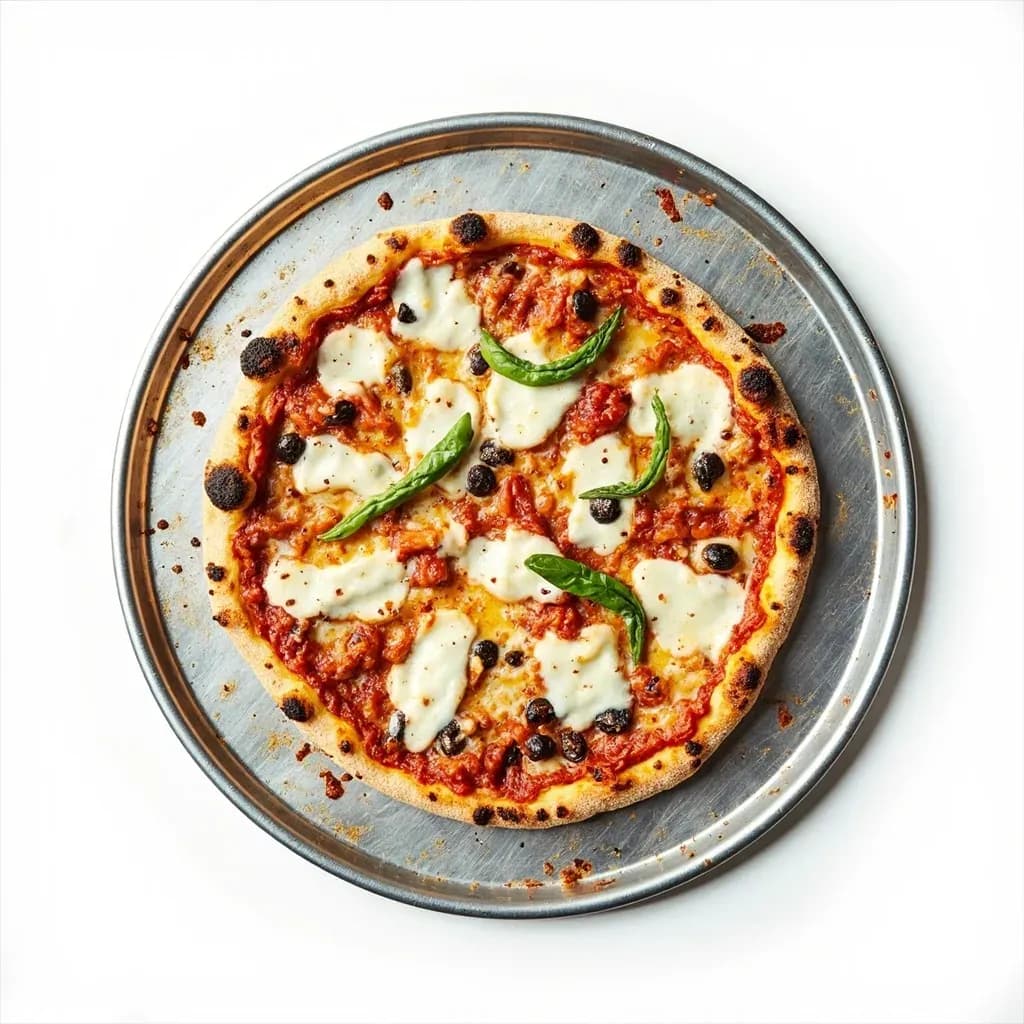
A round aluminum mesh disc that bakes pizza with airflow underneath for an even, crisp crust.
A pizza screen is a flat circle of perforated aluminum mesh on a rigid rim, used in place of a solid pan to bake pizza. The open mesh lets hot air reach the underside directly, drying and crisping the bottom crust while making the pie easy to slide on and off. It is widely used in pizzerias to speed baking and to start a pie before finishing it on a stone or deck.
A pizza screen is a flat, round disc of expanded or woven metal mesh—almost always aluminum—that sits on an oven rack and lets hot air circulate beneath a pie while it bakes. Where a baking stone or steel works by storing and conducting heat upward into the dough, a screen works the opposite way: it stays out of the way and lets the oven's dry, moving air reach the bottom of the crust. That is the whole point. A pizza resting on a solid surface bakes the way bread bakes in a covered pot—steamed from below, soft on the base. Lift the dough off the surface and the bottom dries and crisps the moment the dough sets, which is exactly why conveyor-oven pizzas and many American thin-crust pies have the audible snap they do.
Screens also have a practical edge over stones for the home cook. They preheat in minutes rather than an hour, cost a fraction of a steel, and weigh almost nothing, so they slip onto any rack without the thermal mass of a 15-pound stone. The trade-offs are real and worth knowing: a screen cannot sear a wet, slack dough the way a 700°F stone can, it leaves a faint crosshatch imprint on the bottom of the finished pie, and any loose or wet topping will fall straight through onto the oven floor. Pick a screen for thin, crisp, tavern-style, or reheated pies; reach for a stone or steel when you want a leopard-spotted Neapolitan cornicione or a chewy, blistered bottom.
Alternatives
Types & varieties
The classic style: no rim, full mesh, slides directly onto an oven rack.
Darker, more durable finish that resists corrosion and warping better than plain aluminum.
Coated mesh to reduce sticking; can mute browning and is less common among pizzaioli.
Has a shallow raised edge, easier to handle with a peel but slightly less airflow at the perimeter.
Tighter weave that supports thin, loaded pies and prevents small toppings from falling through.
Open weave that maximizes airflow for a drier, crispier bottom on cracker-thin crusts.
Less common; used for sheet-pan, Sicilian, or party-cut pizzas where a round disc is impractical.
Screen vs. stone or steel
All three tools solve the same problem—getting dry, radiant heat to the bottom of the dough—but they do it differently. A stone or steel stores heat and conducts it into the crust, producing the oven-spring and leopard spotting of a true pizzeria bake. A screen is essentially a heat-permeable rack: it does not store energy, it just keeps the dough off the rack so air can move beneath it. The result is a thinner, drier, crispier base and a less puffy rim, with almost no preheat time. For American thin-crust, tavern-style, and most reheating jobs, that is exactly what you want. For Neapolitan or pan pizzas where you want chew and char, a stone or steel is the better tool.
- Use a screen for thin-crust, tavern-style, flatbread, and reheating jobs.
- Use a stone or steel for Neapolitan, pan, deep-dish, or any wet dough that needs oven-spring.
Picking the right mesh and size
Match the screen to the pie. Fine mesh is the safer choice for loaded or thin doughs that would sag or bleed toppings; wide mesh gives the most aggressive airflow and the driest, cracker-like base. Diameter should be 1–2 inches larger than the finished pizza so the dough has a small margin of mesh to grip and is easy to slide off the peel.
- 8–10 in screen for personal pies; 12–14 in for standard home pizzas; 16–20 in for party pies.
- Tighter mesh = more support, less airflow; wider mesh = more airflow, less support.
Launching and retrieving a pie
Build the pizza on a wooden peel dusted with semolina or flour—never assemble it on the screen itself, where loose toppings will fall through and wet dough will weld to the mesh. Once launched, the screen stays on the rack for the entire bake; only the pizza moves on and off.
- A preheated screen gives the bottom its initial sear; a cold screen gives a pale, leathery base.
- Slide the peel back under the finished pie to remove it—do not lift the screen with the pizza on it.
Common uses
Tips & pitfalls
- Preheat the screen in the oven for at least 10–15 minutes before launching the dough—a hot surface is what sets the bottom and prevents sticking.
- Dust the peel (not the screen) with semolina or cornmeal to keep the dough sliding freely during launch.
- Build and transfer the pizza on a wooden peel; never try to lift the screen with the pizza on it mid-bake—slide the peel back underneath instead.
- For loaded pies with wet toppings, use a finer mesh or line the screen with a parchment round for the first 2–3 minutes, then pull the parchment so the bottom can finish directly on the mesh.
- Avoid heavy sauces, fresh mozzarella water, or oily toppings that will drip through the mesh and smoke on the oven floor—pre-drain wet cheeses and reduce loose toppings.
- Hand-wash only and dry immediately; the alkaline detergent in dishwashers will oxidize and pit aluminum in a handful of cycles.
- If the screen warps from thermal shock or a drop, press it flat or replace it—a warped screen creates uneven contact and burned spots.
Good to know
- Material
- Aluminum (most common); hard-anodized aluminum also available
- Typical diameters
- 6, 7, 8, 9, 10, 12, 14, 16, 18, and 20 inches
- Mesh gauge
- Varies by maker; tighter mesh supports thinner dough, wider mesh gives more airflow
- Rim style
- Flat (no rim) is standard; some have a shallow raised lip
- Heat tolerance
- Withstands typical pizza baking temperatures up to roughly 600°F / 315°C
- Primary purpose
- Lets hot air circulate beneath the dough so the bottom crisps instead of steaming
- Cost range
- Roughly $5–$30 for home sizes; commercial screens $10–$40 each
- Cleaning
- Hand-wash only; dishwasher detergent oxidizes and pits aluminum quickly
Also called
pizza mesh · pizza baking screen · aluminum pizza screen
Related

Muffin Pan
Multi-cup pan for muffins, cupcakes, and egg bites

Bundt Pan
Fluted ring mold for showstopping cakes with a center hole

Springform Pan
Latch-release pan that frees delicate cakes without flipping

Pie Dish
Sloped round dish for crisp-bottomed pies and quiches

Tart Pan
Fluted pan with a pop-out base for clean-edged tarts

Rolling Pin
Rolls dough into even sheets for pastry and bread

Pastry Brush
Brushes on egg wash, glaze, butter, and marinades

Bench Scraper
Flat blade that divides dough and clears your work surface