Knives & Cutting
Poultry Shears
Heavy spring-loaded scissors built to cut through poultry joints and small bones.
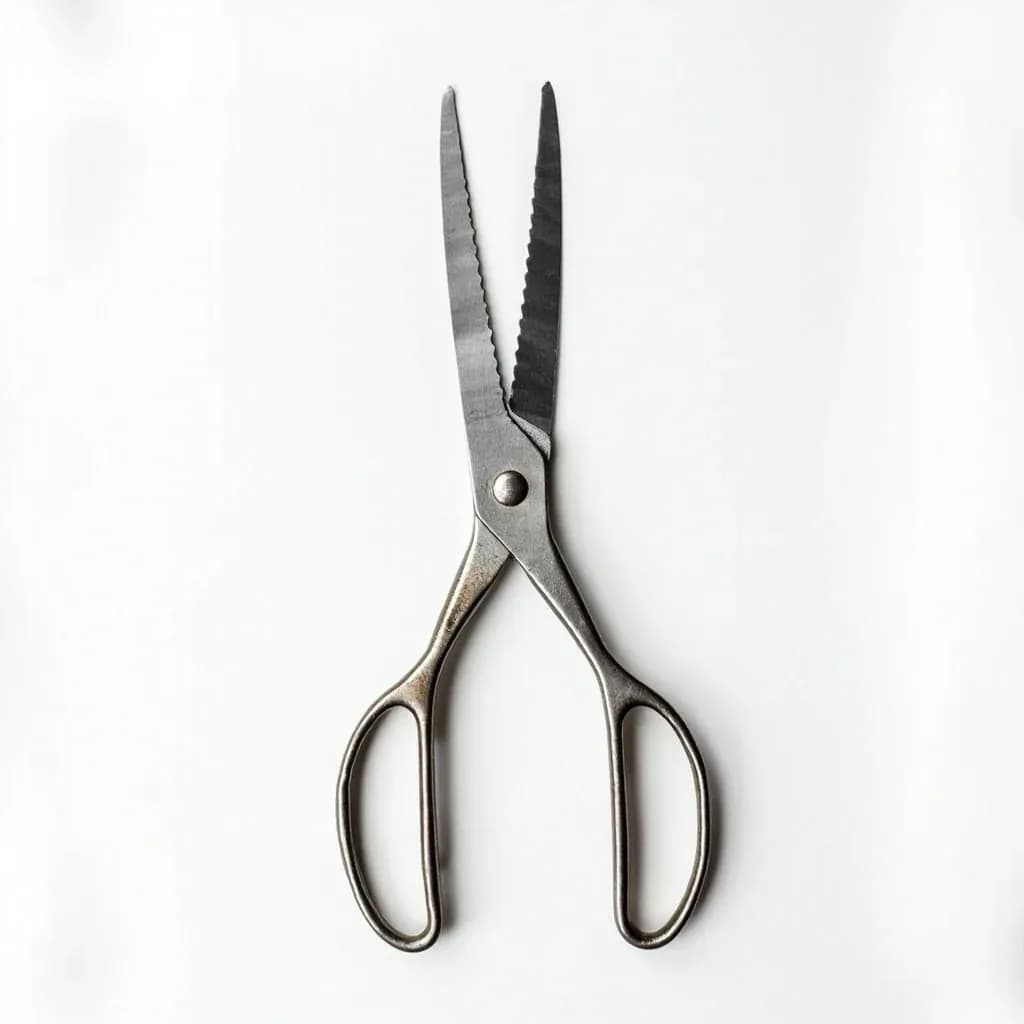
Poultry shears are robust kitchen scissors with curved, often serrated blades and a notch near the pivot for gripping bone. Cooks use them to spatchcock chickens, snip through wing and leg joints, trim ribs, and portion whole birds quickly. The spring-loaded handle and strong pivot give the leverage needed to cut cartilage and thin bones that would dull a knife.
Poultry shears are heavy-duty, spring-loaded scissors engineered for one job above all: cutting cleanly through raw poultry joints, small bones, and cartilage without the blade skating sideways or bending the pivot. What separates them from ordinary kitchen scissors is a hardened bone notch — a curved cutout near the pivot that grips a joint and keeps the cutting edge seated against bone as you squeeze. Most modern designs are take-apart at the pivot screw, which lets the two halves be separated for thorough washing; this is a genuine food-safety feature when working with raw chicken, where trapped fat and juices in a fixed pivot are a real contamination risk. The action is almost always spring-assisted, so the blades open automatically between cuts and the cook only has to squeeze, not reset the tool each time.
For a cook who breaks down whole birds, they are arguably more useful than a cleaver. A cleaver smashes through bone, splintering cartilage and leaving ragged edges that don't render or brown evenly. Shears cut, producing a clean joint face that lies flat, looks tidy on a platter, and cooks predictably. They are equally at home on the raw side of a chicken backbone during spatchcocking, on a cooked bird at the table, and on the trimmings that need to come off before a stock goes on — backs, wing tips, and necks are handled in seconds.
The trade-off is specialization. Poultry shears cannot do what a chef's knife does (precise slicing, rocking cuts on herbs, fine work on aromatics), and they will not survive misuse on frozen blocks, thick beef marrow bones, or wire. Used for their intended task — thawed poultry, small game, soft cartilage, and the occasional kitchen string or parchment round — they will outlast several chef's knives and make the messiest part of poultry cookery genuinely fast.
Alternatives
Types & varieties
Blades separate at the pivot screw for full cleaning; the dominant modern style and the safest choice for raw poultry work.
Angled blades designed to follow the contour of a bird's spine during spatchcocking; the preferred shape for backbone removal.
Classic scissor geometry, versatile for general kitchen snipping and joint work where the cut is short and straight.
Larger, more robust models used by professional butchers for whole birds, rabbits, and small game; overkill for home cooking.
Multi-purpose shears with a built-in herb stripper and a notch capable of light poultry work; compromises on both tasks.
All-purpose kitchen shears that can manage light poultry joints but lack a true hardened bone notch.
How to Spatchcock a Whole Bird
Spatchcocking — removing the backbone so a bird lays flat for even roasting or grilling — is the single most useful task for poultry shears, and the one most home cooks never attempt because they think it requires a cleaver. It does not. A pair of curved-blade poultry shears will do it in under a minute with clean, even cuts.
- Pat the bird very dry and place it breast-side down on a stable board with the tail pointing away from you.
- Using the bone notch, start at the tail end and cut straight up one side of the spine, in short bites, keeping the blade as close to the bone as possible.
- Repeat on the other side of the spine, removing the backbone in one connected strip — save it for stock.
- Flip the bird breast-side up, press firmly on the breastbone with the heel of your hand to flatten, and tuck the wing tips behind the shoulders.
Choosing Between Models
For a cook who buys whole birds regularly, the shears matter more than the brand. A few practical points of comparison:
- Forged stainless take-apart models (Wüsthof, J.A. Henckels, Kai, Shun) keep a tight pivot action over years of use and are worth the premium for serious home cooks.
- Spring-loaded polymer-handled models (OXO, Fiskars) are lighter, easier on arthritic hands, and simpler to disassemble — a sensible choice for most households.
- Look for a clearly defined bone notch; a vague dimple will slip off knuckles and joints and is a sign the tool was not designed for bone.
- Avoid shears that lock by sliding a metal bar between the handles — these tend to loosen and rattle. A simple loop or catch lock is more reliable.
Common uses
Tips & pitfalls
- Use the bone notch for every cut through a joint — it is the only part of the blade designed to bear that load, and skipping it is the most common cause of chipped edges.
- Cut in one smooth, full squeeze. Twisting or prying to finish a cut bends the pivot and ruins the blade alignment.
- Open the shears fully before each cut so the notch can reseat on the bone; partial strokes leave ragged joints and stress the spring.
- Disassemble take-apart shears after every session with raw poultry and wash both halves — fat trapped at the pivot is the leading cause of stiff, sticky action and a real contamination risk.
- Dry the blades immediately and store with the lock engaged; moisture left in the pivot will pit stainless steel and corrode the spring.
- Sharpen only with a pull-through sharpener rated for shears, or send them to a professional — a standard knife stone or rod can ruin the curved cutting edge.
- Oil the pivot screw with a drop of food-grade mineral oil every few months to keep the action smooth and prevent rust at the joint.
- Never use poultry shears on frozen birds, thick beef bones, or wire. The first chips the edge, the second bends the pivot, and the third dulls the blade and risks metal contamination.
Good to know
- Type
- Heavy-duty spring-loaded kitchen shears designed for poultry bones and joints
- Typical length
- 8–10 inches (20–25 cm) overall
- Blade material
- High-carbon stainless or forged stainless steel
- Defining feature
- A bone notch — a curved cutout near the pivot that grips joints and prevents blade slip
- Action
- Spring-loaded; blades open automatically so the user only squeezes
- Cleaning
- Take-apart at the pivot on most modern models; hand-wash and dry immediately
- Dishwasher safety
- Many are top-rack safe, but hand-washing extends edge life and pivot tension
- Not suited for
- Frozen bones, thick beef bones, wire, metal packaging, or anything harder than poultry bone
Also called
Kitchen Shears · Poultry Scissors
Related

Knife
The fundamental cutting tool every kitchen is built around

Chef's Knife
The do-everything blade for chopping, slicing, and mincing

Paring Knife
Small, nimble blade for peeling and detailed in-hand work

Serrated Knife
Saw-toothed blade that slices crusty bread without crushing

Cleaver
Heavy broad blade for chopping through bone and bulk prep

Cutting Board
The stable surface every cut starts on

Mandoline
Adjustable blade for paper-thin, perfectly even slices

Kitchen Shears
Heavy-duty scissors for poultry, herbs, and packaging