Baking & Pastry
Pullman Loaf Pan
A rectangular bread pan with a sliding lid that bakes perfectly square sandwich loaves.
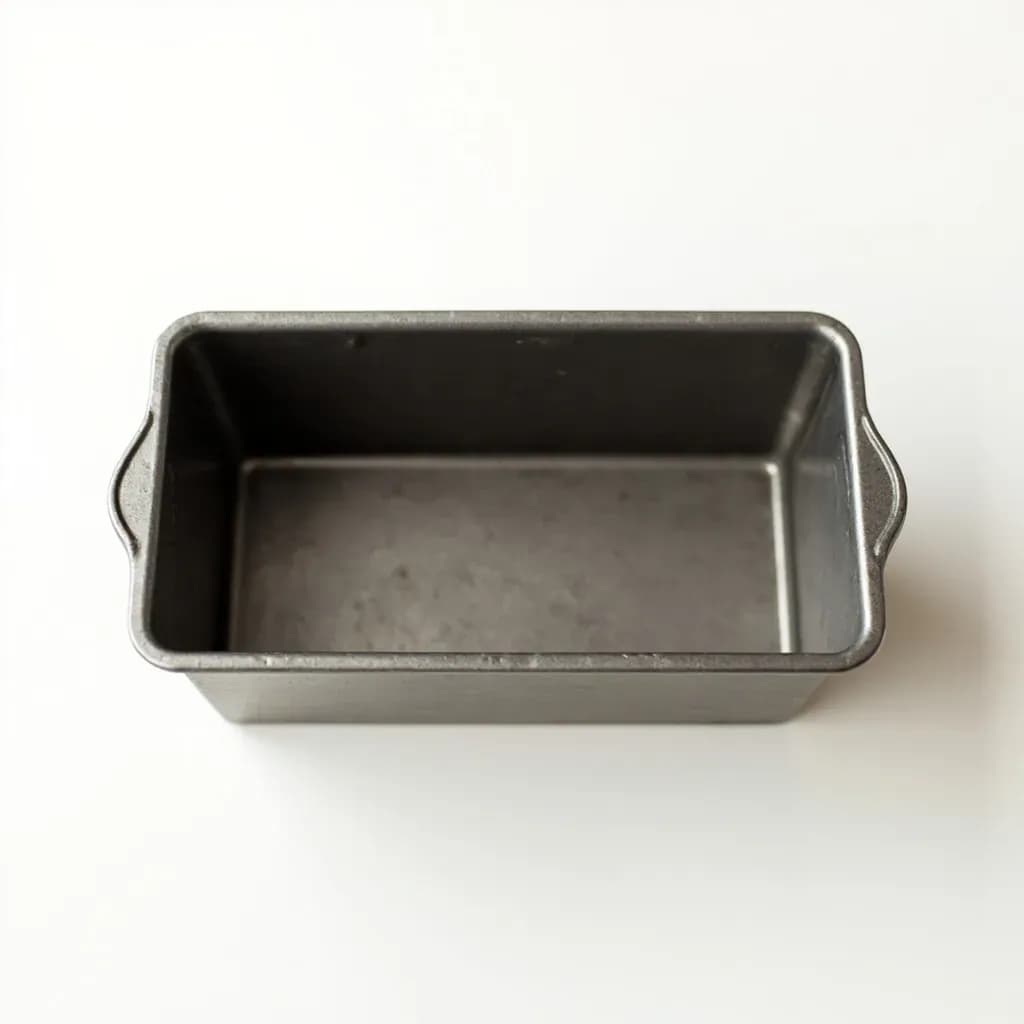
A Pullman loaf pan is a long, straight-sided bread mold fitted with a sliding lid that constrains the dough as it rises and bakes. The cover produces a dense, tight, flat-topped crumb with no dome, giving the uniform square slices ideal for sandwiches and pain de mie. Baking with the lid off instead yields a more traditional rounded top from the same pan.
A Pullman loaf pan is a tall, narrow, straight-sided rectangular pan fitted with a flat lid that slides into rails running along the long edges. When the lid is in place during baking, the rising dough has nowhere to go but up, so the loaf bakes into a perfectly squared brick with flat top, flat bottom, and sharp corners. That geometry is the whole point: it is the pan that produces the classic French pain de mie, the crustless-looking sandwich loaf, and any bread meant to be sliced into uniform, tidy squares. The thin crust is a side effect of the lidded bake — steam is trapped against the dough and the top never sees direct oven heat, so the crumb stays pale, soft, and almost crustless on the upper face.
The pan is named for the 19th-century Pullman railway car, whose long, flat-roofed, boxy silhouette the finished loaf resembles. Bakers reach for it whenever presentation and slice uniformity matter more than a rustic, crackly crust. It is also a genuinely forgiving tool for beginners: the lid prevents the dramatic oven spring and blowouts that plague open-top loaves, so first attempts usually look polished even if the crumb isn't yet perfect. The trade-off is that the lid demands a slightly different technique — you must grease it, control proofing carefully, and match dough weight to pan volume — but those adjustments are easy to learn.
Alternatives
Types & varieties
13 × 4 × 4 in pan with lid; the classic sandwich-bread size
Smaller version, roughly 9 × 4 × 4 in, used for individual loaves or shorter sandwich bread
Same pan body sold without the sliding cover; functions as a tall, straight-sided loaf pan when uncovered
Pro-style choice; resists warping and gives even browning on the sides
Coated interior and lid for easier release; slightly shorter lifespan than bare metal
Heavier and retains heat longer; common in commercial bakeries
Commercial-bakery style with a lid that flips up rather than sliding off
How the Lid Changes the Bake
A lidded pan is, in effect, a small oven-within-an-oven. The lid traps steam that would otherwise escape upward, keeping the loaf's surface moist and plastic longer, which is why the crust comes out pale and thin. It also constrains expansion: instead of springing outward and forming an irregular mushroom cap, the dough rises straight up against the lid and bakes into a true rectangle. The trade-off is that the loaf depends entirely on the pan's heat for its crust, so pan material and color matter more than with an open bake. A heavy, light-colored metal gives the most even, gentle browning; a dark non-stick pan runs hot and can scorch the bottom corners before the center is done.
Matching Dough to Pan
Because the lid fixes the loaf's final height, the dough weight you pan determines everything about the finished shape. Too little dough and you bake a short brick with a tunneled top; too much and the dough slumps into the lid track or bakes over the rails. The sweet spot for a standard 13-inch pan is about 1 lb 8 oz to 1 lb 12 oz (roughly 680–800 g) of dough, with the shaped loaf filling the pan about halfway to two-thirds up the wall before the final proof. A kitchen scale is the single most useful tool for this pan — volume measures are unreliable because enriched doughs vary so much in density.
- Aim for the shaped dough to reach halfway to two-thirds up the wall before panning
- Proof only until the crown sits about ½ in below the lid track
- Chill the shaped dough 15–20 minutes before panning so the corners hold their shape during the final rise
Care and Storage
Pullman pans last decades if treated well. The lid rails are the vulnerable feature — they bend if the pan is dropped or stored under heavy weight, and a bent rail means the lid will not seat flush, which ruins the squared shape. Store the lid separately or nested loosely so nothing presses on the rails. Hand-wash and dry the pan thoroughly before putting it away; trapped moisture in the lid track will oxidize bare steel. If your pan is unlined aluminized steel, a light wipe of neutral oil after drying will help protect any exposed steel edges from oxidizing. The aluminum surface is naturally fairly non-reactive, so there is no need to build a polymerized seasoning layer the way you would on carbon steel.
Common uses
Tips & pitfalls
- Grease — and flour, or use a baking spray with flour — the lid as well as the pan interior. The top of the loaf bakes directly against the lid and will stick if it isn't well oiled.
- Weigh the dough rather than measuring by volume. Aim for 1 lb 8 oz to 1 lb 12 oz (680–800 g) in a standard 13-inch pan for a fully filled, square profile.
- Proof the dough only until the crown reaches about ½ in below the lid. An over-proofed loaf will smash into the lid and bake with a dented or concave top — the most common Pullman mistake.
- Prefer a lighter-colored metal pan. Dark non-stick coatings (especially with the lid trapping heat) can scorch the bottom and edges before the center is fully baked.
- If the loaf resists sliding out, run a thin offset spatula or knife around the inside walls before lifting the lid off. Forcing it can tear the soft crumb.
- Cool the loaf in the pan on its side for 5–10 minutes, then turn out. Resting in the pan keeps the soft crumb from compressing under its own weight.
- Do not fill the pan with more than about 1 lb 12 oz (800 g) of dough or it will bake over the lid track and weld itself to the rails.
- The lid doubles as a flat baking sheet for small rolls, biscuits, or as a makeshift cover for a banneton — useful when the pan is otherwise idle.
Good to know
- Also known as
- Pain de mie pan, sandwich loaf pan, lidded loaf pan
- Origin of name
- Named after the Pullman railway car, whose long, flat-roofed silhouette the squared loaf resembles
- Standard interior dimensions
- Approximately 13 × 4 × 4 in (33 × 10 × 10 cm); mini versions run about 9 × 4 × 4 in
- Typical material
- Aluminized steel or heavy-gauge aluminum; some are non-stick coated; occasionally cast aluminum
- Wall thickness
- Heavy-gauge metal (often 0.8–1.0 mm) to resist warping from the lid's pressure during baking
- Lid style
- Flat metal lid with rolled edges that slides into rails on the long sides of the pan
- Dough yield
- 1 lb 8 oz to 1 lb 12 oz (680–800 g) per standard pan, yielding roughly 12–16 sandwich slices
- Care
- Hand-wash recommended; do not put a non-stick coated lid in the dishwasher
Also called
Pullman Pan · Pain de Mie Pan · Lidded Bread Pan
Related

Muffin Pan
Multi-cup pan for muffins, cupcakes, and egg bites

Bundt Pan
Fluted ring mold for showstopping cakes with a center hole

Springform Pan
Latch-release pan that frees delicate cakes without flipping

Pie Dish
Sloped round dish for crisp-bottomed pies and quiches

Tart Pan
Fluted pan with a pop-out base for clean-edged tarts

Rolling Pin
Rolls dough into even sheets for pastry and bread

Pastry Brush
Brushes on egg wash, glaze, butter, and marinades

Bench Scraper
Flat blade that divides dough and clears your work surface