Baking & Pastry
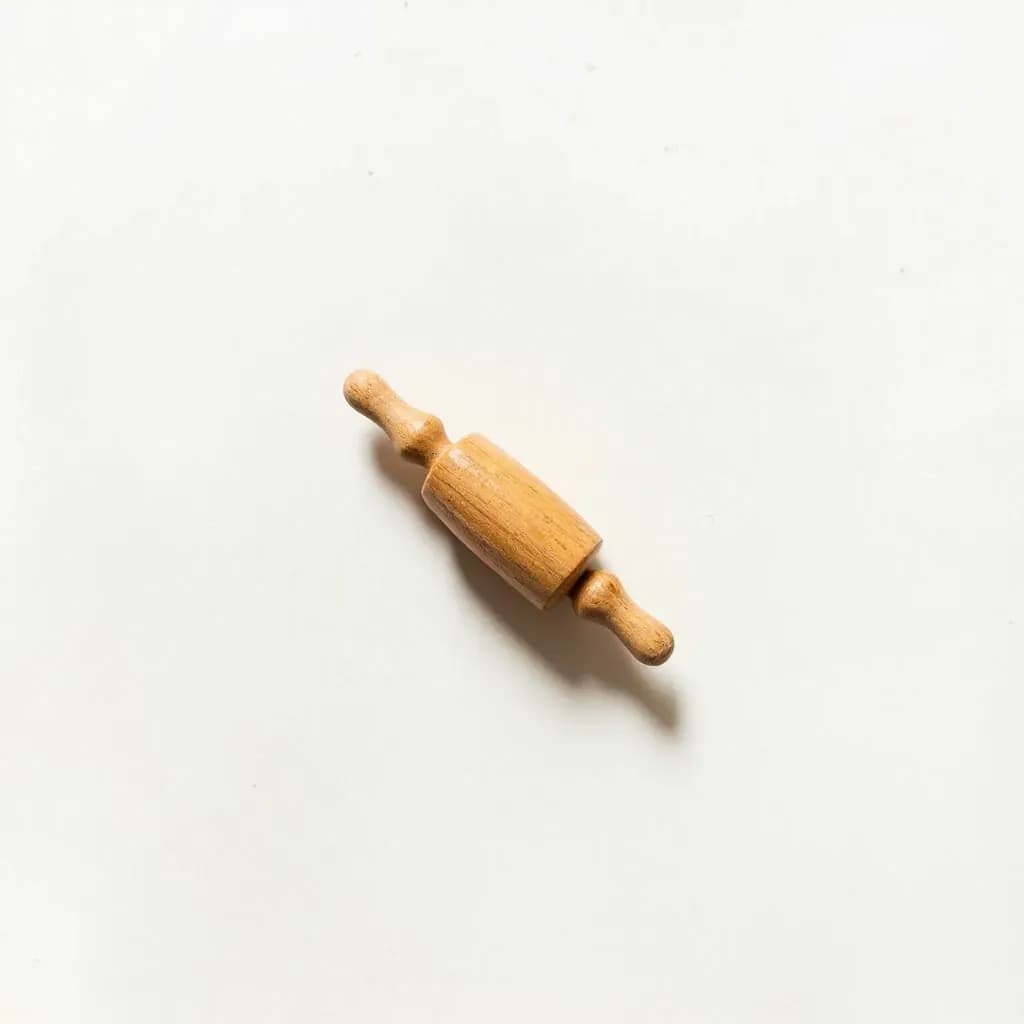
Small Dumpling Rolling Pin
Short, slim wooden pin for rolling individual dumpling wrappers into thin, even rounds.
A short, lightweight wooden rolling pin sized for one-handed work, used to roll small balls of dough into thin dumpling skins. It's a staple for jiaozi, gyoza, and bao, letting the cook spin the wrapper with one hand while rolling the edges thinner than the center. The compact length gives precise control that a full-size pin can't match.
The small dumpling rolling pin is a short, slim, handle-less wooden dowel — the scaled-down descendant of the ancient tapered rolling form that has shaped filled dumplings from Harbin to Kraków for centuries. Its size is the whole point: a dough ball weighing 8–20 g vanishes under a full-size pin, while a short dowel gives a light, controllable stroke and a circular wrist motion that turns out an even round. The absence of handles is a feature, not a limitation — it lets the cook drive the pin with the flats of the palms, slide it with the wrists, and rotate the dough underneath as they work.
Hardwood is the preferred material because it grips the dough just enough to push without grabbing it; marble and bamboo have their places, but neither matches wood for everyday wrapper work. A well-kept wooden mini pin can outlast its owner, and a sanded, oiled piece of hardwood dowel from a hardware store is a perfectly serviceable substitute in a pinch.
The small pin marks a quiet conceptual shift from the Western handled pin — a two-handed lever for rolling large sheets — to a wrist-rolled tool that excels at small, repeated tasks. The same tapered-dowel geometry survives in the South Asian belan, the Chinese gǎn miàn zhàng, and the Italian mattarello, a reminder that the physics of small, repeated dough work have not changed in a very long time.
Alternatives
Types & varieties
The classic form: one piece of dense wood, slightly thicker in the middle, no handles. The most versatile and most commonly recommended style for dumpling wrappers.
Stays cold and is heavy; favoured for laminated doughs and any dough where you want to keep butter or shortening firm during rolling.
Light and inexpensive, common in East Asian markets; transfers less force than hardwood, which can be an advantage for very delicate wrappers.
A long, smooth, slightly tapered hardwood dowel with no handles, used for chapati and for shaping small samosa, kachori, and gujiya wrappers. Often heavier and longer than a typical mini pin.
A short wooden or hollow-bamboo dowel used at home for jiaozi wrappers; the longer version is for noodle sheets.
A small barrel-shaped pin with turned handles at each end. Some bakers prefer the grip for fondant, stiff cookie dough, or very small tart lids.
Why a handle-less dowel?
The handle-less dowel is older than the handled pin by centuries, and for small, repeated work it is genuinely better. A short, heavy dowel sits in the crook of the hands and is driven with the flats of the palms; the wrists supply the rolling motion, and the dough itself is rotated a quarter turn every few strokes. This produces a round wrapper without a single wasted movement.
The handled pin, by contrast, was developed for rolling large, even sheets of pastry — pies, tarts, biscuits — where two-handed leverage over a long stroke is the point. Trying to use a full-size handled pin on a 10 g dough ball is like trying to hammer a tack with a sledgehammer. The work is not just awkward; the lever action of the handles makes it almost impossible to feel when the dough is evenly thin.
Common uses
Tips & pitfalls
- Roll from the centre outward and rotate the dough a quarter turn every two or three strokes; the rotation is what keeps the wrapper round.
- Use a light, even hand. Heavy downward pressure shoves the dough off-centre and thins one side faster than the other, not faster overall.
- Dust sparingly with flour or potato starch. Over-floured wrappers turn tough and dry, and the extra starch can gum up the pin.
- Press a brand-new wooden pin against the dough for a moment before you start rolling; the wood picks up just enough surface moisture to resist sticking without absorbing into the dough.
- Keep unworked dough balls under a damp cloth and pull them out one at a time so the exposed surface does not skin over before you reach it.
- Aim for roughly 1.5–2 mm of thickness for most boiled dumpling wrappers — thin enough to feel the dough yield under the pin, but not so thin that the filling shows through. Pan-fried and steamed wrappers are usually rolled a touch thinner.
- Never soak a wooden pin in water or put it in the dishwasher; the wood will crack. Wipe it, dry it upright, and condition it with a light coat of food-grade mineral oil a few times a year.
- A piece of clean hardwood dowel from a hardware store (about 25 cm long, 3 cm diameter, sanded smooth and oiled) is a perfectly serviceable substitute for dumpling work if you do not have a dedicated pin.
Good to know
- Typical length
- 15–25 cm (6–10 in); 10–15 cm versions exist for very small wrappers such as modak
- Diameter
- 2.5–4 cm (1–1.5 in) at the thickest point
- Weight
- Hardwood roughly 100–250 g; marble 400–600 g; bamboo lighter than hardwood
- Material
- Hardwood (maple, beech, birch, cherry, walnut); also bamboo, marble, and food-safe nylon
- Form
- A single solid dowel, usually without handles; some models have small turned knob handles at each end
- Target dough ball
- Balls of 8–20 g — the size used for individual dumpling, pierogi, or samosa wrappers
- Origin
- The tapered, handle-less dowel is the older form, used across many cuisines for centuries; the Western handled pin is a 19th-century industrial-era development
- Care
- Wipe with a dry or barely damp cloth; never soak or dishwasher. Condition occasionally with food-grade mineral oil or beeswax
Also called
Dumpling Pin · Jiaozi Rolling Pin
Related

Muffin Pan
Multi-cup pan for muffins, cupcakes, and egg bites

Bundt Pan
Fluted ring mold for showstopping cakes with a center hole

Springform Pan
Latch-release pan that frees delicate cakes without flipping

Pie Dish
Sloped round dish for crisp-bottomed pies and quiches

Tart Pan
Fluted pan with a pop-out base for clean-edged tarts

Rolling Pin
Rolls dough into even sheets for pastry and bread

Pastry Brush
Brushes on egg wash, glaze, butter, and marinades

Bench Scraper
Flat blade that divides dough and clears your work surface