Baking & Pastry
Round Cutter Set
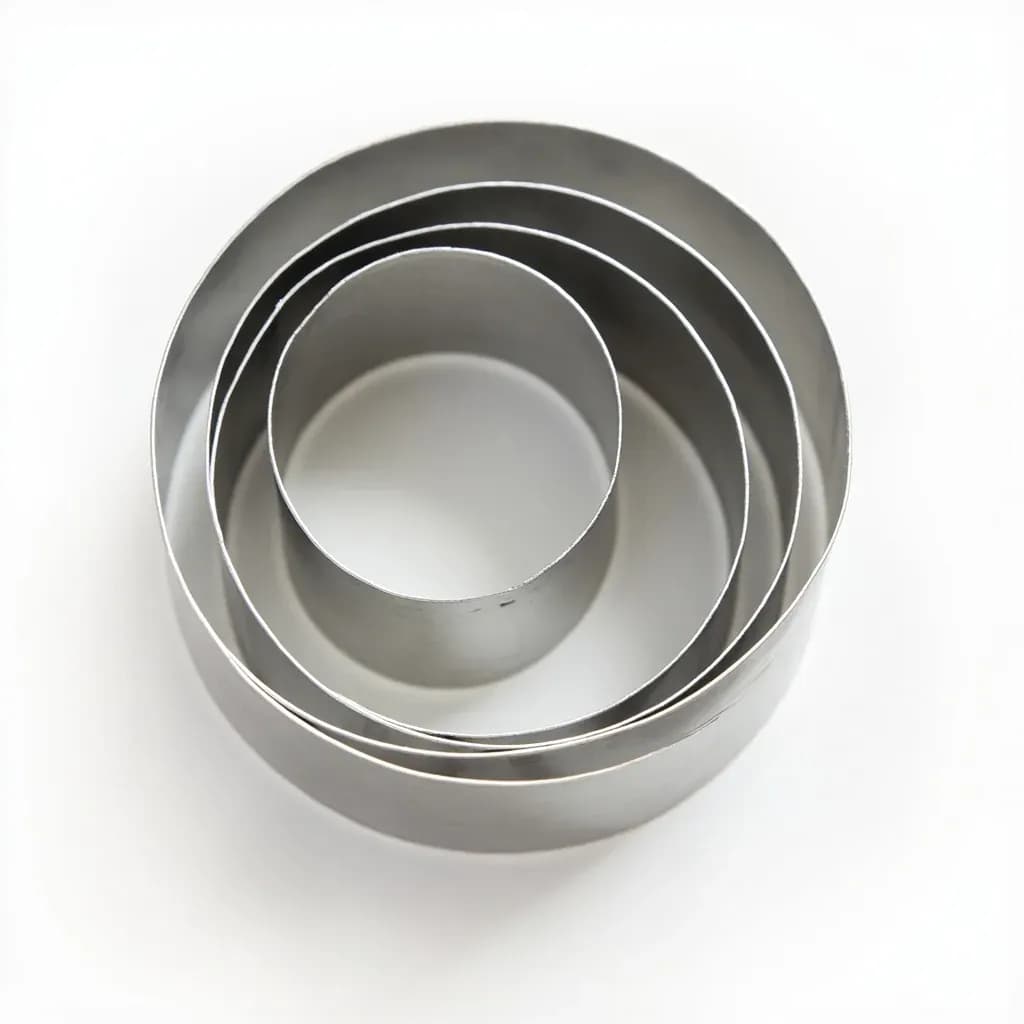
A nested set of circular metal cutters for stamping out dough, biscuits, and rounds.
A round cutter set is a graduated collection of plain or fluted metal rings used to stamp uniform circles from rolled dough. Bakers reach for them to cut biscuits, scones, cookies, dumpling wrappers, and pastry discs, choosing the size that fits the recipe. The nesting design stores compactly, and the sharp rims give clean edges that rise straight without dragging.
A round cutter set is the pastry kitchen's most quietly indispensable tool: a nested series of plain or fluted metal rings, ranging from roughly 2.5 cm to 10 cm in diameter, used to stamp clean, even rounds out of rolled or pressed dough. The classic French emporte-pièce rond is little more than a thin tin-plated ring with a folded top edge for finger pressure, and that simplicity is the point — there is no handle to obstruct the cut, and the open-ended design means the cut shape can be pushed out cleanly onto a baking sheet. Every professional bakery and serious home baker keeps a set on hand because so much of pastry work comes down to producing uniform rounds: cookies, scones, tart bases, hand pies, English muffins, vol-au-vent lids, even neat rounds of vegetable for plating.
Cutters come in two essential profiles. A plain (bord droit) edge slices straight through dough and releases it cleanly, which is what you want whenever even rise and clean geometry matter — biscuits, scones, dinner rolls. A fluted or scalloped (cannelé) edge leaves a decorative wavy border prized for shortbread, Linzer cookies, and tartlet shells, but the ridges grip the dough slightly and can inhibit a little of the lift in leavened bakes. Materials range from the traditional thin tin-plated steel favored in French kitchens (sharp, light, and inexpensive, though it must be dried to prevent rust) to heavier stainless and copper versions prized for their rigidity and longevity.
The single most important thing to know about a round cutter is that it is not a cookie-cutter in the American pressed-handle sense; the tool only does its job if you press it straight down in one firm motion and lift it cleanly, never twisting. A twist seals the laminated or aerated structure of the dough at the cut edge and is the most common reason biscuits bake up with slanted tops and scones rise unevenly. Once you internalize that single habit — straight down, lift, flour between cuts — the rest of the technique is essentially common sense.
Alternatives
Types & varieties
Straight, smooth edge; the everyday workhorse for biscuits, scones, tart bases, and rolls where even rise matters.
Wavy edge that leaves a decorative ridged border; traditional for Linzer cookies, shortbread, and tartlet shells.
The classic French professional cutter; very thin wall for a clean cut, light in the hand, economical, but must be dried promptly to prevent oxidation.
More durable and rust-resistant than tin plate; slightly thicker wall; the modern default for home and pro kitchens alike.
Heavier individual cutters prized in classic patisserie for rigidity, heat conduction, and long life; expensive but near-indestructible.
Some French cutters have a folded or rolled upper rim that adds finger comfort and structural rigidity without a full handle.
The no-twist rule
A round cutter cuts by compressing the dough in a clean vertical line, severing the flour-and-butter matrix at the edge. Twisting the cutter, however slightly, drags that severed edge along the cut face and smears the layers back together, effectively sealing the rim. The result is familiar to anyone who has wondered why their biscuits spread sideways instead of rising straight up, or why scones dome on one side and lean: the sealed edge can't expand, so the dough rises where it still can. The fix is simply a confident vertical press — hand on top of the cutter, even pressure, lift straight up. If the dough is sticky, flour the cutter between cuts; if it is firm and cold, a tap on the bench edge will release the round cleanly without any twisting at all.
- Press straight down; never rotate the cutter in the dough.
- Flour (or rice flour for pale doughs) between cuts to prevent sticking.
- Lift cleanly upward so the cut shape stays in the dough.
Choosing plain vs. fluted
The two edge profiles are not interchangeable. Plain cutters are the right choice whenever leavening is doing real work — drop biscuits, rolled biscuits, scones, dinner rolls, English muffins, vol-au-vent bases and lids — because the clean cut allows the dough to expand evenly at the rim. Fluted cutters are the right choice when appearance is the point: shortbread, Linzer, sugar cookies, decorative tartlet shells, and the lids of sweet hand pies. A fluted edge also grips the dough slightly, which can help when transferring a delicate round to a baking sheet, though it costs a little vertical rise in yeasted or chemically leavened bakes.
- Plain: biscuits, scones, rolls, puff pastry rounds, vol-au-vents.
- Fluted: shortbread, Linzer, sugar cookies, tartlet shells.
- For vol-au-vent rings, use a large cutter for the base and a smaller cutter to remove the center of a second round, forming a ring-shaped lid — both plain.
Care and storage
Tin-plated cutters are sharp and light but will rust quickly if stored wet, so they should be hand-washed, dried immediately with a tea towel, and stored nested in a dry drawer with a piece of kitchen paper between them to absorb residual moisture. Stainless versions tolerate a dishwasher, though hand-washing preserves the cut edge longer. Any cutter, in any material, benefits from a quick pass with a fine file on the inside edge once a year: a dull edge deforms the dough rather than slicing it, leaving a slightly pinched rim that bakes unevenly.
- Hand-wash and towel-dry tin-plated cutters before storing.
- Nest with kitchen paper to slow oxidation.
- Touch up the inside edge with a fine file if cuts start to look ragged.
Common uses
Tips & pitfalls
- Dip the cutter in flour (or rice flour for pale doughs) between every cut to stop the dough sealing to the metal.
- Press straight down in one firm motion and lift clean — never twist. Twisting seals the cut edges of biscuits and scones and prevents even rise.
- Chill the cutters in the freezer for a few minutes when working with very buttery or sticky doughs; cold metal cuts cleaner and releases more easily.
- Cut as close together as possible in geometric patterns to minimize scraps, and re-roll scraps only once — overworked dough toughens and bakes up tough and shrunken.
- Use a ruler or marked bench strip to space cuts evenly so every round bakes in the same time.
- Reach for a plain cutter whenever leavening matters (scones, biscuits, rolls); save the fluted cutter for shortbread, Linzer, and other flat cookies where the decorative edge is the point.
- Touch up the inside edge with a fine file once a year — a dull cutter deforms dough rather than slicing it.
- For very small cutters (under 3 cm), push the dough out with the tip of a paring knife or skewer rather than poking it out with your finger, which dents the round.
- Tap the cutter gently on the edge of the bench to release chilled, firm doughs cleanly.
Good to know
- Also called
- Pastry cutters, biscuit cutters, round cookie cutters, emporte-pièce ronds (French)
- Typical set size
- 5–12 nested pieces
- Common diameters
- Approximately 2.5 cm, 3.5 cm, 5 cm, 6 cm, 7.5 cm, 9 cm, 10 cm (1"–4")
- Standard materials
- Tin-plated steel (traditional), stainless steel, copper, occasionally aluminum or plastic
- Edge types
- Plain (bord droit) or fluted/scalloped (cannelé)
- Construction
- Open-ended ring with a top fold or soldered seam; no handle on classic French models
- Care
- Hand-wash and dry immediately; tin plating can oxidize; stainless versions are generally dishwasher-safe
- Approximate price range
- Basic sets from ~$10; professional tin-plated sets $25–$60; copper individual cutters from ~$15 each
Also called
Round Dough Cutter · Dough Cutter Round · Biscuit Cutter Set · Pastry Cutter Set
Related

Muffin Pan
Multi-cup pan for muffins, cupcakes, and egg bites

Bundt Pan
Fluted ring mold for showstopping cakes with a center hole

Springform Pan
Latch-release pan that frees delicate cakes without flipping

Pie Dish
Sloped round dish for crisp-bottomed pies and quiches

Tart Pan
Fluted pan with a pop-out base for clean-edged tarts

Rolling Pin
Rolls dough into even sheets for pastry and bread

Pastry Brush
Brushes on egg wash, glaze, butter, and marinades

Bench Scraper
Flat blade that divides dough and clears your work surface