Knives & Cutting
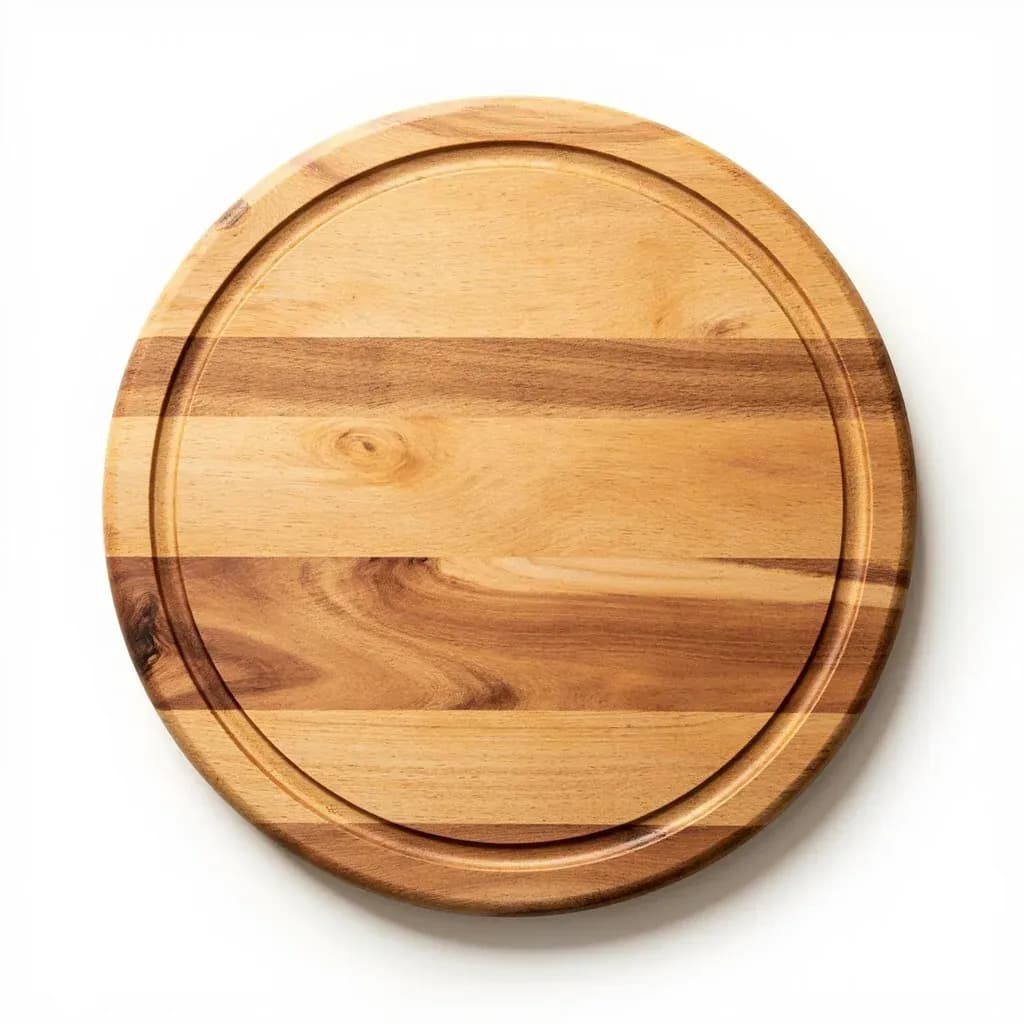
Round Wooden Cutting Board
A thick round wooden block for chopping, mincing, and breaking down ingredients.
A round wooden cutting board is a thick, end-grain or face-grain disc that provides a stable, knife-friendly surface for chopping and mincing. The dense wood is gentle on blade edges and self-heals minor cuts better than plastic. Heavy round blocks are favored in Asian kitchens for cleaving through bone and breaking down poultry where extra mass keeps the board steady.
A round wooden cutting board is a circular chopping surface cut from hardwood — most commonly maple, walnut, cherry, or teak — typically 8 to 18 inches across and 1 to 2 inches thick. The round form is less a functional innovation than a cultural one: in Alpine, German, Austrian, and Swiss kitchens it has long served as the 'Brettl' for bread and cheese, while in Italian homes the same shape handles pizza, focaccia, and antipasti. Thickness matters as much as diameter; a proper chopping round is heavy enough (often 4–7 lb for a 12-inch board) to sit firmly on the counter, and the wood itself gives slightly under a blade, cushioning the edge in a way glass, stone, or hard plastic cannot.
The round shape does have one real trade-off versus a rectangle: without a square corner to brace a wrist or stop a runaway vegetable, a round can pivot under a hard chop. A damp towel or non-slip mat underneath solves this in practice, and most cooks who reach for a round are choosing it for tradition, presentation, or the simple pleasure of carrying a beautiful object to the table. Wood is quieter, gentler on knives, and — per UC Davis food-safety research — behaves at least as well as plastic for bacterial die-off, since microbes drawn below the surface tend not to survive.
Used well, a round wooden board is a decades-long tool. The same piece can be sanded, re-oiled, and refreshed many times; the round format simply asks for a little more care than a rectangle in two ways — even heat exposure (no overhead stoves, no dishwashers, no soaking) and a stable base during use.
Alternatives
Types & varieties
The professional workhorse — pale, dense, tight grain, durable, and neutral in odor.
Dark chocolate-brown, slightly softer than maple; favored when chopping meets presentation.
Reddish-brown that deepens with age; medium hardness, attractive for fruit and cheese work.
Naturally oily and water-resistant; pricier but excellent for humid kitchens or wet tasks.
Checkerboard or 'pie' pattern made from glued blocks; the most knife-friendly and self-healing construction.
Sustainable and affordable, but very dense — dulls edges faster and can splinter along glue lines.
Mediterranean tradition; richly figured grain, dense, usually sold as smaller presentation boards.
Thick round mounted on a turned foot — the classic Alpine bread-and-cake stand, also used as a carving platter.
Two usable faces, sometimes with a juice groove on one side; allows separation of raw protein and produce work.
Carrying cutout or metal bail for hanging; practical when the board moves between counter and table.
Choosing the right wood and construction
Wood choice is really a choice between knife friendliness, durability, and aesthetics. For a board that will see daily chopping, edge-grain maple is the safe, affordable, professional standard; it has a tight, even grain and resists scoring. Walnut sits just behind maple in hardness but brings a much darker, warmer color that suits a board meant to double as a serving piece. Cherry is similar in feel to walnut, with a reddish cast that deepens noticeably over the first year of use.
End-grain construction is the upgrade worth paying for if the board will host a lot of knife work. Because the wood fibers stand vertically — like a dense brush — the blade slips between them on each cut rather than slicing across them. The fibers close back afterward, so shallow cuts seem to disappear and the board 'self-heals' over time. This is also why end-grain boards feel almost soft under a knife and keep an edge sharper longer. The cost is weight and price: end-grain rounds are typically cut thicker and run several times the price of an edge-grain board of the same diameter.
Bamboo and oak sit at the other end of the scale. Bamboo is technically a grass, not a wood, and its silica-rich fibers are hard enough to dull a blade noticeably faster than maple. Oak is attractive and traditional but very porous, so it absorbs moisture and odors more readily and is harder to keep sanitary. Both are acceptable for light or occasional use, less ideal as a primary chopping surface.
Care, oiling, and refreshing
A wooden round asks for two things above all: it must stay dry between uses, and it must be fed oil on a regular schedule. The oil is not for looks alone — it fills the pores between wood fibers and slows the absorption of water that causes warping and splitting. Food-grade mineral oil is the standard because it never goes rancid; ordinary cooking oils (olive, vegetable, coconut) oxidize inside the wood and can turn the board sour.
- On a new board, apply a generous coat of mineral oil, let it soak 20–30 minutes, then buff off the excess. Repeat daily for the first week, then weekly for a month — the wood will stop accepting oil once it is saturated.
- Re-oil monthly thereafter, or whenever the surface looks pale, dry, or rough. A beeswax-and-mineral-oil blend (roughly 4 parts oil to 1 part melted beeswax) gives a harder, water-resistant finish that is especially useful on end-grain boards.
- Wash only by hand: warm water, mild soap, a scrub brush, immediate towel dry, then stand on edge so air circulates on both faces.
- Sanitize between tasks with coarse salt and a cut lemon half — rub the surface, let sit a minute, rinse — or wipe with white vinegar or 3% hydrogen peroxide. Both lift odors and reduce surface bacteria without soaking the wood.
- Refresh a tired or scratched board by sanding flat with 120-grit, then 220-grit sandpaper, wiping clean, and re-oiling. End-grain rounds can be refreshed this way many times before the wood grows too thin.
Round versus rectangular
The circular form is mostly tradition and presentation. A rectangle gives a wrist a square corner to brace against and a long edge to catch runaway ingredients; a round has neither. In heavy, repetitive chopping — mountains of mirepoix, a full case of shallots — a rectangle is simply more efficient.
A round earns its place in three situations: when the food is round (loaves of bread, wheels of cheese, pizza, focaccia), when the board will travel to the table as a serving piece, and when the Alpine or Mediterranean aesthetic is part of the meal. A pedestal round in particular straddles kitchen and dining room — it sits on the counter for carving, then on the table as a bread or cake stand. For most cooks, the practical answer is to own both: a rectangle for daily chopping, a round for bread, cheese, pizza, and presentation.
Common uses
Tips & pitfalls
- Place a damp kitchen towel or silicone non-slip mat under the board before chopping; round boards rotate under a heavy knife, and the towel stops them from skating.
- Never put a wooden round in the dishwasher or leave it sitting in a puddle of water — prolonged moisture and heat will warp and split the wood within a cycle or two.
- Keep raw meat, poultry, and fish on a separate board from produce, bread, and cheese; the round format pairs naturally with a dedicated 'bread and cheese' board that never sees raw protein.
- Avoid storing the board in direct sunlight or directly above a stove — uneven heat warps a round faster than a rectangle, because no straight edge resists curling.
- Resurface scratches and stains by sanding flat with 120- then 220-grit paper, then re-oil; an end-grain round can be refreshed this way many times over its life.
- Lift strong odors (onion, garlic, fish) by rubbing the dry surface with coarse salt and a halved lemon, then rinsing and towel-drying.
- Choose end-grain or edge-grain maple, walnut, or cherry over bamboo or oak when knife-edge longevity matters; bamboo is hard on edges, oak is too porous to sanitize easily.
- Oil monthly with food-grade mineral oil — never olive, vegetable, or coconut oil — and buff off any excess after 20 minutes so the surface does not turn gummy.
Good to know
- Primary material
- Hardwoods such as maple, walnut, cherry, oak, or teak; bamboo (technically a grass) is also common but is significantly harder on knife edges.
- Construction styles
- Edge-grain (long strips glued side-by-side), end-grain (small blocks arranged with cut ends up — gentlest on knives and most self-healing), and face-grain (rare for heavy chopping).
- Typical diameter
- 8 to 18 inches (20–46 cm) for kitchen work; presentation and cheese boards can run 20 inches or larger.
- Typical thickness
- 1 to 2 inches (2.5–5 cm) for chopping-grade rounds; thinner 'cheese' boards are 0.5–0.75 inch.
- Origin / tradition
- Round wooden boards are traditional in Alpine, German, Austrian, and Swiss cuisines for bread service (the 'Brettl' or 'Schneidbrett') and in Italian kitchens for pizza prep and cheese presentation.
- Weight
- A 12-inch, 1.5-inch-thick hardwood round typically weighs 4–7 lb (2–3 kg), heavy enough to stay put on a counter.
- Maintenance finish
- Conditioned with food-grade mineral oil, optionally blended with beeswax; never vegetable or olive oil, which go rancid.
- Antimicrobial behavior
- UC Davis food-safety research (mid-2000s) found that bacteria applied to wooden boards migrate below the surface and die off, performing comparably to or better than plastic.
- Heat tolerance
- Cannot go in dishwashers; prolonged heat, steam, or soaking warps and splits the wood.
- Knife impact
- Wood is gentler on blade edges than glass, stone, bamboo, or hard plastic; end-grain is the most forgiving.
- Price range
- Mass-produced maple rounds from about $20; artisan end-grain hardwood rounds from $80 to several hundred dollars.
Also called
wooden-chopping-block · Round Cutting Board · Wooden Chopping Block · Butcher Block
Related

Knife
The fundamental cutting tool every kitchen is built around

Chef's Knife
The do-everything blade for chopping, slicing, and mincing

Paring Knife
Small, nimble blade for peeling and detailed in-hand work

Serrated Knife
Saw-toothed blade that slices crusty bread without crushing

Cleaver
Heavy broad blade for chopping through bone and bulk prep

Cutting Board
The stable surface every cut starts on

Mandoline
Adjustable blade for paper-thin, perfectly even slices

Kitchen Shears
Heavy-duty scissors for poultry, herbs, and packaging