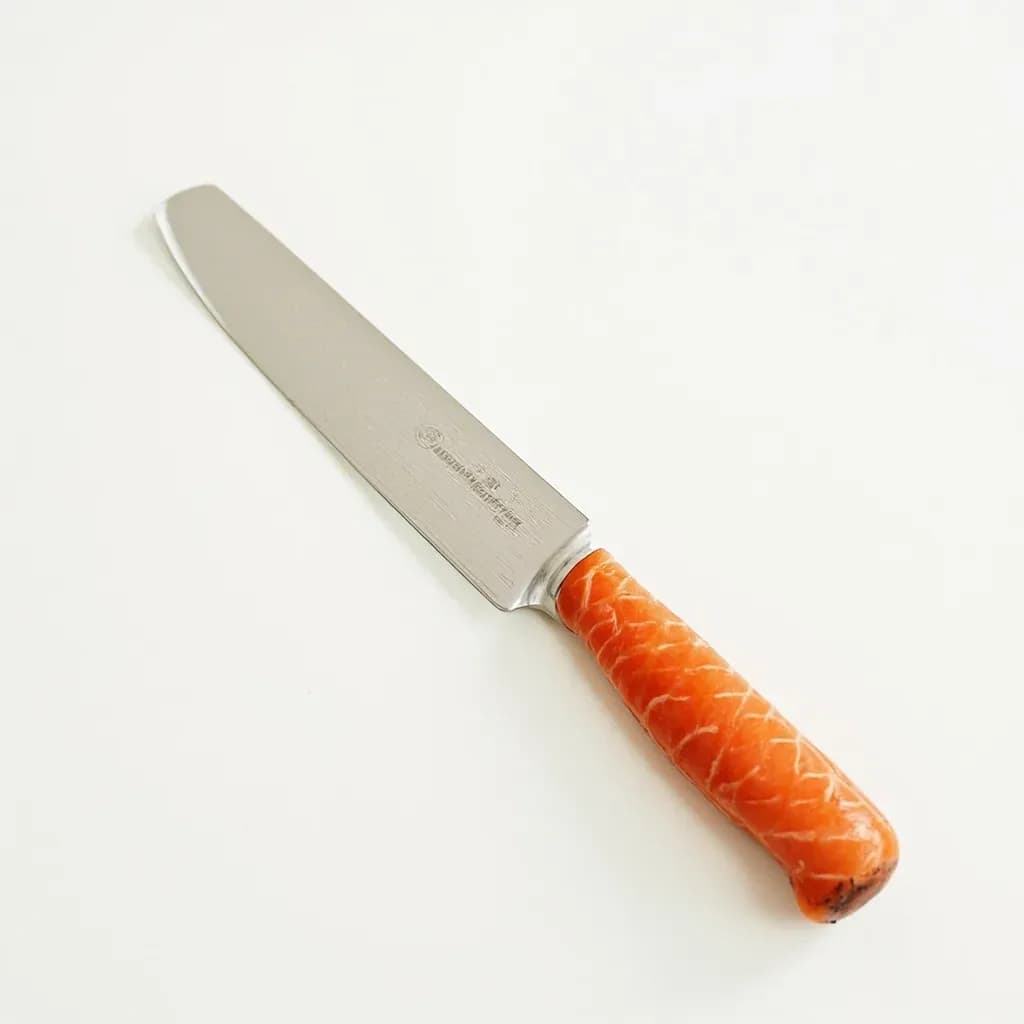
Knives & Cutting
Salmon Slicer (Flexible Slicing Knife)
Long, thin, flexible blade for carving paper-thin slices of cured or raw salmon.
A salmon slicer is a long, narrow knife with a very flexible blade, often scalloped with hollow dimples to reduce drag. It is used to cut wafer-thin, even slices from a side of smoked, cured, or fresh salmon in a single smooth stroke. The flex lets the blade glide flat along the skin, separating the flesh cleanly.
A salmon slicer is a specialized slicing knife built for one job: cutting delicate fish flesh — salmon chief among them — without tearing or crushing it. Its defining traits are length (9–14 inches), thinness (around 2–2.5 mm at the spine), and tip flex, all working together so that a single long stroke can traverse an entire fillet from heel to tip. The thin geometry produces very little drag through soft flesh, while the flexibility lets the blade follow the curve of a whole side of salmon as you work. Where a chef's knife would saw and crush, this blade glides and lifts cleanly — the difference between a ragged edge and a translucent, tissue-paper slice.
The tool sits at the crossroads of two traditions: European ham and carving slicers, which gave the long narrow profile and (often) granton edge, and the Japanese sujihiki, refined for the single-pull cuts central to sashimi work. A Western slicer is the forgiving, general-purpose choice for home cooks slicing lox, gravlax, or a roasted side. A Japanese sujihiki offers surgical precision for sashimi blocks and a single-bevel edge that parts flesh with almost no resistance. Both reward the same technique: chill the fish, hold the blade low, and let one smooth stroke do the work.
The payoff shows up on the plate. Paper-thin gravlax drapes and catches the light; sashimi slices lie flat with clean, intact muscle fibers; a poached fillet portions into neat coins rather than ragged chunks. For any kitchen that regularly handles whole sides of salmon, the slicer is the tool that does what no other knife in the drawer can.
Alternatives
Types & varieties
Double-bevel, 9–12 in, full-tang riveted handle; the common 'salmon slicer' sold in Western kitchens.
Single-bevel, often with a magnolia wa-handle; ground on one side for exceptionally clean pull-cut slices.
Long, single-bevel sashimi knife; rigid rather than flexible. Used for similar tasks but not a substitute when flex is required.
Western slicer with hollow scallops along the blade; reduces sticking when slicing oily fish like salmon.
Fully flexible blades curl around the contour of a whole side; semi-stiff (more common on Japanese sujihiki) gives a straighter cut for sashimi blocks.
Similar profile but stiffer and taller; usable on salmon but lacks the fine tip and flex preferred for fish.
Choosing a Western slicer vs. a Japanese sujihiki
The right choice depends on what you slice most and how much sharpening discipline you want to take on.
- Pick a Western double-bevel slicer (9.5–10.5 in, granton edge, full-tang handle) if you mostly slice lox, gravlax, poached salmon, or roasted sides. It is forgiving, ambidextrous, and easy to maintain.
- Pick a Japanese sujihiki (10–12 in, single-bevel, wa-handle) if you cut sashimi blocks, want the cleanest possible pull-cut, and are comfortable sharpening on whetstones. Single-bevel blades must be matched to the user's handedness.
- A yanagiba is the wrong choice for whole sides of salmon: it is rigid and designed for the straight, drawing cuts of sashimi, not the curving flex needed for following a fillet.
- Heavier carving slicers designed for ham or brisket will work in a pinch but lack the thin tip and flex that make a salmon slicer feel surgical on fish.
Technique for paper-thin slices
The slicer rewards restraint. Let the geometry do the work; do not force it.
- Chill the fish 20–30 minutes — a firmer, slightly frozen surface resists tearing and shaves thinner than room-temperature flesh.
- Hold the blade at a low, almost flat angle to the fish for translucent slices; raise the angle slightly for thicker portion cuts.
- Make one long, smooth pull from heel to tip. Sawing crushes the fibers and leaves a ragged edge.
- Wipe the blade with a damp cloth between cuts if the fish is oily; sticky steel pushes the slice rather than cutting it.
- For cured salmon, cut on the bias to lengthen each slice and let it drape nicely on a platter or bagel.
- Anchor the board with a damp paper towel underneath; bamboo boards are too hard and can dull thin edges quickly.
Care and maintenance
A thin, hard edge is the slicer's whole reason for existing — and its most vulnerable feature.
- Hone with a ceramic or smooth honing rod before each use to realign the edge.
- Sharpen on a 1000/3000-grit whetstone (or send it to a professional) every 6–12 months under regular home use.
- Hand wash in warm soapy water, rinse, and towel-dry immediately. Dishwashers, salt, and air-drying will pit the steel and ruin handles.
- Store in a wooden saya, on a magnetic strip, or in a dedicated block slot. Loose drawer contact with other blades dulls the edge quickly.
Common uses
Tips & pitfalls
- Chill the salmon side or fillet for 20–30 minutes before slicing; a firmer, slightly frozen surface gives cleaner, thinner slices with less tearing.
- Make one long, smooth pull stroke from heel to tip — do not saw. Let the blade do the work; this knife is sharpened to glide, not to be forced.
- Slice against the grain of the muscle fibers to shorten them and improve mouthfeel, especially on poached or roasted salmon.
- For cured salmon, cut on the bias to maximize surface area and let slices drape on a platter or bagel.
- For a long uncut side of salmon, begin at the tail end and use the flexible tip to follow the contour of the belly, lifting the blade as you run out of fish to avoid tearing the tail end.
- Common mistake: using a chef's knife. Its shorter, thicker blade crushes delicate fish flesh and produces ragged edges — reserve it for tasks the slicer cannot do.
- Common mistake: pressing down. The thin blade will flex and the slice will tear or buckle — guide it, do not shove it.
- Common mistake: trying to slice through skin on a whole fillet. Slide the tip under the skin at the tail and use a light sawing motion to remove the skin first, then portion the flesh separately.
Good to know
- Also known as
- Sujihiki (Japanese), salmon knife, fish slicer, smoked salmon knife
- Typical blade length
- 9–12 in (23–30 cm); professional models up to 14 in (36 cm)
- Blade thickness
- Approximately 2–2.5 mm at the spine; tapers to a fine point
- Blade material
- High-carbon stainless steel (VG-10, SG2, AEB-L) on premium models; standard stainless on entry-level
- Typical hardness
- HRC 56–60 (Western stainless); up to HRC 62–63 (powdered-steel Japanese models)
- Edge geometry
- Double-bevel on Western versions; single-bevel (right-handed) on traditional sujihiki
- Flex
- Full or partial blade flex; tip is the most flexible section
- Granton edge
- Many Western models have hollow-ground oval scallops to reduce drag and sticking on oily fish
- Dishwasher safe
- No — hand wash and dry immediately to protect edge and handle
Also called
Slicing Knife · Benriner Slicer · Smoked Salmon Knife · Lox Knife
Related

Knife
The fundamental cutting tool every kitchen is built around

Chef's Knife
The do-everything blade for chopping, slicing, and mincing

Paring Knife
Small, nimble blade for peeling and detailed in-hand work

Serrated Knife
Saw-toothed blade that slices crusty bread without crushing

Cleaver
Heavy broad blade for chopping through bone and bulk prep

Cutting Board
The stable surface every cut starts on

Mandoline
Adjustable blade for paper-thin, perfectly even slices

Kitchen Shears
Heavy-duty scissors for poultry, herbs, and packaging