Knives & Cutting
Santoku Knife
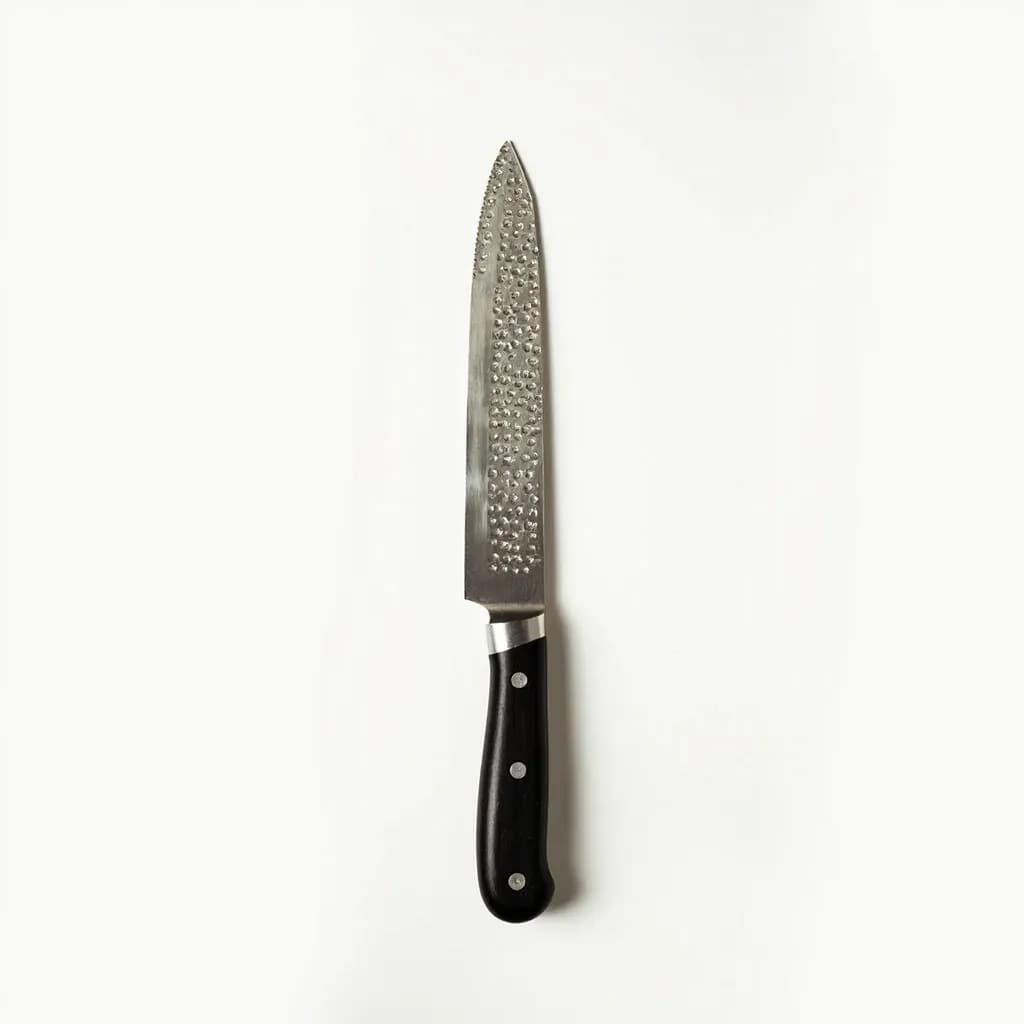
A Japanese all-purpose knife with a flat edge and sheepsfoot tip for slicing, dicing and mincing.
A santoku is a Japanese general-purpose knife whose name means three virtues, slicing, dicing and mincing, with a flatter edge and a rounded sheepsfoot tip than a Western chef's knife. The straighter blade favors an up-and-down push cut rather than a rocking motion. Many have a Granton (dimpled) edge that helps thin slices release instead of sticking.
The santoku is a Japanese all-purpose kitchen knife built for the three daily tasks the home cook performs most: slicing, dicing, and mincing — the "three virtues" (三徳, santoku) that give the knife its name. Developed in postwar Japan as a generalist alternative to the longer gyuto, it typically measures 165–180 mm from heel to tip and carries a flat edge that runs almost straight from heel to a rounded sheepsfoot tip, with a short flat section at the very end where the edge curves down to meet the spine.
What distinguishes the santoku from a Western chef's knife is not its appearance so much as the cut it asks you to make. The flat edge rewards a straight, downward push — a controlled slice in which the blade travels away from the handle in a single clean line, with the tip staying in contact with the board. Rocking the blade the way you would with a French or German chef's knife lifts the tip off the board, throws off your alignment, and turns the geometry of the knife against you. Once a cook internalizes that single shift in technique, the santoku becomes an exceptionally efficient tool for produce and boneless protein prep.
For most home kitchens, a well-made santoku in stainless steel with a granton edge is the most forgiving and versatile knife in the drawer. It is not, however, a universal replacement: it lacks the length of a gyuto for breaking down large roasts, the tall flat profile of a nakiri for big vegetable jobs, and the heft of a deba for fish butchery. Used for what it was designed to do — mid-sized vegetables, herbs, boneless meats, and skinless fish — it is among the most rewarding knives a cook can own.
Alternatives
Types & varieties
The most common Western-market version; hollow-ground oval scallops along the blade create air pockets that keep starchy foods like potato and eggplant from clinging to the edge.
Traditional Japanese D-shaped or octagonal wooden handle (often magnolia); lighter in the hand and typically more tapered toward the heel, with a horn, composite, or stainless bolster.
Full-tang construction with riveted synthetic or composite handle; familiar grip for cooks transitioning from a European chef's knife.
A close cousin with a k-tip (angular reverse-tanto point) instead of the sheepsfoot tip; same flat edge, but the pointed tip is well-suited to scoring and detail work.
A 130–150 mm blade suited to small produce, single-serve prep, and cooks with smaller hands.
A hard core steel (VG-10, SG2) forge-welded between softer stainless layers; the layered pattern is decorative, and the softer outer steel adds corrosion resistance and chip toughness.
Zirconia blades hold an edge far longer than steel but chip on bone, frozen food, or lateral stress; they cannot be resharpened on standard whetstones (diamond stones are required).
The Push Cut: Making the Geometry Work
The santoku's flat edge is not a limitation — it is a design choice. By removing the belly curve found on a chef's knife, the santoku keeps the entire edge in contact with the food as you slice, which translates downward force into a clean cut rather than a wedge. The motion is a single, straight stroke: tip on the board, knuckles forward, blade driven down and away from you in one movement. For taller items, a slight pull-back of the heel finishes the slice. Rocking the blade is a habit to unlearn, because the moment the tip lifts, the heel stops cutting and the slice tears instead of cleaves.
- Start each cut with the tip resting on the board; this anchors the blade and gives you a reference point for slice thickness.
- Drive the knife straight down and forward in a single motion; let the weight of the blade do the work rather than pressing hard.
- For tall items, slice forward and then draw the heel back slightly — never rock the tip up off the board.
- Curl your fingertips inward and use your knuckles as a guide; this protects your fingers and keeps slice thickness consistent.
Choosing a Santoku
Among santoku in the same price range, edge geometry matters more than steel name. A thin, well-ground blade in modest VG-10 will out-cut a thick, poorly ground knife in premium SG2 every time. For a first santoku, look for a 165–180 mm stainless blade with a granton edge, a comfortable handle, and a bolster that does not force a cramped grip. A western-handled version eases the transition from a chef's knife; a wa-handled version rewards the cook who wants a lighter, more traditional tool.
- 170 mm is the most versatile size for most home cooks; 180 mm if you have a large board and prep a lot at once.
- A hollow granton edge is genuinely useful for potatoes, eggplant, and other starchy vegetables that tend to stick.
- Test grip comfort in person if possible — a handle that is too thick or too short will cause fatigue long before the blade wears out.
- Skip ceramic unless you are committed to a soft-food, no-bone kitchen; the chip risk outweighs the edge retention for most cooks.
Care and Maintenance
A santoku rewards a small, regular maintenance routine. Honing with a ceramic or fine diamond rod every few uses realigns the edge without removing steel; a whetstone session two or three times a year restores the geometry. Hand washing and immediate towel drying protect both the edge and the handle, and storing the knife on a magnetic strip, in a saya, or in a block keeps the tip from contacting other utensils.
- Hone lightly every few uses — a heavy hand with the rod removes steel unnecessarily.
- Sharpen on whetstones: 1000 grit to set the edge, 3000–6000 to refine; pull-through sharpeners strip the convex grind.
- Hand wash and towel dry; never put a Japanese-steel knife in the dishwasher.
- Cut only on end-grain wood or quality polyethylene; glass, marble, ceramic, and bamboo will dull the edge within minutes.
Common uses
Tips & pitfalls
- Do not rock the blade — the flat edge is designed for straight downward and forward strokes; rocking lifts the tip off the board and tears instead of slices.
- Keep the tip on the board at the start of each cut for stability, then drive the knife down and away from you in a single straight motion.
- Grip the knife with a light pinch just in front of the bolster; a tight grip causes fatigue and reduces the precision the geometry offers.
- Hone every few uses with a ceramic or fine-diamond rod using light, even strokes — heavy pressure removes steel and shortens blade life.
- Sharpen on whetstones (1000 grit to set, 3000–6000 to refine) rather than pull-through sharpeners, which strip the convex edge geometry.
- Hand wash and towel dry immediately after use — dishwashers damage the edge, swell wooden handles, and pit the bolster joint.
- Cut only on wood or quality plastic boards; glass, marble, stone, and bamboo will dull the edge within minutes.
- Never pry, snap, or break bones with the santoku — the flat sheepsfoot tip and thin edge chip easily under lateral force.
- Store in a saya, on a magnetic strip, or in a knife block to protect the edge and tip.
Good to know
- Origin
- Japan; developed in the mid-20th century and widely adopted after World War II
- Etymology
- Santoku (三徳) means "three virtues" — slicing, dicing, and mincing
- Typical blade length
- 130–200 mm (5–8 in); the most common size is 170–180 mm (7 in)
- Blade profile
- Flat edge with a sheepsfoot (rounded) tip; lacks the curved belly of a Western chef's knife or gyuto
- Bevel
- Double-bevel on essentially all modern production; traditional single-bevel santoku are rare
- Common steels
- Stainless, high-carbon, VG-10, AUS-10, SG2/R2, often clad as Damascus for corrosion resistance
- Typical hardness
- 56–62 HRC depending on steel
- Common features
- Granton edge (hollow-ground scallops) reduces food sticking; full or partial bolster
- Handle styles
- Western full-tang or Japanese wa-handle (often octagonal magnolia wood)
- Weight
- Generally lighter than a comparable Western chef's knife of the same length
- Best on
- Vegetables, boneless meats, and skinless fish; avoid bone-in cuts, frozen food, and hard squash with force
- Cutting surface
- End-grain wood or quality polyethylene only — never glass, marble, ceramic, or bamboo
Also called
Santoku · Japanese Chef's Knife
Related

Knife
The fundamental cutting tool every kitchen is built around

Chef's Knife
The do-everything blade for chopping, slicing, and mincing

Paring Knife
Small, nimble blade for peeling and detailed in-hand work

Serrated Knife
Saw-toothed blade that slices crusty bread without crushing

Cleaver
Heavy broad blade for chopping through bone and bulk prep

Cutting Board
The stable surface every cut starts on

Mandoline
Adjustable blade for paper-thin, perfectly even slices

Kitchen Shears
Heavy-duty scissors for poultry, herbs, and packaging