Cookware
Sauce Pot (Russe)
A deep straight-sided pot for simmering sauces, stocks, and liquids with controlled evaporation.
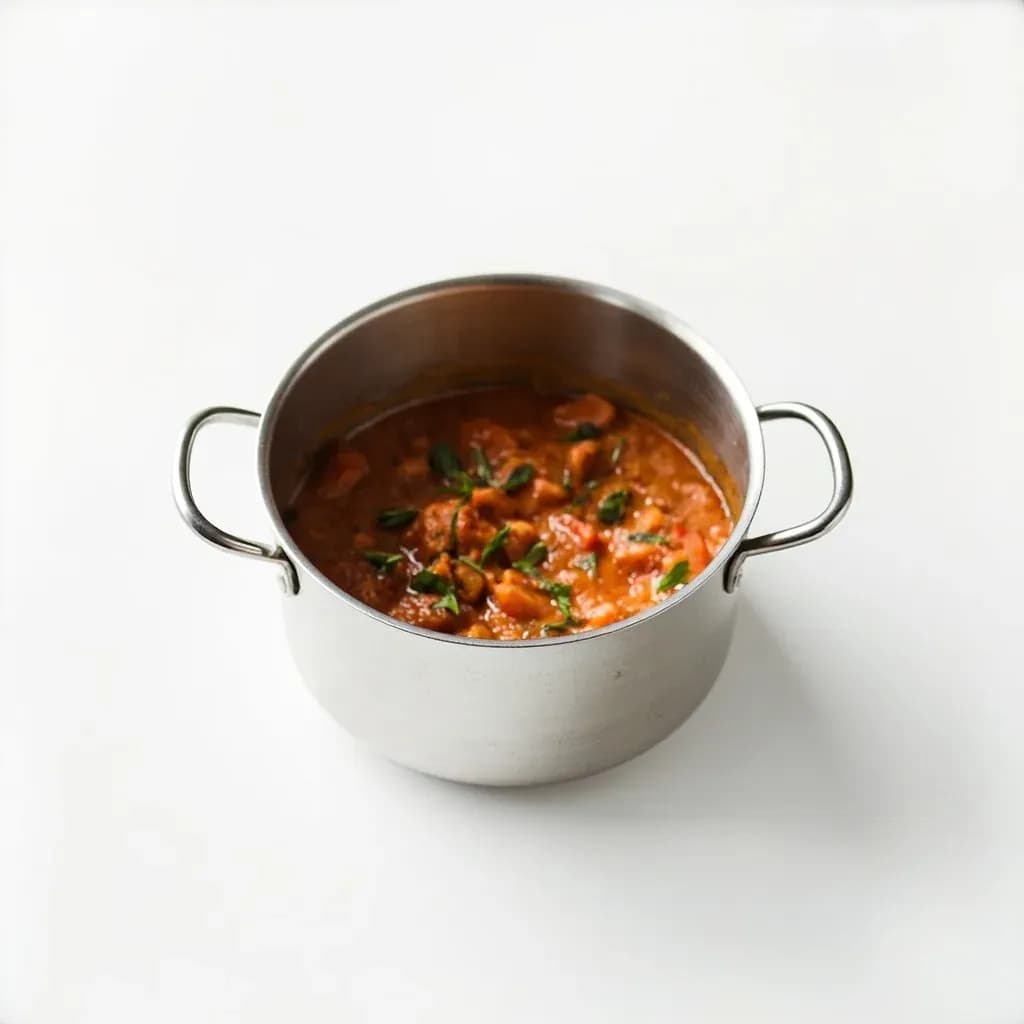
A sauce pot, called a russe in French kitchens, is a tall, straight-walled pot, usually with two handles, designed for cooking with liquids. Its depth relative to width slows evaporation, making it ideal for simmering sauces, reducing stocks, blanching, and cooking grains. It is one of the most-used vessels on any line, sized from small to very large.
The sauce pot known as a Russe is defined less by its size than by its silhouette: the walls curve outward as they rise, so the rim is noticeably wider than the base. That profile comes out of the 19th-century French copperware tradition — the name simply distinguishes it from the straighter Lyonnaise and the shallower Parisienne — and it has survived because the geometry solves a real cooking problem. In a straight-sided saucepan, a whisk's loop cannot reach the corner where wall meets base; in a Russe, the gentle outward slope lets a flat whisk sweep the entire cooking surface in a single circular motion, which is exactly what you need when roux, egg yolks, or starch-thickened liquids are in play.
For sauce work, the curved walls do more than improve whisking access. They expose a relatively large surface area at the rim compared to the volume below, encouraging steady, predictable evaporation during a reduction. The 1.5- to 2-quart size is the workhorse: large enough to cook a quart of liquid at a rolling simmer without boiling over, yet small enough that a reduction actually concentrates in reasonable time. Heat response depends almost entirely on the material — tin-lined copper heats and cools within seconds, so a sauce about to break can be pulled off the flame just in time; stainless-clad versions trade some of that agility for durability and easy cleaning.
Size the pot to the job. A Russe that is too big for the volume wastes fuel and reduces too slowly; one that is too small will surge and spit when a liaison, slurry, or whisked-in butter hits the liquid. The traditional 1.5-quart handles most pan sauces and small reductions; reach for the 3- or 4-quart only when you are building a full batch of stock-based sauce or cooking grains by the quart.
Alternatives
Types & varieties
The classic profile; sloped walls maximize both whisking access and exposed reduction surface
Cylindrical walls preferred when a deep, flat vessel matters more than whisk reach — closer to a classical saucepan
Wider and shallower, approaching a sauté pan; used for shallow reductions and quick pan sauces
Traditional tin-lined copper; the historical standard in classical French brigade kitchens and pastry work
Modern home and professional version; usually tri-ply or multi-clad for more even heat across the base
Lighter and less expensive than copper, with responsive heat; uncoated aluminum reacts with acidic ingredients
Rare; heavy with high heat retention, suited to long slow reductions rather than quick sauce work
The three classical French saucepan profiles
French copperware catalogs from Mauviel, Dehillerin, and their contemporaries group saucepots into three named profiles, and learning the difference helps you pick the right tool without staring at a wall of pans. The Russe curves outward, the Lyonnaise goes straight up, and the Parisienne spreads wide and shallow. Each is the right answer to a different problem.
- Russe — curved, sloped walls. Best for whisking-based work: roux sauces, egg-thickened sauces, custards, pastry cream, and reductions where you want a large exposed surface relative to volume.
- Lyonnaise — straight, cylindrical walls. Best when you want a deep column of liquid with minimal evaporation, or when a flat-sided surface is preferable to whisking reach (deep stocks, long braises, cooking grains).
- Parisienne — wide and shallow, close to a sauté pan. Best for pan sauces, glazing vegetables, and reductions that should finish in seconds rather than minutes.
Material choice and heat behavior
The shape of a Russe is constant; the material changes everything about how it cooks. Copper's thermal conductivity is an order of magnitude greater than stainless steel's, which in practice means a copper Russe responds to burner changes within a second or two, while a heavy stainless-clad one keeps climbing for ten or fifteen seconds after you turn the knob down. For emulsified sauces that break in an instant — hollandaise, béarnaise, sabayon — that responsiveness is the difference between a glossy finished sauce and a broken one.
- Copper Russe: the standard for classical French and pastry work; tin lining must be retinned every few years of heavy use, and acidic ingredients left sitting will strip the tin.
- Stainless-clad Russe (tri-ply or multi-clad): the modern default; slower to respond but durable, dishwasher-safe, and nonreactive.
- Anodized aluminum Russe: light, quick, and nonreactive; a reasonable mid-range option that mimics much of copper's responsiveness without the upkeep.
- Cast iron: rarely made in this shape; if you do find one, its heat retention suits long slow reductions well, but it is the wrong tool for quick whisked sauces.
Common uses
Tips & pitfalls
- Use the sloped walls — the whole point of the Russe shape is that a flat whisk can reach the center, edges, and the wall-to-base junction in a single circular motion; a balloon whisk loses this advantage and reintroduces lumps.
- Whisk roux-based sauces constantly from the moment liquid hits the fat; curved sides help, but lumps still form if the liquid is added too fast, too cold, or in too large a slug.
- Size the pot to the job: a Russe that is too large reduces glacially, while one that is too small boils over the moment a liaison, slurry, or starch hit the liquid.
- For hollandaise, béarnaise, and sabayon, keep the heat gentle — barely simmering water in a double boiler or the lowest possible direct flame; high heat breaks the emulsion faster than you can rescue it.
- Deglaze fond with cold stock or wine; the thermal shock against a hot pot lifts cooked-on bits far more effectively than warm liquid.
- Never run an empty stainless or tin-lined copper Russe over high heat; the metal can warp and tin can oxidize or discolor.
- For clean reductions, leave the lid off and use the largest-diameter Russe that still holds the volume; more exposed surface per quart means faster, more even concentration.
- If the tin lining on a copper Russe shows through to copper or develops gray patches, send it for retinning rather than cooking around it — exposed copper can leach metallic flavors into acidic sauces.
Good to know
- Defining shape
- Sloped, outwardly curved sides; base is noticeably narrower than the rim
- Traditional material
- Copper, typically tin-lined on the interior
- Modern materials
- Stainless steel (often tri-ply or multi-clad), aluminum, occasionally cast iron
- Typical sizes
- 1 to 4 quarts; the 1.5–2 qt is the workhorse for sauce work
- Distinguishing feature
- Curved walls let a flat whisk sweep the entire base — including the wall-to-base junction — in one circular motion
- Heat response
- Copper is the fastest to heat up and cool down; stainless is slower but more durable and easier to maintain
- Companion profiles
- Lyonnaise (straight-sided) and Parisienne (shallower and wider) are the other two classical French saucepan shapes
- Handle config
- Single long handle on 1–2 qt sizes; 3+ qt versions usually add a helper handle opposite
Also called
russe · saucepot · stock pot (small)
Related

Steamer
Gentle moist heat that keeps vegetables, fish, and dumplings tender

Frying Pan
Shallow sloped pan for frying, sautéing, and quick sears

Saucepan
Tall, straight-sided pot for sauces, grains, and small batches

Sauté Pan
Wide straight-sided pan with room to brown and braise

Dutch Oven
Heavy lidded pot that turns tough cuts tender over hours

Stock Pot
Tall, roomy pot for stocks, pasta, and big-batch cooking

Wok
High-sided bowl pan built for blistering-hot stir-fries

Griddle
Flat, broad surface for pancakes, smash burgers, and breakfast