Cookware
Rice Noodle Roll Steaming Tray
A shallow flat tray for steaming rice batter into silky Cantonese cheung fun noodle rolls.
A rice noodle roll steaming tray is a thin, shallow rectangular pan, usually metal, used to steam a thin layer of rice flour batter into a soft sheet. Once set, the cooked sheet is scraped up and rolled, sometimes around shrimp or pork, to make the Cantonese dim sum dish cheung fun. The flat, low-rimmed shape spreads the batter evenly so it steams into a smooth, tender noodle.
The rice noodle roll steaming tray — cheung fun tray in Cantonese cooking shorthand — is the shallow, flat-bottomed pan that turns a thin rice batter into the silken sheets wrapped around shrimp, char siu, and beef in cheung fun. Its defining feature is depth: roughly 1 to 1.5 inches of sidewall, just enough to contain a thin puddle of batter and a handful of filling, with a perfectly flat cooking surface so the sheet sets in an even 1.5 to 2 mm layer. Anything deeper wastes batter and slows the cook; anything with a warped or ridged bottom gives an uneven sheet that tears when scraped off.
In practice the tray is a steam vessel, not a sauté pan. It is preheated empty over boiling water, oiled, filled with batter, and returned to the steamer for under two minutes. The hot metal flashes the starch on contact so the sheet releases cleanly, and the shallow rim lets steam wash up against the underside rather than cooking from above. That is why a wok, stockpot, or bamboo steamer is the heat source — the tray itself is essentially a lid-fitted mold. Modern home cooks usually work with one or two trays; dim sum kitchens rotate ten to thirty at a time, keeping a constant rhythm of pouring, steaming, scraping, and rolling.
Alternatives
Types & varieties
Modern standard. Durable, non-reactive, easy to clean, slightly slower to heat than aluminum.
Classic Hong Kong and Guangdong dim sum kitchen choice. Heats fast and evenly but can discolor and may react with acidic batters if left uncoated.
Easiest release for beginners, especially when oiling technique is not yet consistent; the coating eventually wears and the tray must be replaced.
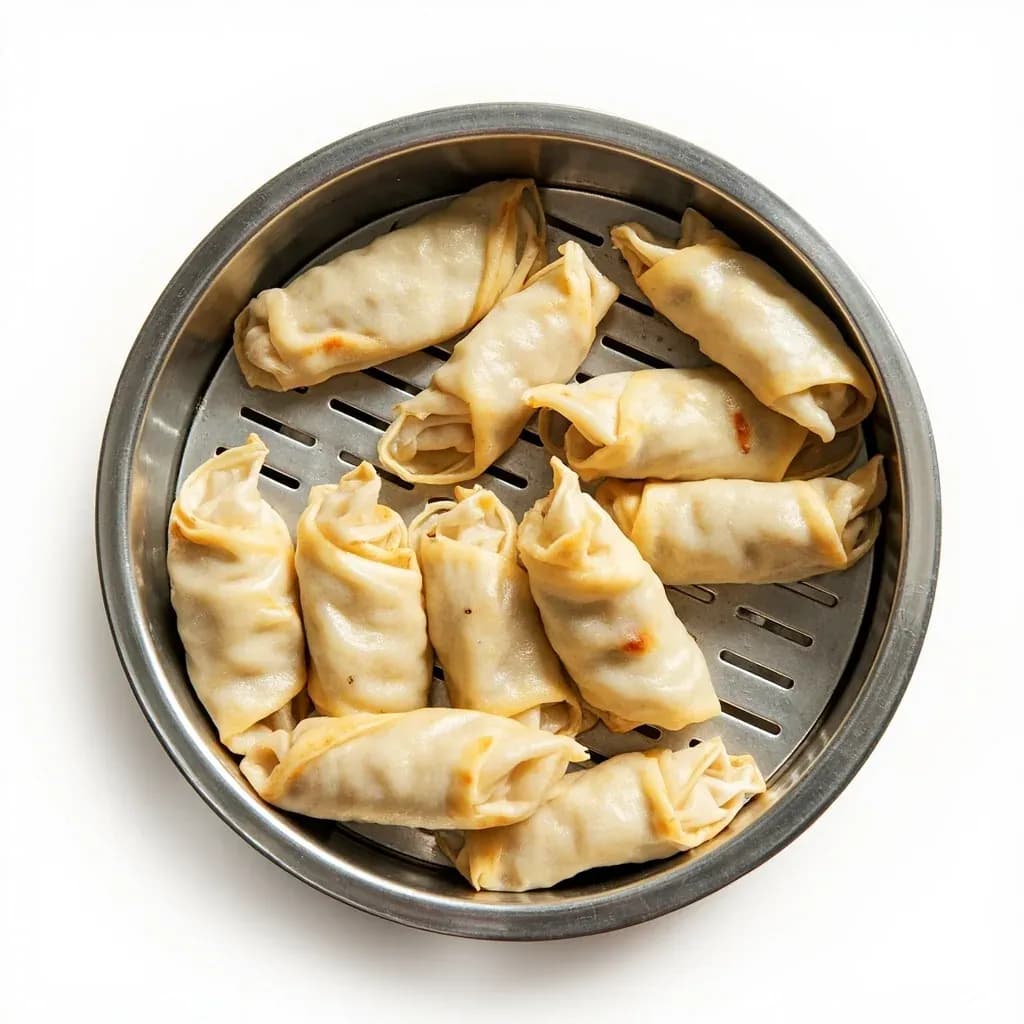
Used for shrimp cheung fun (har cheung fun) and smaller portions; produces a tighter, more cylindrical roll than the rectangular version.
Pre-metal method: a wet muslin or fine cheesecloth stretched over a wide pot. Still works at home and gives a slightly more rustic, uneven texture, but largely replaced by metal trays in restaurants.
Setting up at home
A single 9 x 13 in tray is enough for a home cook. Set it over a wok or wide pot with about an inch of simmering water and a trivet or steamer rack that holds the tray above the waterline. The lid should fit tightly so steam does not escape — a domed wok lid is ideal. Keep a shallow basin of cool water on the counter for dipping the hot tray between batches; this is what lets the next pour of batter spread into a perfectly thin layer and lets the cooked sheet release without tearing.
- Use a wide wok or 12 in stockpot with a tight-fitting lid.
- Keep water at a rolling simmer, not a violent boil — splashing water pits the sheet.
- Have a folded paper towel in a small dish of neutral oil for greasing between batches.
- Reserve a flat bench scraper or dedicated cheung fun scraper; a knife will tear the sheet.
The batter is half the system
A proper Cantonese cheung fun batter is not pure rice flour. The blend of rice flour with a small amount of wheat starch and tapioca or cornstarch is what produces the silky, elastic sheet that rolls without cracking. A typical ratio is roughly 100 g rice flour, 20 g wheat starch, and 10 g tapioca starch to 250–280 g water, with a pinch of salt and a teaspoon of oil. The batter must rest at least 20–30 minutes — many cooks rest it overnight in the refrigerator — so the starches fully hydrate and any lumps disperse. Pouring batter that has not rested gives a gritty, tear-prone sheet no matter how good the tray is.
The dim sum kitchen rhythm
In a Cantonese dim sum kitchen, the cheung fun station is one of the most physically demanding. A single cook may rotate 10 to 30 trays at once: one tray steaming with the lid on, one tray cooling briefly on the counter, one tray being oiled and filled, and another waiting its turn. Each sheet is scraped off with a flat metal scraper in a single motion, laid on a cutting board, filled, rolled, and portioned — usually in well under two minutes per tray. This rotation is why the shallow metal tray replaced the older cloth-lined method: it heats faster, releases more reliably, and turns around in seconds rather than minutes.
Common uses
Tips & pitfalls
- Oil the tray with a thin, even film — too much oil pools and leaves greasy rolls. A folded paper towel dipped in neutral oil and wiped across the surface is the simplest method.
- Preheat the empty tray over the steamer for at least 30–60 seconds before pouring. A cold tray gives a gummy, uneven sheet that resists spreading and tears on release.
- Dip the hot tray in a basin of cool water between batches so the next pour spreads thin and the cooked sheet lifts cleanly off the metal.
- Pour batter from a small jug close to the tray surface and swirl immediately — the consistency should be that of thin cream. Too thick and the sheet is heavy; too thin and it tears.
- Add fillings (shrimp, sliced beef, scallions) right after the batter is poured, not after steaming begins — this sets them into the sheet rather than leaving them sitting on top.
- Keep the lid on tight. Escaping steam leaves a dimpled, dry surface instead of the glossy, tender skin cheung fun should have.
- Scrape with a flat, flexible bench scraper held nearly parallel to the tray; a knife tears the delicate sheet even when the cook is being careful.
- Do not over-steam. The sheet goes from silky to rubbery in a matter of seconds past its window — 60–90 seconds for plain, 90–120 seconds with filling.
- If the sheet sticks, the cause is almost always one of three things: the tray was under-oiled, the tray was too cool, or the batter sat on the metal too long before steaming began.
- Rest the batter. A batter that has just been mixed will produce a gritty, tear-prone sheet no matter how good the tray is.
Good to know
- Also called
- Cheung fun tray, cheung fun pan, rice noodle roll pan, 腸粉盤 (Cantonese: cheung fun pun)
- Material
- Stainless steel (modern standard); aluminum or tin-plated steel (traditional dim sum kitchen); occasionally non-stick coated
- Shape
- Mostly rectangular; round versions exist for smaller portions and shrimp rolls
- Typical size
- Rectangular trays around 9 x 13 in (23 x 33 cm); round trays 10–12 in (25–30 cm) diameter
- Depth
- Very shallow, about 1–1.5 in (2.5–4 cm) — only enough to hold batter and let steam contact the underside
- Wall profile
- Low, straight sides; the bottom must be perfectly flat and smooth for even heat
- Fits in
- A bamboo steamer, a large stockpot with a rack, or directly inside a wok over simmering water
- Batter pour thickness
- About 1/16 in (1.5–2 mm) — thin enough to see the tray through the spread batter
- Steam time per batch
- 60–90 seconds for plain sheets; 90–120 seconds once fillings are added
- Required accessory
- A flat, flexible scraper (metal or plastic) for lifting the cooked sheet off the tray
- Restaurant setup
- Serious dim sum kitchens keep 10–30 trays, rotating them continuously through the steamer
- Cleaning
- Hand-wash and dry immediately; non-stick coatings should not be scoured with abrasives
- Storage
- Stackable; trays are nested and stored dry once cool
Also called
cheung fun tray · rice noodle roll pan · sheung fun tray · chee cheong fun tray
Related

Steamer
Gentle moist heat that keeps vegetables, fish, and dumplings tender

Frying Pan
Shallow sloped pan for frying, sautéing, and quick sears

Saucepan
Tall, straight-sided pot for sauces, grains, and small batches

Sauté Pan
Wide straight-sided pan with room to brown and braise

Dutch Oven
Heavy lidded pot that turns tough cuts tender over hours

Stock Pot
Tall, roomy pot for stocks, pasta, and big-batch cooking

Wok
High-sided bowl pan built for blistering-hot stir-fries

Griddle
Flat, broad surface for pancakes, smash burgers, and breakfast