Baking & Pastry
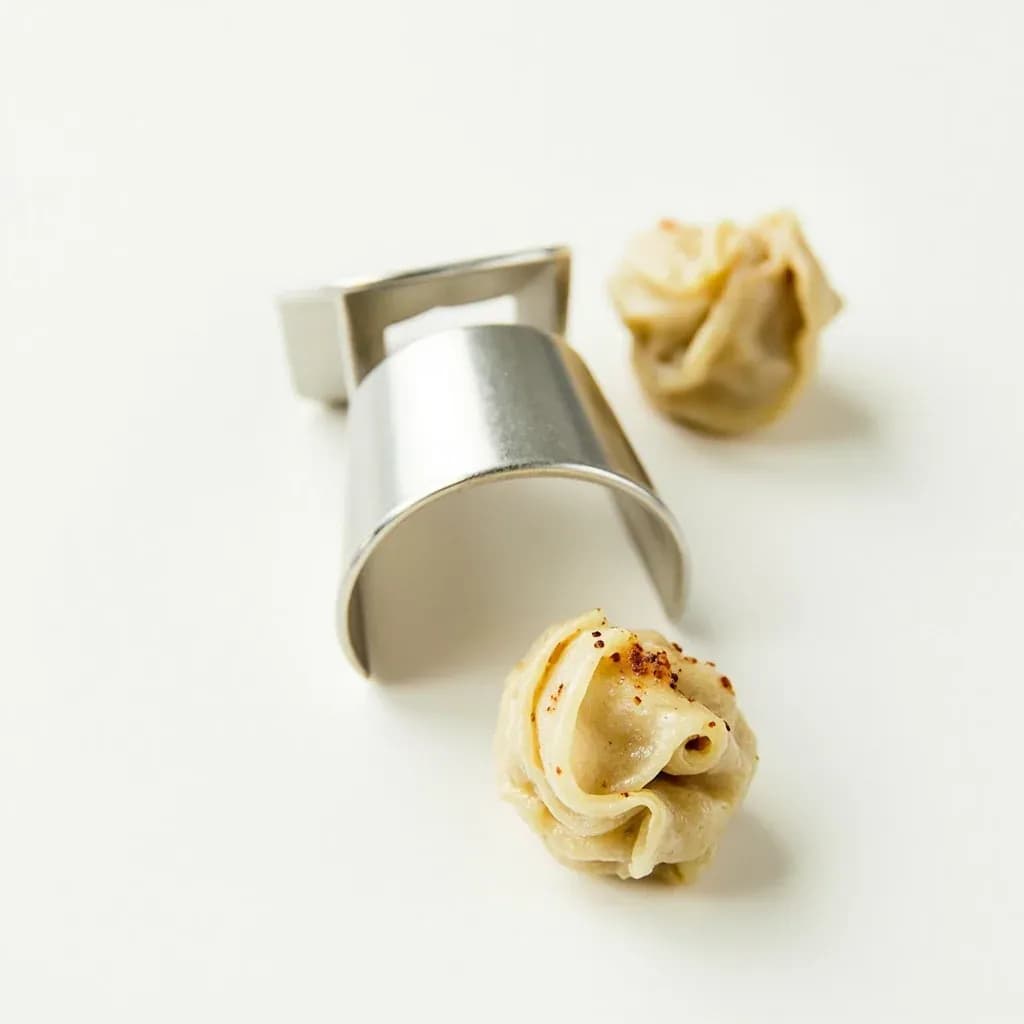
Siu Mai Forming Tool
Shaping tool that pleats and forms open-topped siu mai dumplings quickly and uniformly.
A forming tool used to shape siu mai, the open-faced steamed pork-and-shrimp dumplings of Cantonese dim sum. It helps gather the thin wrapper into a uniform cup so the dumplings hold their classic frilled, open-topped shape and steam evenly. Cooks who make siu mai in volume use it to speed up an otherwise fiddly hand-pleating step.
A siu mai forming tool is a small shaping aid — most often a slatted bamboo mat, but also a multi-cavity plastic mold or a smooth wooden dowel — used to turn a flat wonton wrapper and a mound of filling into the pleated, open-topped cup that defines Cantonese siu mai. The tool does two jobs at once: it presses the wrapper into vertical pleats so the dumpling holds its shape and the filling peeks out the top, and it compacts the filling evenly so every piece stands upright in the steamer with the same height and weight. In a busy dim sum kitchen this consistency is not cosmetic — it is the difference between a basket of dumplings that cook in the same time and a basket of misshapen pieces that have to be sorted by eye.
The traditional bamboo mat, the kind still used in Hong Kong dim sum kitchens, lays a wrapper across the slats, takes a strip of filling, and rolls up like a small cigar; the slats leave faint pleat marks and the squeeze compacts the filling. Plastic multi-cavity molds work by pressing a wrapper into a round well, dropping in filling, and tamping with a plunger. Neither tool is used in cooking — formed dumplings are transferred to a parchment-lined steamer — so the only real demands on the tool are that it shapes cleanly, releases without tearing the wrapper, and survives daily washing.
Hand-shaping siu mai in the palm of one hand is a perfectly valid skill and produces beautiful dumplings, but it is slow and uneven at scale. The forming tool exists to shortcut that learning curve and make batch production viable, and the choice between mat and mold is mostly a question of tradition, throughput, and how much authentic pleating you want to see on the finished dumpling.
Alternatives
Types & varieties
A short, flat mat of thin bamboo dowels held by string or wire. The wrapper is laid across the slats, filling is laid in a strip, the mat is rolled and squeezed to pleat and compact, then tapped on the board to release.
A smooth cylinder the wrapper is wrapped around. Faster to use but produces little of the characteristic pleating — closer to a plain cup. Common in home kitchens where speed matters more than looks.
A tray of round wells (usually 6 or 12) with a matching plunger. Wrapper is pressed into the well, filling is added, the plunger tamps it down, and the dumpling pops out. Very uniform and very fast — standard in dim sum factories and high-volume restaurants.
Found in some professional settings. More durable than plastic but tends to stick unless lightly oiled, which complicates cleanup.
A flat wooden board paired with a bamboo mat; the mat shapes and pleats, the board is used to tap the finished dumpling cleanly out of the mat. Common in traditional Hong Kong dim sum kitchens where the cook works the mat over the board for rhythm.
Common uses
Tips & pitfalls
- Keep your stack of wrappers under a barely-damp cloth while you work — exposed wrappers dry out in minutes and tear on the mat.
- If the wrapper sticks to a bamboo mat, dust the slats with a little cornstarch, not flour; flour leaves a pasty film on the dumpling skin.
- Tap the mat firmly against the cutting board to release the dumpling — don't peel it off, which tears the pleats.
- Squeeze the mat hard enough to compact the filling but not so hard that the wrapper splits at the seam; one firm, even press is better than two cautious ones.
- Never put the forming tool in the steamer; transfer the dumplings to a parchment round or cabbage leaf first, then steam.
- Rinse a bamboo mat under hot running water only — no soaking, no dishwasher. Stand it upright to dry so air reaches every slat.
- For plastic molds, a quick spritz of neutral oil on the cavity before adding the wrapper makes release easy and clean.
- Practice the roll-and-squeeze motion without filling first; the muscle memory is the part that actually takes time to learn.
Good to know
- Also known as
- Shumai mat, siomai mold, dim sum forming mat, siu mai press
- Origin
- Cantonese dim sum tradition (Southern China)
- Traditional material
- Slatted bamboo — thin dowels strung on wire or twine
- Modern materials
- Food-grade plastic, hardwood, occasionally aluminum or stainless steel
- Standard size
- ~15 cm (6 in) long; fits a 9–10 cm square wonton wrapper
- Plastic mold cavities
- Typically 6 or 12 round wells, ~6 cm diameter each
- Function
- Pleats the wrapper and compacts the filling into a uniform open-topped cup
- Cleaning
- Bamboo: hand-wash and dry immediately upright. Plastic: usually dishwasher-safe
- Storage
- Store dry and flat or hung; never leave bamboo wet — it molds and splits
- Throughput
- A trained cook can form many siu mai per minute with a mat versus one at a time by hand
Also called
Shumai Mold · Dim Sum Forming Tool
Related

Muffin Pan
Multi-cup pan for muffins, cupcakes, and egg bites

Bundt Pan
Fluted ring mold for showstopping cakes with a center hole

Springform Pan
Latch-release pan that frees delicate cakes without flipping

Pie Dish
Sloped round dish for crisp-bottomed pies and quiches

Tart Pan
Fluted pan with a pop-out base for clean-edged tarts

Rolling Pin
Rolls dough into even sheets for pastry and bread

Pastry Brush
Brushes on egg wash, glaze, butter, and marinades

Bench Scraper
Flat blade that divides dough and clears your work surface