Knives & Cutting
Skinning Knife
A short curved blade designed to separate hide and skin from meat cleanly.
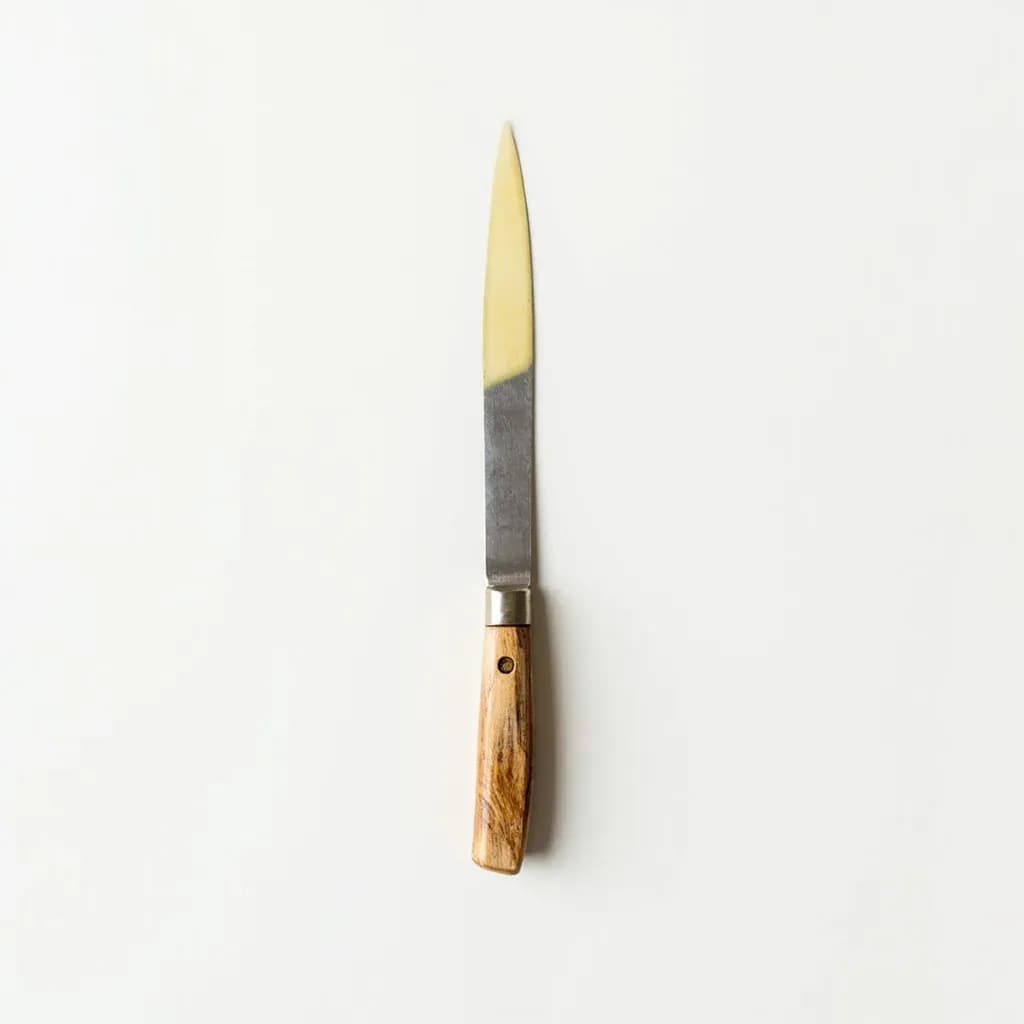
A skinning knife is a small knife with a sharply upswept, curved blade made for slipping between skin and flesh without piercing the meat. Butchers and hunters use it to remove hides and pelts, and in the kitchen the same curve helps skin large fish and game. The rounded belly lets the blade follow contours in long, controlled sweeps rather than straight cuts.
A skinning knife is a specialized short-bladed knife built for one demanding job: separating hide, pelt, or scale from the carcass beneath it without gouging the meat or tearing the skin. Its short, broad, upswept belly is the defining feature — that curve lets the edge ride along the inside of the hide in long, sweeping strokes while the rounded or drop-point tip stays controlled in tight spots around joints, ears, and antler pedicles. Unlike a chef's knife or breaking knife, a skinner is meant to be drawn toward the user with the edge facing the hide, and most of the work happens by feel as much as by sight, with the off hand knuckling the skin ahead of the blade to maintain tension.
For cooks and butchers, the skinner earns its place not only in the field but on the block. The same geometry that pulls a pelt off a deer also slips silver skin and thin membranes off roasts and steaks, and the stiff, fine edge that survives hide work is excellent for the trim work a boning knife or slicer handles less elegantly. It sits between a butcher's breaking knife and a hunter's outdoor knife — shorter and more curved than a chef's or breaking knife, with a finer, more controllable tip than a bowie or camp knife.
Most skinning knives are full-tang fixed blades in carbon or stainless tool steel, with handles of wood, stabilized burl, G10, rubber, polymer, or antler chosen for grip in cold and wet conditions. They are usually sold plain-edged, often with a convex or Scandinavian grind, and priced from modest utility models around twenty-five dollars up to handmade customs in the low hundreds.
Alternatives
Types & varieties
The classic 3.5–4 in upswept blade for deer, elk, hog, and similar mammals; widest belly for long separating strokes.
Smaller (2–3 in), narrower, often with a finer point for the delicate work around the head, ears, eyes, and antler pedicles where a regular skinner is too bulky.
Deeply hooked, sharply curved edge that rolls skin off in short, controlled scrapes; favored for small game and furbearers.
Short, stiff, slightly curved blade with a small hook or blunt tip for skinning poultry, pheasant, duck, and other fowl.
Longer, thinner, more flexible blade (often 6–7 in) with a slightly upturned tip, built for separating skin from salmon, trout, and other fish; distinct from but related to a fillet knife.
Scandinavian all-purpose outdoor knife with a Scandi grind and relatively straight, short blade, used for skinning, food prep, and carving.
Larger clip-point blade adapted from the Bowie tradition; used by hunters who want one big knife for skinning, breaking, and camp chores.
Blade Geometry and Why It Works
The skinner's silhouette is the result of a specific set of tradeoffs, and understanding them helps you pick the right one and use it well.
- The upswept belly gives you a long, continuously curving edge contact line, so each stroke separates more hide per pull than a straight blade would.
- The short blade keeps the tip close to your hand, which is exactly what you want when the work is by feel and the consequences of a slip are a punctured paunch or a nicked pelt.
- A rounded or drop-point tip — rather than a clip or spear point — slides under hide without snagging and is less likely to punch through into viscera during field dressing.
- Full tang construction and a simple plain edge mean the knife can be reground in the field on a stone or strop without specialized equipment, and it can take the lateral stress of working against bone and hide without snapping.
On the Block: Kitchen and Butchery Uses
Even cooks who never pull a pelt can justify a skinner in the kitchen, where its short, stiff, curving edge is well suited to certain trim work that a chef's knife or boning knife handles awkwardly.
- Trimming silver skin, fell, and thin membranes off venison, beef, and lamb roasts — the upswept belly rides the contour of the muscle and the short length keeps the tip under control.
- Peeling silverskin off racks of ribs and chops where a long blade is unwieldy.
- Skinning fish (salmon, trout, catfish) when you want a stiffer edge than a typical fillet knife offers.
- Skinning out whole birds — chicken, pheasant, duck — for stuffings, ballotines, and galantines, where a long slicer is too clumsy and a paring knife is too short.
Common uses
Tips & pitfalls
- Strop the edge every few minutes in the field — a hair-popping edge is what lets the blade slide between hide and fascia instead of tearing either.
- Hold the knife with the back of the blade angled slightly toward the meat so the edge rides against the inside of the hide; this leaves silver skin on the carcass and a clean, uncut pelt.
- Pull toward you in smooth, long strokes for the broad belly work; switch to short, controlled strokes near the legs, head, and joints where the hide clings.
- Knuckle the hide with your off hand to lift a tension line ahead of the blade; cutting into slack skin is what causes nicks and holes.
- Avoid working over the gut sac during field dressing — keep the blade tip up and outward once the body cavity is open.
- Don't soak a wood- or natural-handle skinner in water; wipe, dry, and oil the blade after every use, especially with high-carbon steel.
- Use a leather strop, not a honing rod, to refresh the working edge in camp — honing rods can chip thin skinning blades and re-angle an edge meant to be convex or Scandi.
- Store in a leather or kydex sheath; leather wicks moisture and should be treated occasionally with mink oil or beeswax.
- Keep the knife dedicated to skinning (or at least hand-washed and sanitized) before it touches cooked or ready-to-eat food; game meat carries bacteria and parasites.
Good to know
- Tool type
- Specialty fixed-blade knife
- Blade length
- Typically 2.5–5 in (6–13 cm); caping versions 2–3 in (5–8 cm)
- Blade shape
- Short, broad, upswept belly with a rounded or drop-point tip
- Edge type
- Plain (non-serrated), often a fine convex or Scandi grind
- Common steels
- High-carbon (1095, D2) or stainless (440C, S30V) tool steel
- Handle materials
- Wood, stabilized burl, rubber, G10, antler, or polymer
- Tang
- Almost always full-tang for field strength
- Primary use
- Separating hide, pelt, or scale from carcass without gouging the meat
- Hold orientation
- Designed to be drawn toward the user with the edge facing the hide
- Maintenance
- Hand-wash, dry immediately, oil carbon blades; strop frequently during use
- Typical cost range
- $25–$250 USD depending on steel and maker
Also called
Skinner · Curved Skinning Knife
Related

Knife
The fundamental cutting tool every kitchen is built around

Chef's Knife
The do-everything blade for chopping, slicing, and mincing

Paring Knife
Small, nimble blade for peeling and detailed in-hand work

Serrated Knife
Saw-toothed blade that slices crusty bread without crushing

Cleaver
Heavy broad blade for chopping through bone and bulk prep

Cutting Board
The stable surface every cut starts on

Mandoline
Adjustable blade for paper-thin, perfectly even slices

Kitchen Shears
Heavy-duty scissors for poultry, herbs, and packaging